

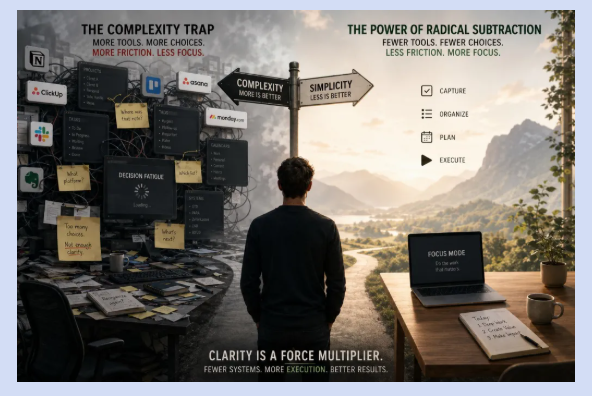
How to escape the complexity trap, defeat decision fatigue, and find clarity through radical subtraction.
Curator’s Note: The post, written by Gary L Fretwell, emphasizes that success in productivity comes not from complex systems but through simplicity and clarity achieved by radical subtraction. Many high-achievers fall into the complexity trap, believing they need sophisticated organizational systems to handle demanding work. However, each additional tool introduces cognitive load and decision fatigue, detracting from actual productivity. Drawing from modern research and Stoic philosophy, the author advocates for stripping away unnecessary distractions to focus on what truly matters. By minimizing decisions and simplifying workflows, individuals can redirect their attention to meaningful work, thus enhancing creativity and execution in their professional lives.
The path to greater productivity isn’t adding more tools. It’s removing the ones that stand between you and the work that matters. / Author created image using ChatGPT
For decades, I fell hard for a compelling lie.
It’s the exact same trap that catches thousands of high-achievers every single day: the belief that a complex life demands a complex productivity system.
The logic seems airtight. If your work is demanding, your organizational system should be equally sophisticated. More projects require more folders. More responsibilities require more tags. More ambitious goals require more dashboards, automations, and interconnected apps. We convince ourselves that somewhere out there, in the digital ether, is the perfect combination of tools that will finally make everything click into place.
So, we keep building.
A new app promises to organize our thinking. Another claims to eliminate distractions. A productivity influencer introduces yet another framework that supposedly changes everything. Before long, we are spending more time maintaining the scaffolding of our work than doing the actual work it was meant to support.
I know, because I did exactly that.
Over the years, I experimented with nearly every productivity methodology in existence. I built elaborate workflows. I refined categories, labels, perspectives, and review processes. Each new layer felt like progress because it created the comforting illusion of control.
But eventually, I had to confront an uncomfortable truth: The people accomplishing the most meaningful work rarely had the most elaborate systems. They had the simplest ones.
That realization sent me searching through both modern research and ancient philosophy. What I found surprised me. Thirty years of decision science and more than two thousand years of Stoic wisdom point toward the exact same conclusion: Productive people do not have better systems. They have fewer.
The Hidden Cognitive Tax of Complexity
Every tool carries a price. Not a financial cost, but a cognitive one.
Every additional app asks you to remember where something belongs. Every new tag requires another decision. Every extra workflow introduces a fresh point where attention can fragment.
Psychologists call this decision fatigue. Every choice, no matter how trivial, consumes a finite amount of mental energy. Individually, these micro-decisions seem insignificant. Collectively, they are exhausting.
- Should this note go in Personal or Writing?
- Does this belong in Someday, Next Actions, or Research?
- Should I capture this in Notes, my task manager, or my journal?
None of these decisions accomplish the work itself. Yet they steadily drain the very resource you need most: attention. By the time many people finally decide what to do next, they have already spent valuable cognitive capital simply navigating their own productivity system.
The system has quietly become a second job.
Motion Isn’t Progress
One of the greatest illusions in modern productivity is confusing activity with accomplishment.
Color-coding tasks feels productive. Reorganizing dashboards feels productive. Watching videos about productivity feels productive. Building a better workflow feels deeply productive.
Yet, none of these move your most important work forward by a single inch.
We often mistake preparing to work for actually working. Our brains reward organization because it creates a satisfying sense of order. You get the dopamine hit of progress without the discomfort of tackling the difficult, ambiguous project sitting on your desk.
The machinery becomes more attractive than the mission.
What the Stoics Already Knew
Long before the birth of neuroscience, the Stoic philosophers understood something profound: Clarity requires subtraction.
Marcus Aurelius constantly reminded himself to eliminate the unnecessary. Epictetus taught that peace comes from focusing exclusively on what truly matters. Their goal was never to manage more variables; it was to remove everything that distracted from wise, deliberate action.
Their philosophy was not about deprivation. It was about liberation.
Every unnecessary commitment, possession, or mental distraction reduced their capacity to focus on what genuinely mattered. Today’s productivity culture encourages the exact opposite. We accumulate systems instead of eliminating them. We optimize endlessly instead of simplifying relentlessly.
The Stoics would likely ask a simpler, sharper question: What could you stop doing?
The Power of Radical Subtraction
Something remarkable happens when you strip away the unnecessary complexity: the friction vanishes.
Instead of wondering which app to open, you already know. Instead of debating where information belongs, you capture it in one trusted place. Instead of maintaining an elaborate ecosystem of tools, you spend your energy creating, solving, writing, leading, and building.
Your attention shifts from managing work to doing work.
That shift is far more powerful than it sounds. Attention is finite. Every ounce you reclaim from unnecessary operational decisions becomes instantly available for creativity, deep focus, and meaningful execution.
This is where genuine productivity begins. Not with another feature, and not with another framework. It begins with fewer decisions.
Simplicity Is a Competitive Advantage
We often think simplicity is for people with easy lives. The opposite is usually true. The more responsibilities you carry, the more valuable simplicity becomes.
Leaders, entrepreneurs, and creators face an endless stream of high-stakes decisions every day. They cannot afford to waste their best thinking on choosing between five different note-taking formats or endlessly reorganizing task lists.
The highest performers understand that simplicity scales; complexity breaks. They protect their attention because they know it is their ultimate leverage.
One Question to Clear the Path
If you find yourself constantly tweaking your setup, reorganizing folders, switching platforms, or searching for the next perfect system, pause and ask yourself one question:
“Is this helping me do the work, or helping me avoid it?”
The answer is often surprisingly honest.
Sometimes the greatest productivity breakthrough is not discovering a better system. It is discovering that you no longer need so much of one.
The answer is not another app; it is fewer decisions. Not more organization; more execution.
Reduce the friction. Remove the unnecessary. Clear the path. Then let your attention return to what mattered all along: doing meaningful work.
I broke down my own hard-learned journey away from this complexity trap, along with the science and philosophy behind why simplicity always wins.
You can read the full, detailed deep dive here: https://medium.com/@gary_fretwell/77de7318edb9?source=friends_link&sk=66a806737dbf77f702d405aeaaf1505d
About the Author
Gary L. Fretwell is a #1 international best-selling author and practitioner of Intentional Living, blending neuroscience with Stoic philosophy to help creators and leaders build a life of lasting significance.
He’s the author of six books on intentional living and retirement, including the #1 international bestseller The Magic of a Moment, Intentional Retirement, Embracing Retirement, and Rewiring the Ring, which explores the cognitive science of tinnitus. His latest, The Identity Ghost, is a blueprint for designing a life of purpose through ancient wisdom and modern neuroscience.
On Medium, Gary founded and edits Illumination: Retirement, Aging & Legacy and Illumination Beyond Identity, and serves as an editor across the broader ILLUMINATION network.
Off the page, he serves as Board President for Prescott Meals on Wheels and mentors MBA students at Western Governors University.
📖 garyfretwell.com · 📬 The Wise Effort on Substack · ✍️ Follow on Medium
Interview with Dr. Mehmet Yildiz


Leave a Reply