

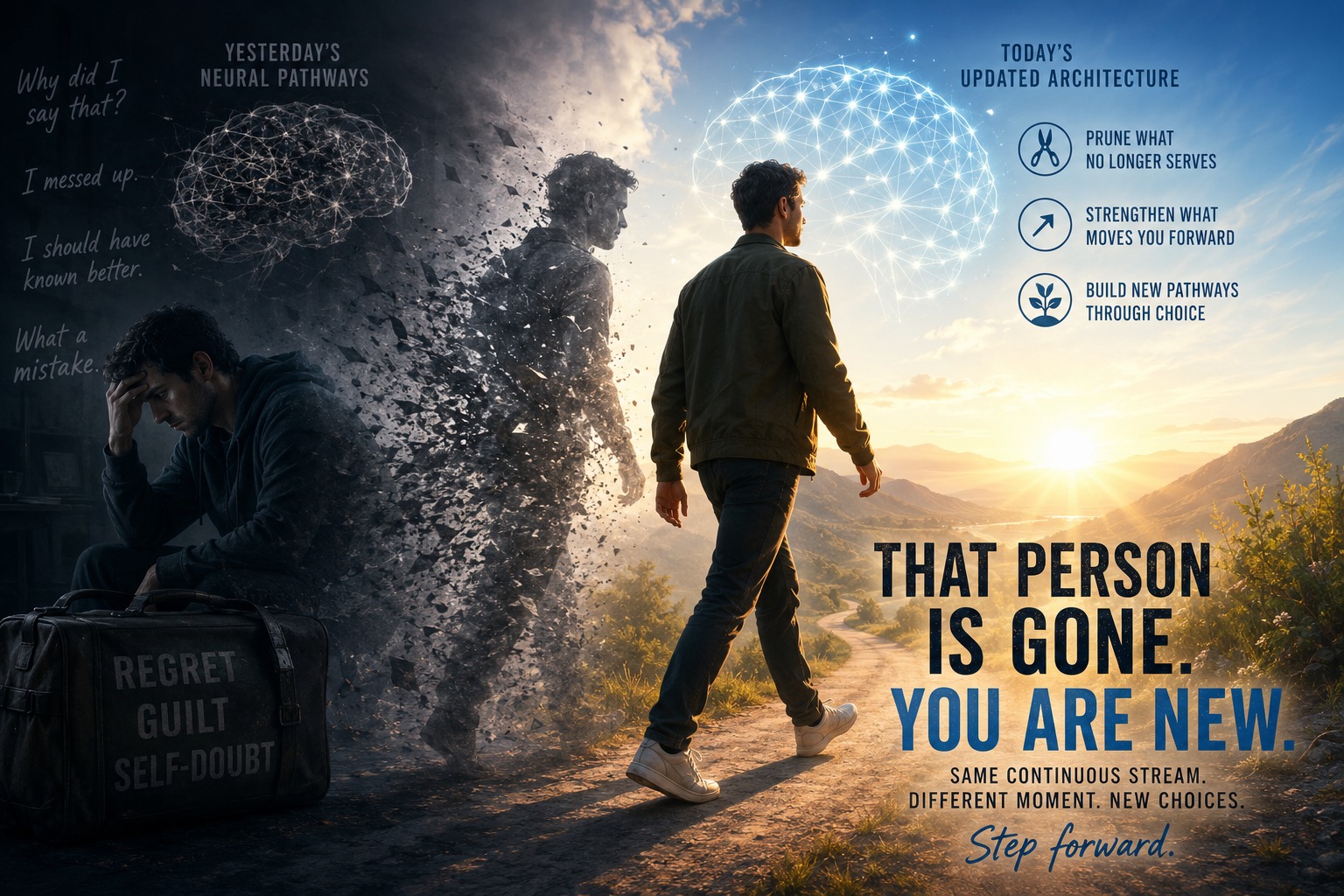
Curator’s Note: Yesterday’s mistakes are linked to an outdated version of yourself that no longer exists due to neuroplasticity, which ensures your brain continuously adapts and rewires. This scientific principle is echoed in ancient wisdom, reinforcing that today is a fresh opportunity for growth and positivity. Guilt ties you to a fixed identity, but recognizing your evolving nature allows you to learn from missteps without carrying emotional baggage. The article suggests three steps for self-empowerment: separating actionable insights from guilt, resetting your mindset each morning, and making small choices to reinforce new neural pathways. Embrace the daily chance to grow and move forward. This story was written by Gary L Fretwell.
Yesterday’s mistakes belong to a brain that has already changed. Through neuroplasticity, every new day offers an updated version of yourself, one built to learn, adapt, and move forward./ Author created image
We have all been held hostage by the 2:00 AM mental film reel. You lie awake staring at the ceiling, playing a single moment from yesterday on an agonizing loop—a clumsy sentence during a meeting, a missed signal in a relationship, or a decision that blew up in your face. You dissect every second, punishing yourself with the same relentless question: Why did I do that?
Here is a liberating truth grounded in modern biology and ancient wisdom: the person who made that mistake yesterday no longer exists.
It sounds like a poetic metaphor, but it is hard science. Every time you wake up, your brain has physically altered its architecture. Understanding this dynamic shift changes how you process regret, guilt, and personal growth.

The Biological Reality of a Fresh Start
For centuries, contemplative traditions have recognized the fluid nature of identity. The Dalai Lama captured this reality with characteristic simplicity:
“There are only two days in the year that nothing can be done. One is called Yesterday and the other is called Tomorrow. Today is the right day to Love, Believe, Do and mostly Live.”
While eastern traditions arrived at this truth through mindfulness, neuroscience arrives at the exact same conclusion through structural biology. Your brain is not a static organ carved from marble; it is a dynamic, living network operating on neuroplasticity, which is the continuous rewiring of synaptic connections in response to internal and external feedback.
When you make a mistake, experience remorse, or gain a moment of clarity, your neural network immediately begins adapting.
- Sleep and Structural Pruning: As you sleep, your brain performs crucial maintenance. Through synaptic pruning, it weakens underutilized pathways and consolidates memories, physically restructuring your neural network overnight.
- Immediate Feedback Loops: The brain network that made yesterday’s misstep has changed simply by integrating the feedback of that error. The moment you register regret or insight, the circuit that caused the fault has already been modified.
- Fluctuating Neurochemistry: Your baseline brain state fluctuates daily depending on sleep architecture, stress levels, hydration, and environmental inputs. Biologically speaking, today’s brain is a distinct state vector from yesterday’s.
When you hold onto guilt, you are treating your identity as a fixed object. In reality, human consciousness is a live software stream. Carrying yesterday’s missteps into today is like trying to install an update while forcing your system to run on an overloaded cache.
Why Guilt Relies on an Illusion
Guilt requires a static identity because it demands that you view yourself as the same static entity that made the mistake. Growth, on the other hand, requires recognizing your fluid nature.
When you criticize yourself for yesterday’s lapse in judgment, you are judging a previous version of yourself using data, context, and insight that only exists because you made the error in the first place. You are holding a past biological state accountable to a future level of awareness.
Once you extract the lesson from an error, the pain has served its evolutionary purpose. Holding onto the emotional baggage after learning the lesson is not accountability. It is simply unnecessary cognitive friction.
Three Steps to Align with Your New Architecture
If yesterday’s version of you is truly gone, how do you practically stop dragging their baggage into today?
1. Separate the Signal from the Debris
A mistake is data, not a permanent character trait. The moment you extract the actionable signal, such as “I need to manage my fatigue better” or “I reacted out of fear,” the neural circuit that generated the original error has served its function. Treat the insight as software patch notes and discard the emotional noise.
2. Practice an Explicit Morning Reset
Begin your morning by acknowledging your biological fresh start. When a thought of yesterday’s misstep bubbles up, interrupt the habit loop with a simple reality check: “That action was taken by a previous version operating on incomplete information. The system has since been updated.”
3. Focus on Incremental Iteration
You do not need a dramatic transformation to leave past mistakes behind. Small, intentional choices reinforce new neural pathways while allowing old, unwanted pathways to naturally atrophy through disuse. Shift your focus entirely to the single decision in front of you right now.
The Daily Clean Slate
You are not bound to the choices, emotional reactions, or errors of yesterday. The human brain is engineered for relentless adaptation, designed specifically to learn from failure and evolve past it.
Give yourself permission to release yesterday’s ghost. You are already someone new, and today is the only day available to live like it.
Read the original essay on Medium:
The Version of You That Screwed Up Yesterday Is Already Gone — Science Says So
About the Author
Gary L. Fretwell is a #1 international best-selling author and practitioner of Intentional Living, blending neuroscience with Stoic philosophy to help creators and leaders build a life of lasting significance.
He’s the author of six books on intentional living and retirement, including the #1 international bestseller The Magic of a Moment, Intentional Retirement, Embracing Retirement, and Rewiring the Ring, which explores the cognitive science of tinnitus. His latest, The Identity Ghost, is a blueprint for designing a life of purpose through ancient wisdom and modern neuroscience.
On Medium, Gary founded and edits Illumination: Retirement, Aging & Legacy and Illumination Beyond Identity, and serves as an editor across the broader ILLUMINATION network.
Off the page, he serves as Board President for Prescott Meals on Wheels and mentors MBA students at Western Governors University.
📖 garyfretwell.com · 📬 The Wise Effort on Substack · ✍️ Follow on Medium
Interview with Dr. Mehmet Yildiz:


Leave a Reply