

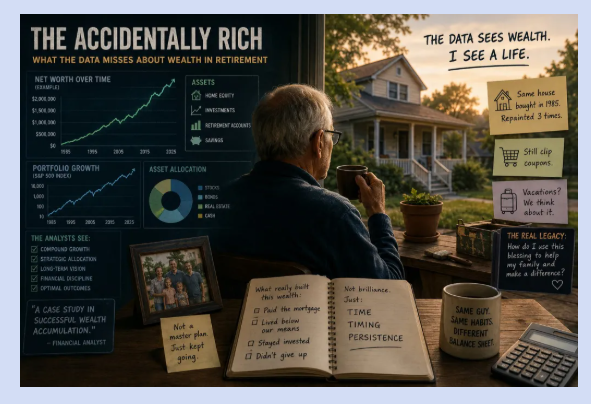
The numbers tell a story of wealth. The person who lived them remembers decades of ordinary choices, persistence, and a life built one month at a time.
Curator’s Note: The article by Gary L Fretwell discusses the disconnect between the statistical analysis of wealth accumulation in retirement and the lived experience of individuals who achieve it. Financial commentators often frame wealth as the result of strategic choices, but for many, it stems from simple, consistent habits like paying off a mortgage and living below one’s means. While retirees may appear financially rich, their wealth is often tied up in assets, leading to continued frugality. The real challenges for retirees are psychological rather than mathematical, involving how to reconcile a lifetime of saving with newfound financial freedom and purpose.
The numbers tell a story of wealth. The person who lived them remembers decades of ordinary choices, quiet persistence, and a life built one month at a time.
Everybody wrote about this study in June. Every financial columnist, wealth advisor, and economic commentator jumped on the opportunity to analyze the raw data, draw elaborate charts, and extrapolate grand trends about the modern retiree’s balance sheet. They framed late-life wealth accumulation as a series of deliberate, highly strategic choices: optimized portfolios, brilliant asset allocations, and perfectly timed market entries.
Not one of those articles was written by the man sitting inside the data.
When you look at financial studies through a purely analytical lens, wealth in aging looks calculated, almost clinical. The graphs present smooth, predictable compound interest curves, steadily escalating home equity values, and enviable net worth totals. Analysts interpret these impressive figures as hard evidence of long-term financial masterminds at work—a demographic of tactical geniuses who played the long game and won.
But when you live inside those numbers, the reality looks completely different. You don’t feel like a genius investor operating a grand financial blueprint. You feel like someone who simply stayed the course, kept his head down, and lived his life while the economic landscape changed drastically around him.
The Invisible Nature of Accumulation
The primary disconnect between statistical analysis and lived human experience is how wealth actually builds over a lifetime. Financial studies inevitably flatten decades of nuanced existence into a single, polished data point. They look at a high net worth at age 65 or 70 and attribute it retroactively to visionary planning.
In truth, most real-world accumulation happens almost by accident—or, at the very least, through boring, invisible habits rather than brilliant financial maneuvers:
- Automatic consistency: Paying off a 30-year mortgage month after month doesn’t feel like executing a master stroke in real estate accumulation. It just feels like paying a regular housing bill so you have a place to raise your family.
- Economic tailwinds: Simply holding onto a family home or maintaining a steady contribution to a simple index fund through decades of unforeseen inflation and macro-market expansion turns modest, routine choices into surprisingly significant sums.
- Habit over ambition: Living below your means for forty years isn’t a aggressive strategy to get rich. It’s simply a quiet personal philosophy grounded in contentment and restraint.
When the market eventually multiplies those quiet, unglamorous efforts over thirty or forty years, the spreadsheet declares that you are wealthy. Yet your daily routines, your foundational self-image, and your fundamental spending habits remain tightly anchored to the person you were when you first started out.
Paper Wealth vs. Lived Reality
Another major blind spot in the commentary surrounding these studies is the vast difference between abstract asset value and everyday liquid reality. A retiree might easily fit the statistical definition of “rich” simply because the modest suburban neighborhood they bought into in the mid-1980s underwent massive, unexpected hyper-gentrification over four decades.
On paper, their net worth is substantial. In reality, that wealth is locked tightly inside the very roof over their head.
They still clip coupons, deliberate carefully over routine grocery expenses, and hesitate before booking a modest vacation. The data analyst sees an asset-rich individual comfortably sitting on a fortune; the individual sees the exact same home they’ve repainted three times with their own hands, carrying on with the same frugal habits that got them there. The paper value on a financial statement doesn’t magically alter the identity of the person sitting at the kitchen table.
The Psychological Shift and the Real Legacy
When experts write about retirement studies, their solutions are almost always tactical: withdrawal strategies, tax minimization frameworks, and capital preservation techniques. But for the human being sitting inside the dataset, the real challenges aren’t math problems—they are deeply psychological and philosophical transitions.
How do you suddenly invert a mental engine built on fifty years of saving, frugality, and accumulation, and give yourself permission to actually spend? How do you navigate the subtle family dynamics that arise when an ordinary life accidentally produces an extraordinary balance sheet? And most importantly, how do you ensure that this unexpected financial fortune translates into genuine purpose, wisdom, and meaningful impact, rather than remaining just a sterile, growing number on a screen?
Wealth in retirement is rarely the result of an extraordinary financial blueprint. Far more often, it is the quiet, unexpected byproduct of time, economic timing, and plain persistence.
To read the full personal narrative and perspective behind the numbers, check out the original article here:
About the Author
Gary L. Fretwell is a #1 international best-selling author and practitioner of Intentional Living, blending neuroscience with Stoic philosophy to help creators and leaders build a life of lasting significance.
He’s the author of six books on intentional living and retirement, including the #1 international bestseller The Magic of a Moment, Intentional Retirement, Embracing Retirement, and Rewiring the Ring, which explores the cognitive science of tinnitus. His latest, The Identity Ghost, is a blueprint for designing a life of purpose through ancient wisdom and modern neuroscience.
On Medium, Gary founded and edits Illumination: Retirement, Aging & Legacy and Illumination Beyond Identity, and serves as an editor across the broader ILLUMINATION network.
Off the page, he serves as Board President for Prescott Meals on Wheels and mentors MBA students at Western Governors University.
📖 garyfretwell.com · 📬 The Wise Effort on Substack · ✍️ Follow on Medium
Interview with Dr. Mehmet Yildiz:


Leave a Reply