

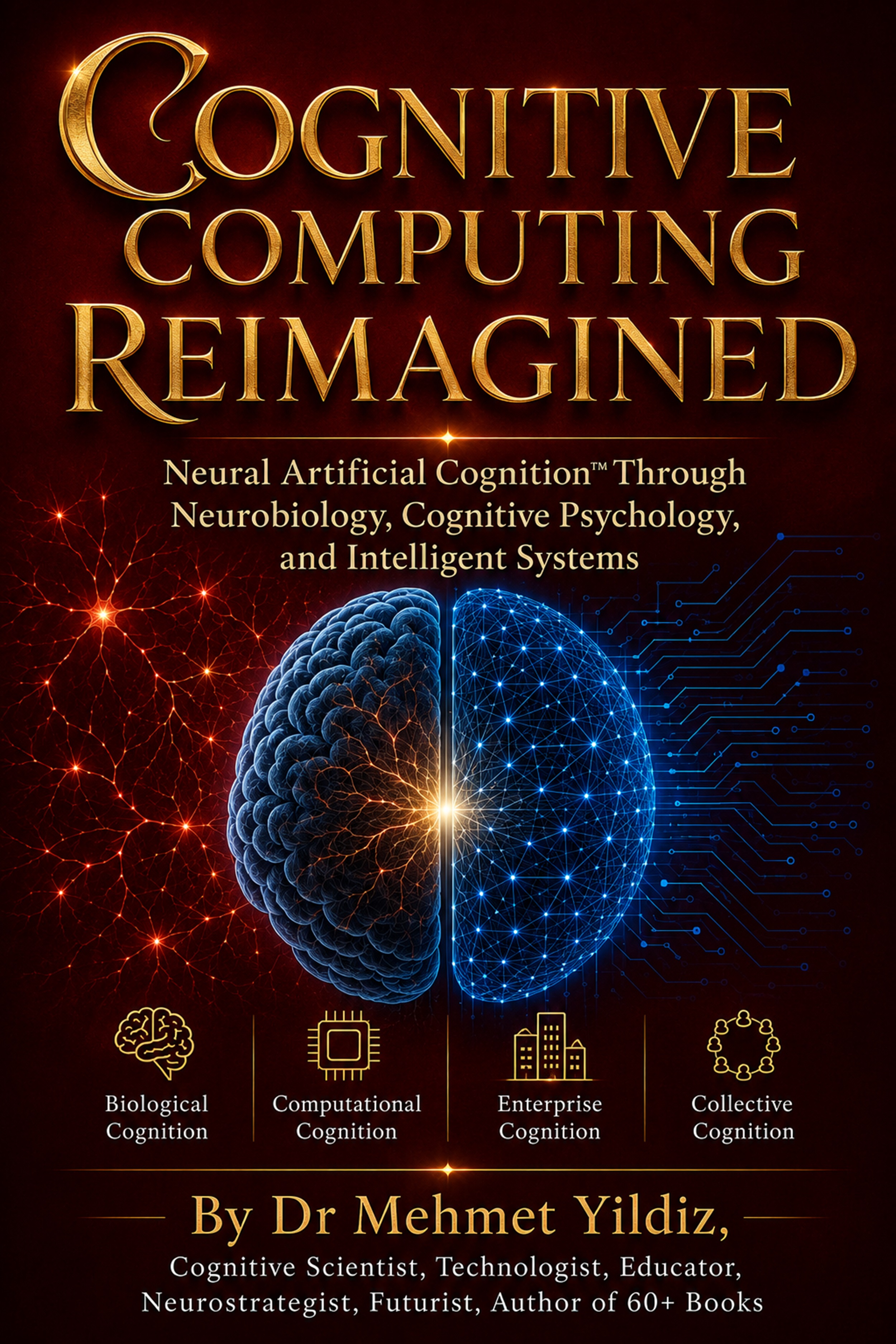
Neural Artificial Cognition™ Through Neurobiology, Cognitive Psychology, and Intelligent Systems , Reflecting 46 Years of Scientific Insights on the Future of Cognitive Computing by Dr Mehmet Yildiz, ISBNs: 9798190284119, 9798190284720, EAN 2940185245118
Image: Cognitive Computing Reimagined: Neural Artificial Cognition™ Through Neurobiology, Cognitive Psychology, and Intelligent Systems (Technology Excellence and Leadership Series) Link to Bibliography, Spanish Version: Computación Cognitiva Reimaginada
Curator’s Note: Cognitive Computing Reimagined by Dr. Mehmet Yildiz presents an innovative framework called Neural Artificial Cognition™ (NAC), emphasizing the distinction between intelligence and cognition. It explores cognition as a universal phenomenon across biological and computational systems, proposing that understanding cognitive principles is vital for the future of intelligent systems. The book integrates insights from neurobiology, cognitive psychology, and systems science, advocating for a broader scientific discourse rather than solely focusing on technology. It encourages readers to view cognition as a foundational element in the evolution of intelligent systems, arguing that advancements in cognitive understanding may define future progress in artificial intelligence and related fields. This editorial review was written and submitted by Dr Albert Jones to Digitalmehmet Content Ecosystem as a community contribution.
My Editorial Review of Cognitive Computing Reimagined
Artificial intelligence has entered one of the most remarkable periods in its history. Advances in machine learning, deep learning, large language models, multimodal systems, robotics, and autonomous agents have impacted scientific research, business, healthcare, education, and countless aspects of everyday life. Intelligent systems are no longer confined to laboratories or specialized industries. They assist with decision-making, accelerate scientific discovery, augment creativity, and support complex human activities across almost every professional discipline.
Despite these extraordinary technological achievements, an important scientific question remains surprisingly underexplored. While we continue to build capable, intelligent systems, our understanding of cognition itself has not advanced at the same pace. Many books on the market describe how artificial intelligence works, explain the mathematics behind algorithms, compare neural network architectures, or survey the historical development of cognitive computing. These contributions remain valuable and necessary. However, they leave readers with a deeper understanding of intelligent technologies while providing comparatively little insight into a more fundamental question: What actually makes a system cognitive? Cognitive Computing Reimagined begins with this question rather than with a particular technology.
Instead of presenting cognitive computing as another branch of artificial intelligence, the book proposes a broader scientific perspective based upon Neural Artificial Cognition™ (NAC). This integrative conceptual framework examines cognition as a universal phenomenon expressed through biological organisms, computational systems, enterprises, and collaborative human-AI ecosystems. This distinction is the book’s central contribution.
Artificial intelligence and cognition are closely related, yet they are not identical. Intelligence is commonly evaluated through observable performance. We recognize intelligence because a system solves problems, recognizes patterns, produces language, makes recommendations, or adapts to changing circumstances. Cognition, however, concerns the underlying processes that enable those intelligent behaviors to emerge. Perception, attention, memory, learning, reasoning, prediction, decision-making, communication, adaptation, and metacognition represent the functional architecture supporting intelligence rather than intelligence itself.
Viewing cognition through this lens fundamentally changes the conversation. Instead of asking whether machines are becoming more intelligent, the discussion shifts toward understanding how intelligent systems perceive information, organize knowledge, construct meaning, anticipate future events, adapt through experience, and collaborate with humans and other intelligent systems. This perspective naturally bridges neurobiology, cognitive psychology, systems science, enterprise architecture, information theory, and modern artificial intelligence into a coherent interdisciplinary narrative.
One of the defining strengths of this book is that it avoids treating cognition as a property exclusive to either biological brains or artificial machines. Instead, cognition is examined as a set of universal processes that may emerge across different forms of intelligent systems. Biological nervous systems provide one implementation. Contemporary AI represents another. Organizations demonstrate collective cognitive characteristics through distributed knowledge, institutional memory, coordinated decision-making, and adaptive learning. Networks of humans and intelligent agents create collaborative cognitive ecosystems that extend beyond the capabilities of any individual participant.
Within this broader context, Neural Artificial Cognition™ serves as the organizing framework without simply being another technical model. Rather than competing with established AI disciplines, NAC™ provides an overarching conceptual foundation that connects multiple perspectives into a unified understanding of cognition. Readers are encouraged to see biological intelligence, computational intelligence, enterprise cognition, and collective cognition not as isolated domains but as complementary expressions of shared cognitive principles.
The book’s structure reflects this philosophy. The opening section establishes the scientific foundations necessary for understanding cognition itself. Readers are introduced to the distinction between intelligence and cognition, the historical evolution of cognitive computing, the rationale behind Neural Artificial Cognition™, and the systems-oriented principles that support the framework. Without immediately focusing on technologies, the discussion develops a conceptual foundation that allows later technological examples to be interpreted within a broader scientific context.
The second section examines cognition through its fundamental capacities. Each major cognitive function, including perception, attention, memory, learning, knowledge representation, reasoning, prediction, decision-making, communication, and metacognition, is explored first through biological systems before being compared with contemporary intelligent computing and subsequently extended to organizational and collaborative contexts. This progression demonstrates that the same cognitive principles frequently appear across diverse intelligent systems, although their implementations differ considerably.
This cognition-centered organization distinguishes the book from conventional treatments of cognitive computing. Most existing texts in this field organize their discussions around technologies such as machine learning, natural language processing, computer vision, robotics, or foundation models. While those technologies remain important and receive appropriate attention throughout this volume, they are presented as examples of broader cognitive principles rather than as the organizing structure of the discipline itself. As technologies continue evolving, the underlying cognitive capacities remain remarkably stable, providing readers with a more enduring conceptual framework.
The third section looks toward the future of cognitive systems. Without speculating about artificial general intelligence through technological predictions alone, the discussion examines human-AI collaboration, enterprise cognition, collective intelligence, cognitive digital twins, neuromorphic computing, ethical governance, autonomous agents, and the expanding role of cognition within tightly interconnected intelligent ecosystems. The emphasis remains on scientific understanding rather than technological hype, encouraging readers to evaluate future developments through enduring cognitive principles instead of short-term innovations.
Another distinguishing characteristic of this work is its interdisciplinary perspective. The discussion draws upon neurobiology to examine the biological origins of cognition, cognitive psychology to explain mental processes, neuroscience to illuminate functional mechanisms, systems thinking to explore emergence and adaptation, enterprise architecture to understand organizational cognition, and modern artificial intelligence to demonstrate computational implementations. Rather than presenting these disciplines independently, the book illustrates how they complement one another in explaining the remarkable phenomenon of cognition across multiple domains.
This interdisciplinary integration reflects an important shift occurring across contemporary science and technology. The most significant advances arise not from isolated disciplines but from the productive intersections among them. Understanding cognition requires contributions from biology, psychology, computing, engineering, organizational science, philosophy, and information systems. Neural Artificial Cognition™ embraces this reality by offering a conceptual framework that connects these traditionally separate perspectives into a coherent whole.
Although the subject matter is scholarly, the writing remains intentionally accessible. Technical concepts are explained through relatable examples, practical analogies, and interdisciplinary comparisons without sacrificing scientific rigor. Graduate students, researchers, AI practitioners, enterprise architects, technology leaders, educators, entrepreneurs, and intellectually curious readers will find a balanced treatment that bridges theoretical foundations with practical implications. The result is neither a conventional textbook nor a popular overview, but a thoughtful exploration designed to stimulate deeper reflection about the nature of cognition itself.
The book’s greatest contribution is in its invitation to reconsider the future direction of intelligent computing. Much public discussion continues to focus on larger language models, faster processors, greater computational scale, and sophisticated algorithms. These developments will undoubtedly remain important. Yet they may represent only one dimension of future progress. A deeper scientific understanding of cognition may ultimately prove even more influential.
As intelligent systems become more integrated into scientific research, medicine, education, business, engineering, public administration, and daily life, understanding how cognition emerges, develops, adapts, and collaborates may become as important as improving computational performance itself. The next generation of innovation may depend not simply upon constructing more capable machines, but upon better understanding the cognitive principles that make intelligence possible across biological and artificial systems alike.
Cognitive Computing Reimagined by Dr Mehmet Yildiz contributes to this emerging conversation by proposing Neural Artificial Cognition™ as a unifying conceptual framework for the study of cognition wherever it appears. Rather than presenting cognition as the exclusive domain of biological brains or artificial machines, it encourages readers to recognize cognition as a broader scientific phenomenon expressed through living organisms, intelligent technologies, adaptive organizations, and collaborative human-AI ecosystems.
The book ultimately argues that the future of cognitive computing will not be defined solely by larger models, faster processors, or more complex algorithms. A deeper scientific understanding of cognition itself will impact it. By placing cognition, not technology, at the center of the discussion, this work offers a fresh perspective on one of the most important scientific and technological questions of our time and invites readers to participate in what may become the next chapter in the evolution of intelligent systems.
I also wrote a scholarly review of this book titled Reclaiming Cognition from Computation: A Scholarly Appraisal of the Interdisciplinary Neural Artificial Cognition™ (NAC) Framework.
You can find the bibliographic details of this book on its universal links.
Sample Chapters published by the author:
Intelligence and Cognition Are Not the Same Thing, and Understanding the Difference Matters
Neuromorphic Computing as the Future of Computer Hardware within the Cognition Context
Why Did I Need to Redefine Cognitive Computing in the AI Era?
Purchase links: Amazon, Google Books, Barnes & Noble Press, Digitalmehmet
Thanks for reading my review. I wish you the best!
Cheers,
Albert
Dr. Albert Jones is a retired forensic psychiatrist and mental health consultant with over 50 years of experience in the field, living in Australia. He also serves as an editor of ILLUMINATION Integrated Publications on Medium and Substack. You can connect with the author on LinkedIn and follow his blog posts at Digitalmehmet.


Leave a Reply