

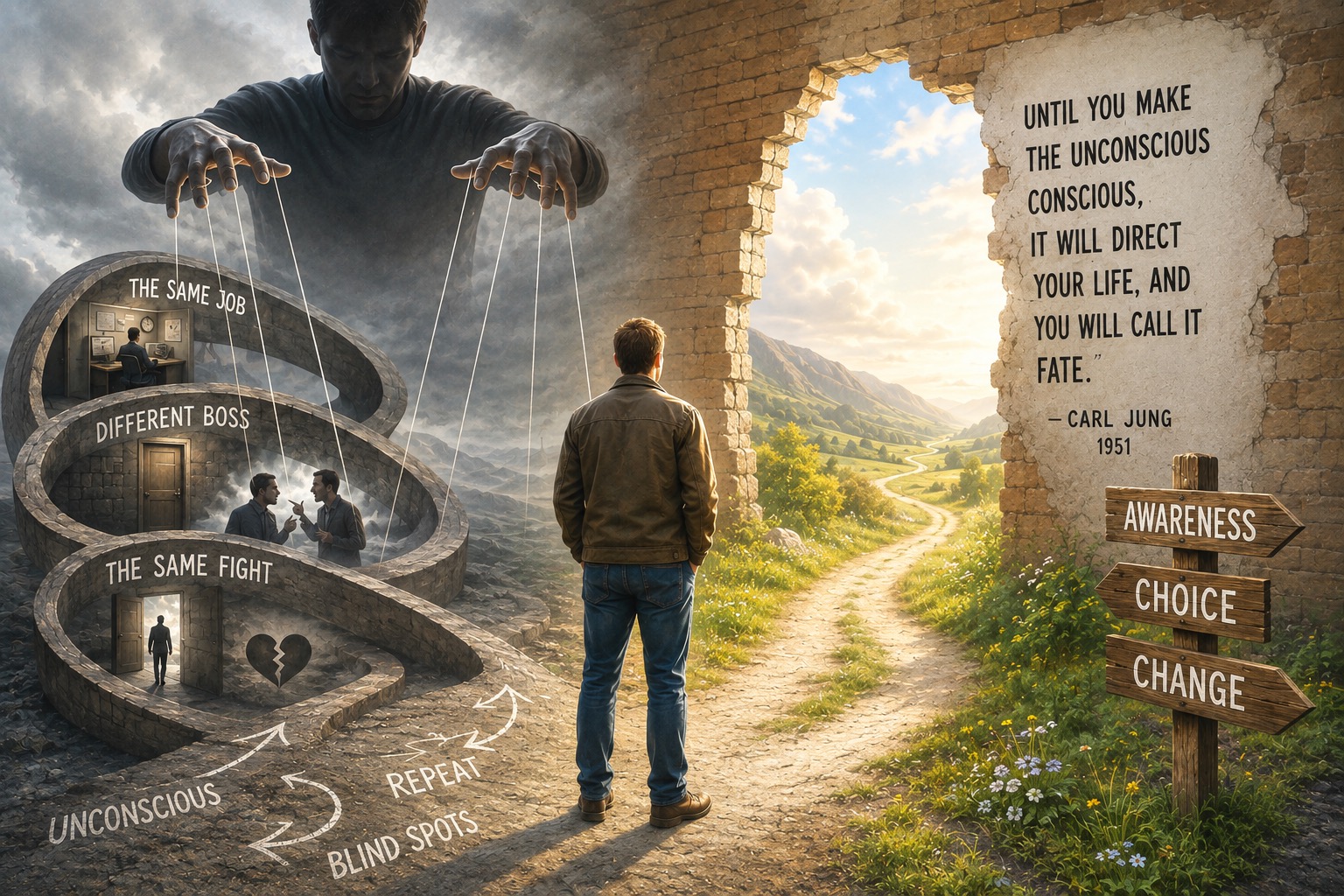
What feels like fate may be a pattern we haven’t learned to see yet.
There’s a sentence Carl Jung wrote in 1951 that still catches me off guard every time I return to it: until you make the unconscious conscious, it will direct your life, and you will call it fate.
Read that twice. It’s not comforting. It’s not “life isn’t fair” or “some things are out of our hands.” It’s something closer to an accusation: you built this, and you never even saw yourself doing it.
The Pattern Wearing Fate’s Costume
Think about the things I used to chalk up to bad luck. The job that always ended the same way, just with a different boss’s name attached. The relationship that collapsed on the same fault line every time, no matter who was standing on the other side of it. The flash of anger that arrived before I’d consciously decided to be angry at all.
I called these things fate because they felt like they were happening to me. They arrived uninvited, on their own schedule, immune to my best intentions. But Jung’s point is sharper than that. If a pattern keeps repeating with your fingerprints all over it, it isn’t fate. It’s a groove you’ve worn into your own behavior, one you haven’t looked at closely enough to see.
That’s the trap. The parts of ourselves we haven’t examined don’t just sit there quietly. They drive. They pick the job, the partner, the argument, the exit. And because we never see the hand on the wheel, we assume nobody’s driving at all.
Why This Is Harder Than It Sounds
This idea is easy to nod along to and genuinely difficult to live. I’ve spent years trying to read everything Jung wrote, and I say “trying” deliberately. He doesn’t let you read him the way you read other books. A page of his prose takes me three or four times longer than a page of almost anyone else, not because the sentences are difficult, but because they keep stopping me. I’ll read a line, then have to put the book down and sit with it, because something in it has just located a part of me I hadn’t looked at in years.
That’s the real work behind “make the unconscious conscious.” It isn’t a slogan you adopt in an afternoon. It’s the slow, sometimes uncomfortable practice of noticing your own patterns in real time, before they’ve already made the decision for you. It’s asking, in the middle of the familiar argument or the familiar retreat, have I been here before?
The Freeing Part
Here’s what makes this worth sitting with instead of flinching from: patterns you can name are patterns you can change. A blind spot has power precisely because it’s blind. The moment you can see it, describe it, predict when it’s about to show up, it loses some of its grip. Not all of it, not instantly, but enough to matter.
“That’s just my luck” is a comfortable thing to say, because it asks nothing further of me. Jung’s sentence asks for something harder: a willingness to look at the parts of myself that have been quietly writing my story, and to pick up the pen.
You can read the original version of this essay on Medium: “The Fate You Never Chose”
About the Author:
Gary L. Fretwell is a #1 international best-selling author blending neuroscience with Stoic philosophy to help people build a life of lasting significance. He’s the author of eight books on intentional living and retirement, including the #1 bestseller The Magic of a Moment and Intentional Retirement.
On Medium, Gary founded and edits Illumination: Retirement, Aging & Legacy.
📖 garyfretwell.com · 📬 The Wise Effort on Substack · ✍️ Follow on Medium


Leave a Reply