

HOW TO STOP CONFUSING MOVEMENT WITH PROGRESS
Curator’s Note: The article critiques the digital nomad lifestyle, arguing that it often leads to a productivity trap rather than genuine progress. Despite the appealing notion of freedom and travel, many nomads experience cognitive burnout due to the blurred boundaries between work and leisure. The constant need to adapt to new environments can deplete mental energy, making it difficult to engage in deep work. To counter this, the author advocates for adopting Stoic principles focused on internal order, such as the dichotomy of control, voluntary hardship, and valuing stillness, emphasizing that true freedom lies in the ability to concentrate fully on meaningful tasks rather than perpetual movement.
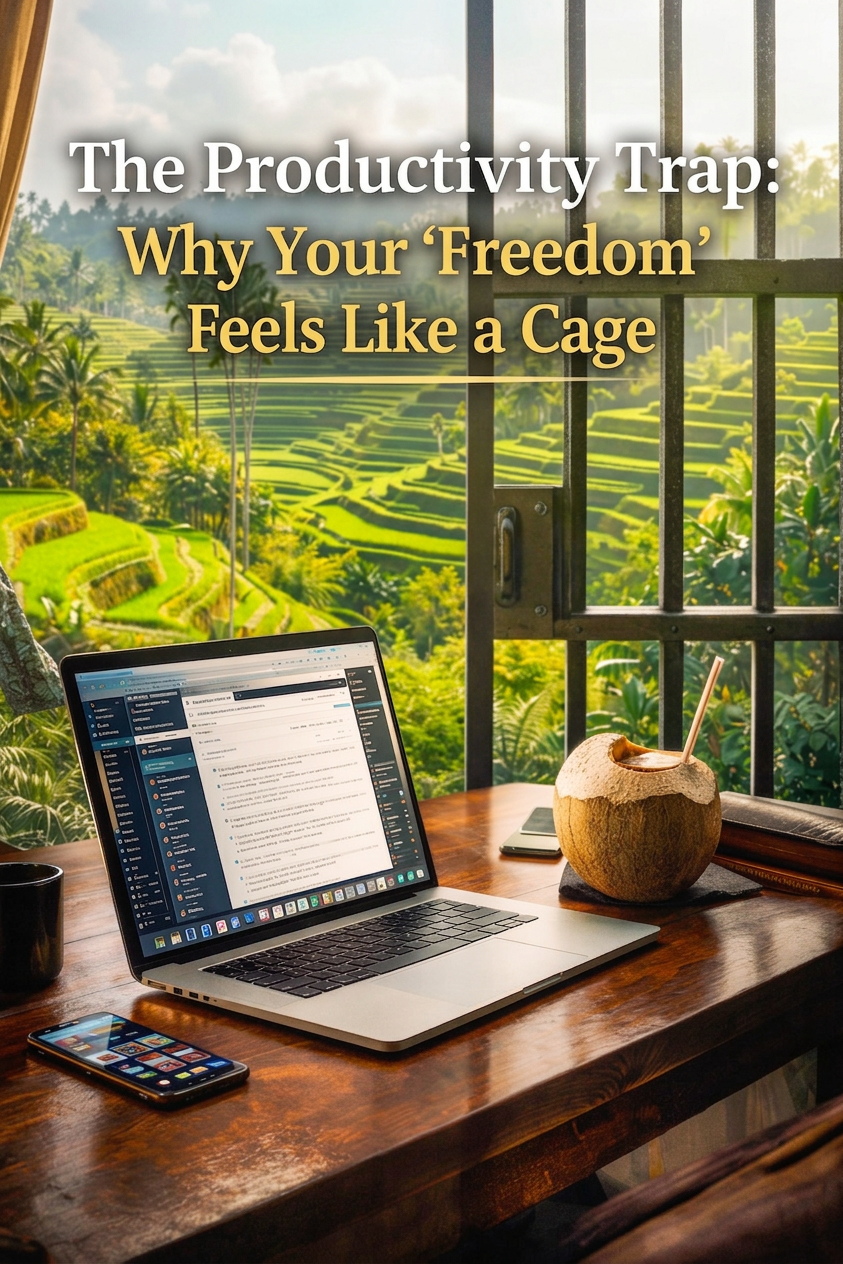
For the better part of a decade, the “Digital Nomad” lifestyle has been positioned as the pinnacle of modern achievement. We’ve all seen the curated feeds: a sleek laptop resting on a rustic wooden table in a tropical villa, a turquoise ocean in the background, and a caption about “escaping the matrix.”
The promise was simple: trade the fluorescent lights of the corporate cubicle for the sun-drenched autonomy of the world. We were told that by removing the physical boundaries of the office, we would unlock a new level of creative output and personal happiness.
But for many who have made the transition, a troubling realization has begun to set in. The white sand beaches haven’t led to better work; they’ve led to a new, more exhausting form of cognitive burnout. We are “free” in location, yet we are more enslaved by our notifications than ever before. We are constantly busy, yet we feel like we are standing still.
This is the Productivity Trap, and it is time we looked at the cost of this digital nomad mirage through the lens of ancient wisdom.
The Myth of the Boundaryless Life
The primary reason the digital nomad dream often turns into a nightmare is the total erosion of boundaries. In a traditional environment, physical walls serve a psychological purpose: they signal to the brain that it is time to work. When you leave that space, those same boundaries signal that it is time to rest.
When you become a digital nomad, your office is your bedroom, which is also your kitchen, which is also a noisy café in a foreign city. When your environment has no boundaries, your work has no end. You enter a state of “perpetual availability,” where the line between living and working becomes so blurred that neither is done well.
This lack of structure creates what psychologists call “decision fatigue.” Every single day, a nomad must decide where to work, how to get there, whether the Wi-Fi will be stable, and how to navigate a new culture. By the time they actually open their laptop, their “cognitive budget” for the day—the energy required for deep, meaningful work—is already half-spent on the logistics of existing.
Movement vs. Progress
We often mistake movement for progress. Because the digital nomad is physically moving—changing cities, hopping on planes, exploring new neighborhoods—there is a dopamine-fueled illusion of advancement.
However, professional and personal growth requires depth. It requires sitting with a single problem for hours, days, or weeks. The nomad lifestyle can be the antithesis of depth; it is often the celebration of the shallow. It is a life of “infinite noise,” where the constant influx of new stimuli prevents the mind from ever settling into the “Deep Work” state required for true mastery.
We have reached a point where we are “always on” but never actually moving the needle. We are responding to emails at 2:00 AM in a new time zone, but we haven’t finished the manuscript, built the new business model, or solved the complex problem we set out to tackle. We are busy being nomads, but we are failing at being producers.
The Stoic Blueprint for Reclaiming Focus
If we want to escape this trap, we don’t need better productivity apps or a faster roaming plan. We need a philosophy of the mind. Specifically, we need to return to Stoic principles that prioritize internal order over external variety.
The Stoics lived in a world of immense distraction and political chaos. Their solution wasn’t to run away to a quiet island—it was to build an internal “inner citadel.” Seneca famously noted, “To be everywhere is to be nowhere.” He understood that a mind that is constantly jumping from one place (or one task) to another is a mind that is incapable of growth.
To reclaim our focus, we must apply three Stoic principles to the modern digital world:
- The Dichotomy of Control: We must stop obsessing over our external surroundings (the “vibe” of the coworking space) and start obsessing over our internal state. Focus is an inside job. If you cannot concentrate in a quiet library, a beach in Bali will not solve your problem.
- Voluntary Hardship: Just because we can work from a beach doesn’t mean we should. Real productivity often requires a boring, sterile environment devoid of distraction. We must choose the “hard” path of discipline—the desk, the quiet room, the turned-off phone—over the “easy” path of novelty.
- The Value of Stillness: Stoicism teaches us that the ability to remain steady while the world moves around us is a superpower. In the nomad context, this means staying in one place long enough to actually build something. It means letting the “noise” of travel fade into the background so the “signal” of your work can emerge.
Conclusion: Finding True Freedom
True freedom is not the ability to move your body across the globe; it is the ability to move your mind toward a singular, meaningful goal without being pulled away by the infinite noise of the modern world.
The digital nomad lifestyle can be a beautiful tool for exploration, but it is a dangerous master. To avoid the productivity trap, we must stop chasing the horizon and start mastering the territory within. It is time to stop being busy and start being effective. Reclaiming your focus isn’t about where you are—it’s about who you are when you sit down to work.
For a deeper dive into the Stoic strategies to beat burnout and reclaim your attention, read the full article here:
The “Digital Nomad” Is a Productivity Trap. Here Is Why You Are Always Busy, But Never Moving.
About the Author
Gary L. Fretwell is a #1 international best-selling author and a student of “Intentional Living.” By blending the rigors of neuroscience with the timeless wisdom of Stoic philosophy, Gary helps creators and leaders build a cognitive architecture of true significance.
As the author of The Magic of a Moment, Unlocking the Magic Daily Journal, and Embracing Retirement, Gary doesn’t just write about purpose — he maps the neuroscience of it. Whether he is serving as Board President for Prescott Meals on Wheels or mentoring the next generation of MBA thinkers at Western Governors University, his mission is to help you navigate the “Identity Ghost” and live an intentional life.
Intentional Retirement, available for pre-order, will be released on May 1. It is a definitive field guide for those ready to move from “Output” to “Influence.”

- Explore the Second Mile: garyfretwell.com
- Weekly Deep Dives: Subscribe to The Wise Effort on Substack.
- Latest Articles: Follow on Medium.


Leave a Reply