

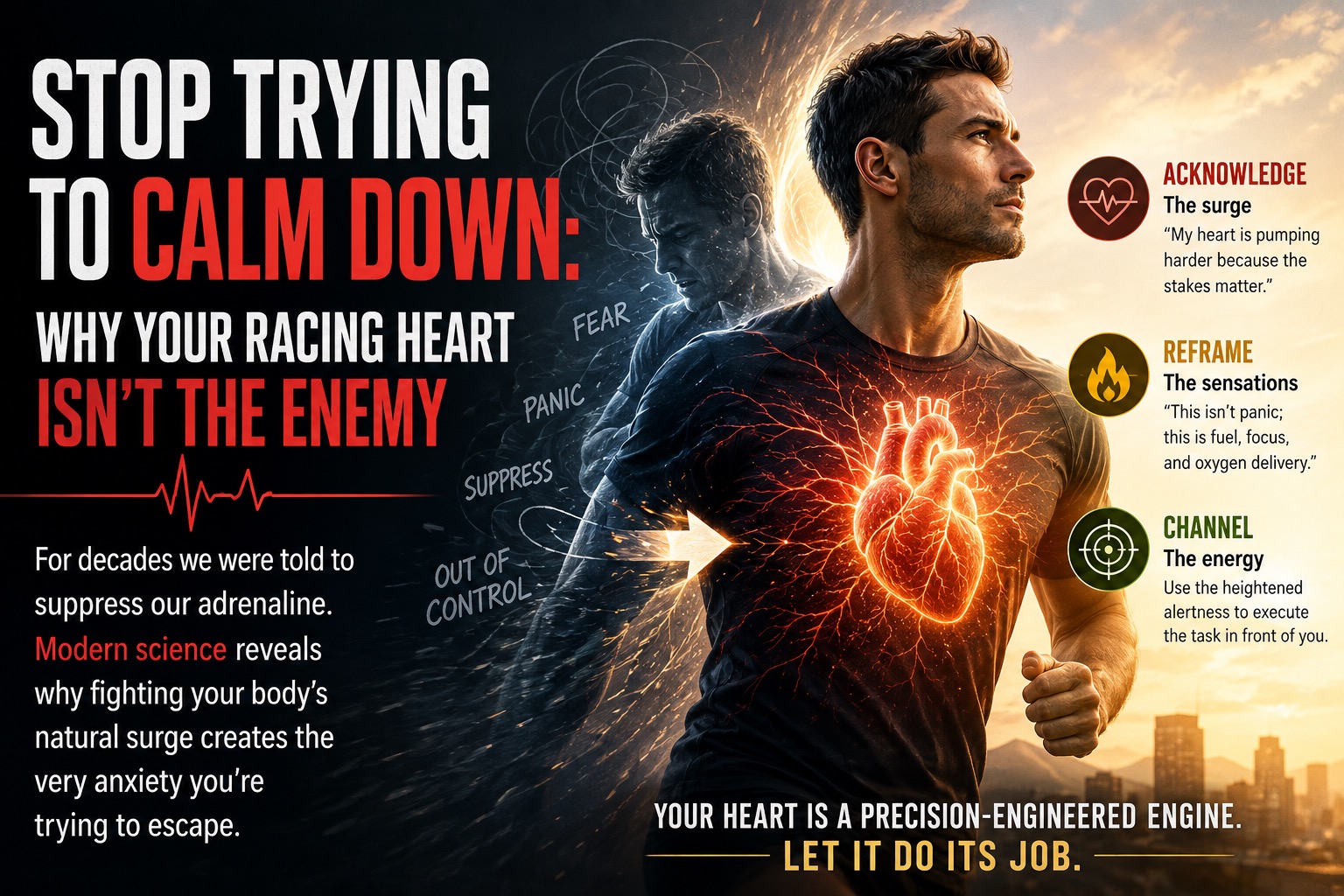
For decades, we were told to suppress our adrenaline. Modern science reveals why fighting your body’s natural surge creates the very anxiety you’re trying to escape.
Curator’s Note: Modern science challenges the traditional belief that a racing heart signifies anxiety, suggesting instead that this physiological response is essential for managing pressure. The sympathetic nervous system activates during high-stakes moments, releasing adrenaline to prepare the body for action. Misinterpreting these sensations as threats leads to interoceptive fear, exacerbating anxiety. Instead, viewing a racing heart as fuel—recognizing it as a physiological benefit—can enhance focus and effectiveness. By reframing the response and addressing it constructively, individuals can harness their body’s natural mechanisms rather than suppressing them. The key is to embrace the surge as a source of energy in challenging situations. This story was written by Gary L Fretwell.
A racing heart isn’t necessarily a warning sign. Reframing the body’s stress response as energy and preparation can change how we experience pressure. / Author created image using A
Picture this: you’re two minutes from walking onstage, pitching a major client, or starting a difficult conversation. Suddenly your throat tightens, your palms go cold, and your heart starts pounding.
What’s the first thing you tell yourself?
For most of us, it’s some version of: Breathe. Calm down. Make it stop.
For decades, wellness culture and mainstream psychology treated a racing heart as a malfunction — something to suppress and shut down as quickly as possible. But newer research in neurobiology and somatic psychology points to a different conclusion: the racing heart was never the problem. The instinct to fight it was.
What Your Body Is Actually Doing
To understand why the “just calm down” approach backfires, it helps to know what’s happening physiologically in high-stakes moments.
When your brain registers a challenge that matters, your sympathetic nervous system activates. Adrenaline and noradrenaline surge through your bloodstream, your airways open wider, stored glucose gets released for fast energy, and your heart rate climbs.
This isn’t your body sabotaging you before a big presentation, it’s your body trying to help. The accelerated heartbeat sends oxygen-rich blood to your brain and muscles, sharpening focus, speeding up reaction time, and heightening your senses. In physiological terms, this is mobilization, not breakdown.
The Trap of Fearing Your Own Symptoms
Trouble starts when we interpret this natural surge as a warning sign of something going wrong.
The moment you notice your pulse racing and conclude that means panic is imminent, you trigger something psychologists call interoceptive fear, fear of your own internal bodily sensations. Now your nervous system isn’t just responding to the outside pressure; it thinks your own heart is the threat.
That second layer of fear is what actually causes the blood vessels to constrict, resistance to spike, and the tight, breathless feeling most people associate with real anxiety. Ironically, trying to force your revved-up system to instantly settle down is what creates the friction. When a few deep breaths don’t immediately lower your heart rate, your brain concludes you’ve lost control, even though nothing has actually gone wrong.
Threat or Challenge? It’s a Matter of Framing
Here’s the surprising part: nervousness and excitement look almost identical inside the body. Both involve a racing heart, adrenaline, and heightened alertness. What differs is how your mind interprets that state.
| Mental Frame | Physical Effect | Result | |
|---|---|---|---|
| Threat mode | “I need to calm down” | Blood vessels constrict | Fog, fatigue, choking |
| Challenge mode | “My body is fueling me” | Blood vessels stay open | Focus, clarity, flow |
People who are coached to see their racing pulse as fuel, rather than danger show a measurably different cardiovascular pattern. Their heart still beats fast, but their blood vessels stay relaxed rather than constricting. Their body starts to resemble that of an athlete locked into peak performance, rather than someone in a state of alarm.
Working With the Surge Instead of Against It
Next time your heart starts pounding before something important, try skipping the emergency response. Instead, try this three-step reset:
- Name it without judgment. Simply notice: “My heart rate is up because this matters to me.”
- Reframe it as fuel. Remind yourself: “This is oxygen reaching my brain so I can think and react faster, not a warning sign.”
- Move with it. Don’t wait to feel completely calm before acting. Walk onstage, start the conversation, or begin the task while the energy is still present.
Your racing heart isn’t an enemy that needs to be tranquilized into silence. It’s a built-in system designed to help you rise to the moment. The goal isn’t to slam on the brakes — it’s to let the engine do the job it was built for.
About the Author:
Gary L. Fretwell spent 43 years in higher education consulting, working with nearly a thousand institutions before retiring to Prescott, Arizona. He is a #1 international best-selling author blending neuroscience with Stoic philosophy to help people build a life of lasting significance. He’s the author of eight books on intentional living and retirement, including the #1 bestsellerThe Magic of a MomentandIntentional Retirement.
On Medium, Gary founded and editsIllumination: Retirement, Aging & Legacy.
📖 garyfretwell.com · 📬 The Wise Effort on Substack · ✍️ Follow on Medium


Leave a Reply