

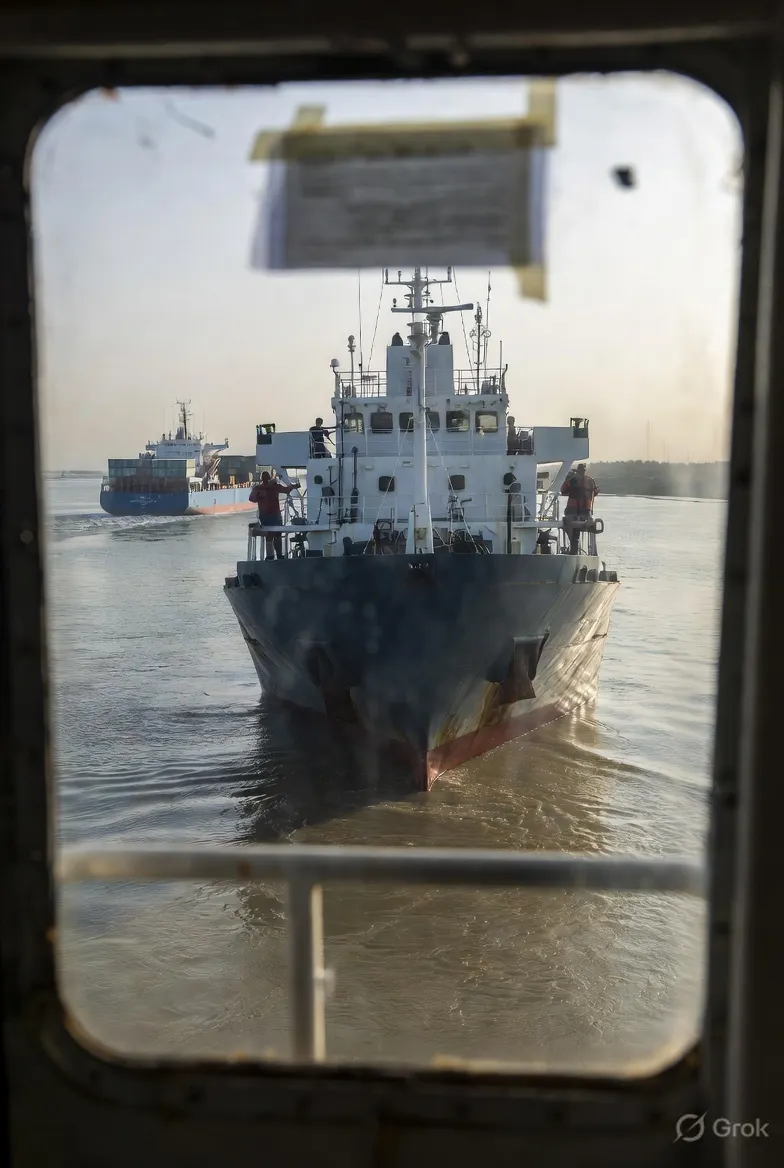
A malfunctioning valve, a looming collision, and the split-second decision that saved my ship in the Great Bitter Lake.
Curator’s Note: As a newly promoted Chief Engineer on a bulk carrier, I faced a daunting challenge during my maiden voyage to deliver iron ore. Accompanied by my wife and daughter, I was eager to prove myself despite staffing issues, including an ill Electrical Officer. As we approached the Great Bitter Lake, a steering failure threatened a collision, forcing me into a high-pressure situation requiring immediate action. The rudder was stuck, and my attempts at emergency steering failed. This crisis tested my resolve and skills, highlighting the vital importance of engine room presence during emergencies and emphasizing the challenges of maritime navigation.
A New Beginning at Sea
My maiden voyage as a Chief Engineer was on a bulk carrier with five holds and four hydraulic cranes. My staff consisted of a Second Engineer and a Fourth Engineer with six months’ experience and three brand-new junior engineers. The Electrical Officer was highly efficient and stood as one of the best Electrical Officers in the fleet.
That shipping company was remarkably generous and permitted my wife and daughter to sail with me, even though I had been recently promoted. They likely allowed it since I had already sailed on the ship as an additional Chief Engineer for three months.
Fervor and Foreshadowing
I had no premonition of what was in store. Like any newly promoted Chief Engineer was brimming with enthusiasm and fervor to deliver excellent results and to prove that the confidence placed in me was justified. I was toiling away, spending a vast amount of time in the engine room and meticulously scouring the previous history and old files.
The ship sailed out from Goa, carrying iron ore to Rostock and Hamburg. As ill luck would have it, the Electrical Officer fell ill with malaria. He could not even rise from his bed. With inexperienced staff and a bedridden Electrical Officer, my hands were more than full. I remained vigilant, and we sailed to Suez without incident.
The Arteries of Global Trade
The Suez and Panama canals are two vital arteries for world trade and the economy. Both save astronomical costs and time for shipping. If ships were forced to circumnavigate the African and South American continents, the additional costs and time delays would cripple the world economy.
The Suez Canal crossing is an exciting and enjoyable experience. A convoy typically starts in the morning, with fast ships — containers, tankers, and other modern vessels — leading the way, while older ships with the slowest speeds trail at the rear of the convoy. Convoys start from both ends of the canal, and midway at the Great Bitter Lake anchor area, ships weigh anchor. The upstream convoy is cleared first, followed by the downstream one.
A Policy of Perspective
For some strange reason, that shipping company maintained a policy that required the C/E to be on the bridge during maneuvering or stations. The logic behind that policy always eluded me, as a Chief Engineer’s presence in the engine room is critical during emergencies. (I should guiltily confess that I enjoyed my stint on the bridge, as I had the opportunity to witness many breathtaking, picturesque scenes, such as the Suez, Panama, and Kiel canals, the Bosporus channel crossings, and the docking and undocking at various ports).
Crisis at the Great Bitter Lake
On that particular day, everything proceeded smoothly, and we were approaching the Great Bitter Lake anchor area. I went to the cabin for a few minutes.
Just as I was about to unlock the bathroom door, my wife started pounding on the wood.
“Hurry up, the Captain called! He says it is an emergency!” she shouted.
I rushed to seize the phone. “Chief, the steering failed! We are heading for a collision!” the Captain bellowed and slammed down the phone.
I sprinted to the steering room. Even as I ran, I could discern that the ship was beginning to list. When I reached the steering room and witnessed the scene, I was paralyzed with shock.
The rudder was stuck at hard-a-port, and the screeching roar of the steering motors was deafening. I quickly recovered my wits and attempted the emergency steering on both motors. Nothing happened. As the ship turned violently, the roller-coaster effect intensified.
Contd…
To read the full story, see Steering failure in Suez Transit
Thank you for reading my story. You can connect with me on Medium, Substack, and Amazon.


Leave a Reply