

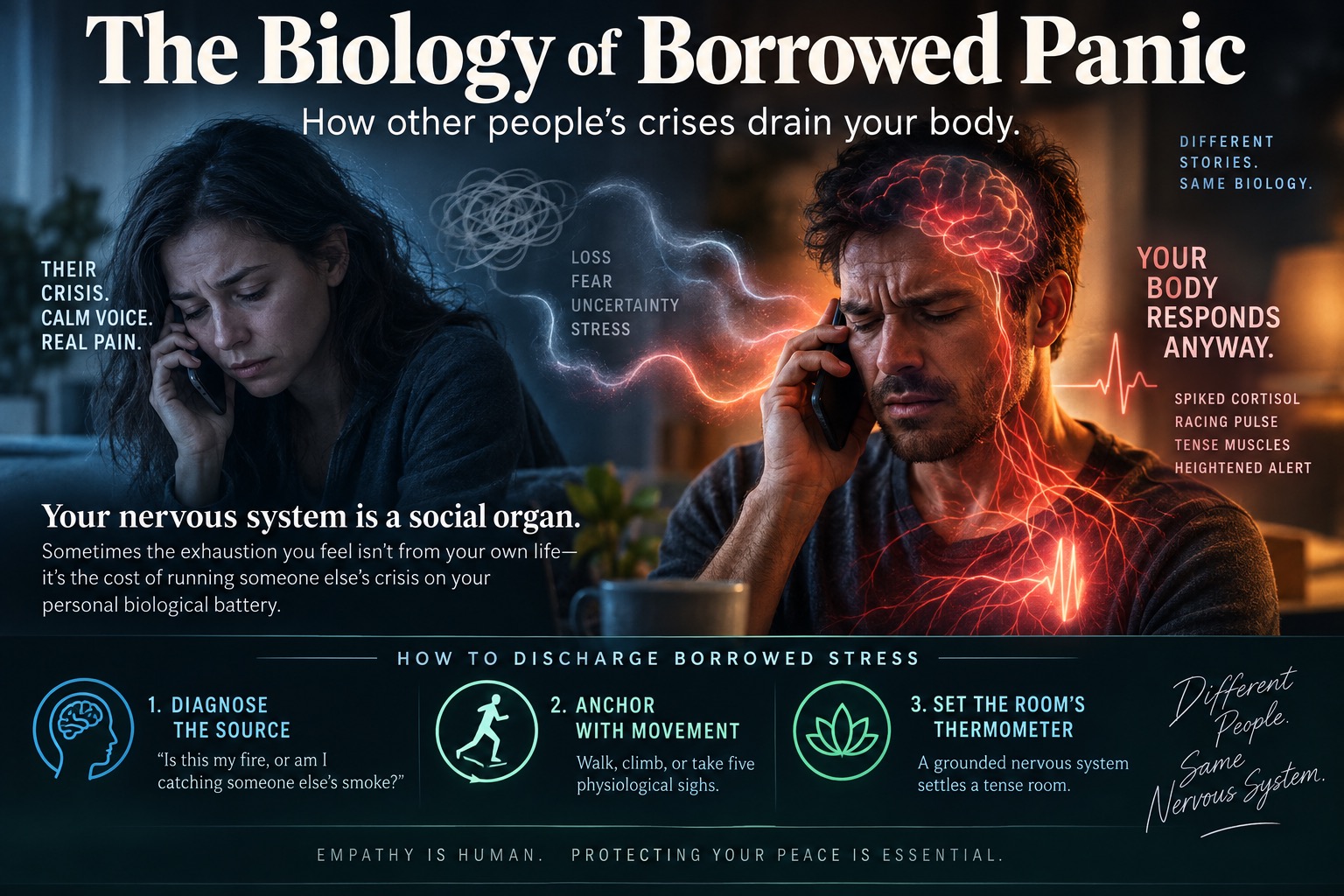
How emotional contagion silently spikes your cortisol, strains relationships, and hijacks your nervous system.
Curator’s Note: The article explores how emotional contagion can affect our biology and relationships, showing that stress can be absorbed from others even without direct engagement. Research shows that individuals can experience elevated cortisol levels just by observing stress in others, leading to physiological responses like tension and exhaustion. This synchronization of stress often strains personal and professional relationships rather than fostering empathy. To mitigate these effects, the author suggests strategies such as recognizing vicarious stress, engaging in physical movement after stressful interactions, and maintaining a calm demeanor to positively influence the surrounding emotional environment.
Aging rarely announces itself all at once. It shows up in small substitutions we barely notice, until we start paying attention./ Author created image using ChatGPT
A friend delivers devastating news over the phone in a voice that is flat, quiet, and completely numb. You murmur words of support, hang up, and stand alone in an empty room. Nobody has threatened your physical safety. Your own family is fine, your immediate environment is entirely secure, and the crisis belongs to someone living hundreds of miles away.
Yet your biology tells a completely different story.
Your jaw is clenched shut, your shoulders are creeping up toward your ears, and your pulse is hammering against your ribs. Nothing in your physical reality has changed, yet your body has just mounted a full-scale emergency defense.
Most of us assume that stress is a strictly private, internal transaction—a chemical cascade generated by our own workload, our own financial pressures, or our own health concerns. But human nervous systems evolved as deeply social, open-loop organs. They are built to constantly scan, mirror, and synchronize with the survival states of the people around us. Often, the profound physical exhaustion you feel at the end of a long day has little to do with what happened in your own life; it is the hidden metabolic tax of running someone else’s crisis on your personal biological battery.
The Architecture of the Borrowed Alarm
In 2014, a research team led by Veronika Engert at the Max Planck Institute constructed an experiment to capture this biological crossover in real time. They placed participants through the Trier Social Stress Test: a standardized gauntlet requiring mental arithmetic and public speaking in front of an unsmiling panel of evaluators, designed specifically to spike systemic cortisol.
A second group of participants did nothing. They simply observed the test through a one-way mirror or across a video feed.
The findings were striking: roughly a quarter of the passive observers showed an immediate, measurable rise in their own cortisol levels. They had never touched the stressor, answered a question, or sat in the evaluation chair, yet their endocrine systems treated the scene as a direct, personal threat.
The researchers identified two distinct ways our bodies absorb outside distress:
- Stress Resonance: Your physiology mirrors the other person’s distress in direct, proportional lockstep, rising and falling in sync with their visible agitation.
- Vicarious Stress: Your body builds an independent alarm, sometimes overshooting dramatically and mounting a severe physiological reaction even when the other person remains flat, quiet, or detached.
In an evolutionary setting, this reflex was essential. If a fellow tribe member froze or panicked, assuming an apex predator was nearby kept you alive. The modern brain, however, has not learned that a difficult sentence delivered across a digital connection is an emotional reality, not an immediate physical ambush.
The Relational and Organizational Cost
Catching another person’s distress is often confused with empathy, but biological synchrony carries a steep relational cost. Studies tracking daily cortisol rhythms in romantic couples reveal that stress linkage is typically strongest in partnerships that are already under significant strain. Rather than fostering compassionate connection, highly synchronized physiological alarms often predict increased defensiveness, short tempers, and relationship friction.
This dynamic scales directly into teams and organizational cultures. Groundbreaking research by the late Wharton professor Sigal Barsade demonstrated that mood transfers across a room like a contagion. A single dysregulated, chronically stressed leader or colleague can subtly alter the collaboration, decision quality, and tension levels of an entire team without ever raising their voice.
Absorbing someone else’s alarm does not ease their burden; it merely leaves two people depleted instead of one.
How to Break the Cycle and Discharge the Charge
Navigating a world of shared distress requires learning how to separate compassionate awareness from automatic physiological absorption:
- Diagnose Before You React: When you feel an acute biological spike during a conversation, pause and ask yourself: “Is this my fire, or am I catching someone else’s smoke?” Recognizing vicarious stress immediately interrupts the unconscious spiral.
- Build a Movement Anchor: Adrenaline and cortisol require a physical completion loop. After high-stress conversations or meetings, deliberately move your body—take a brisk walk down the driveway, climb a flight of stairs, or practice five extended physiological sighs to signal physical safety to your nervous system.
- Act as the Emotional Thermostat: Emotional contagion works in both directions. Cultivating a calm, grounded, and regulated presence stabilizes a tense room just as powerfully as anxiety disrupts it.
You can read the full article and personal reflections here:https://medium.com/health-science/the-stress-you-never-actually-had-a7cf8042dd4c?sk=de983304fef22b6d774dc854a577e540
About the Author:
Gary L. Fretwell spent 43 years in higher education consulting, working with nearly a thousand institutions before retiring to Prescott, Arizona. He is a #1 international best-selling author blending neuroscience with Stoic philosophy to help people build a life of lasting significance. He’s the author of eight books on intentional living and retirement, including the #1 bestsellerThe Magic of a MomentandIntentional Retirement.
On Medium, Gary founded and editsIllumination: Retirement, Aging & Legacy.
📖 garyfretwell.com · 📬 The Wise Effort on Substack · ✍️ Follow on Medium


Leave a Reply