

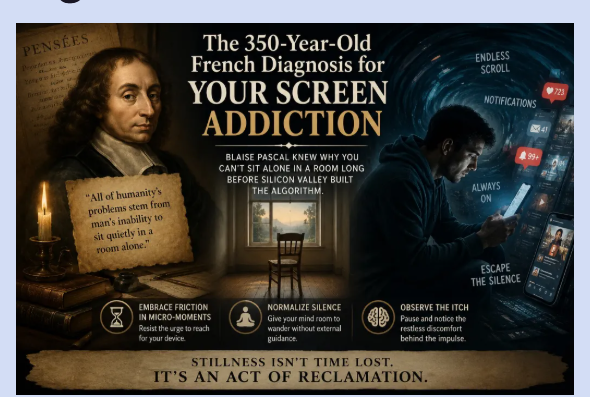
Blaise Pascal knew why you can’t sit alone in a room long before Silicon Valley built the algorithm.
Curator’s Note: Blaise Pascal’s insight from the 17th century—”All of humanity’s problems stem from man’s inability to sit quietly in a room alone”—remains relevant today as modern technology amplifies this struggle. Our society is conditioned to avoid stillness by constantly seeking distractions, from smartphones to relentless media consumption, which serve to mask our deeper anxieties and existential concerns. This incessant diversion leads to diminished capacities for self-reflection, creativity, and emotional resilience. To reclaim the ability to be alone with our thoughts, we must intentionally practice moments of stillness, treat silence as an opportunity for self-discovery, and resist the impulse to distract ourselves constantly.
In the mid-17th century, the French mathematician, physicist, and philosopher Blaise Pascal penned a collection of fragments that would later be published as his Pensées. Among these reflections sits a line that reads less like classical theology and more like an exact psychological diagnosis of the modern world:
“All of humanity’s problems stem from man’s inability to sit quietly in a room alone.”
Pascal wrote this long before the invention of the microchip, the notification badge, or the infinite scroll. Yet centuries later, his observation has evolved from a subtle philosophical dilemma into the defining rhythm of daily life.
Look around any public space today. In waiting rooms, transit hubs, coffee shops, and supermarket checkout lanes, the scene is universally identical. The very second a pause appears, hands reflexively reach into pockets. Silence is no longer experienced as a neutral backdrop or a welcome rest; it is treated as a void that demands immediate filling. We listen to podcasts at 1.5x speed while doing dishes, scroll through short-form video feeds between bites of lunch, and leave streaming television running in the background just to drown out the quiet before sleep.
When we talk about this phenomenon, the blame almost always lands squarely on our devices. We criticize Silicon Valley engineers for weaponizing behavioral psychology and designing algorithms that exploit dopamine loops. While those criticisms are entirely valid, treating technology as the root cause puts the cart before the horse.
Smartphones did not create our inability to sit still. They merely industrialized an ancient human vulnerability that Pascal identified centuries ago.
The Anatomy of Divertissement
To understand why we cannot sit still, we have to understand what Pascal called divertissement, a term usually translated into English as diversion, distraction, or amusement.
Pascal pointed out that human beings rarely pursue frantic activity because the specific tasks are inherently satisfying. Consider a gambler rolling dice at a table. If you offered to hand him all the money he might win on the condition that he must sit still and not play, he would quickly refuse. A hunter braves the biting wind and rugged terrain not because he desperately needs a dead hare, but because the chase itself keeps his mind occupied.
We crave the agitation of the chase because stillness forces an encounter with our interior lives. When the noise stops, we are left alone with the fundamental conditions of our existence: our deep-seated anxieties, our mortality, our unresolved grief, and the precariousness of human life.
Distraction serves as cognitive and emotional anesthesia. As long as the mind remains tethered to an external target (whether it was 17th-century court gossip, war games, or a high-resolution smartphone feed today), we are shielded from having to look directly at ourselves. Modern technology did not invent this escape hatch. It simply optimized the delivery system, making uninterrupted diversion accessible twenty-four hours a day, right from our palms.
The Cost of the Constant Escape
The hidden cost of modern diversion goes far deeper than lost productivity or shortened attention spans. When we lose the ability to tolerate quiet, we forfeit the essential foundation of our inner lives.
Stillness is the fertile soil where original thinking, meaningful self-reflection, and emotional resilience take root. When every idle second is promptly filled with external information, our brains never shift into the default mode network, which is the state associated with creative problem-solving, empathy, and memory integration. Nonstop stimulation traps our minds on a shallow cognitive surface. We react constantly, but we rarely synthesize.
Furthermore, running away from internal discomfort only makes that discomfort more potent over time. The less we sit with our anxieties, the more terrifying they feel whenever the battery finally dies.
Retraining the Muscle of Stillness
Reclaiming your capacity for quiet does not require retreating to a monastery, abandoning technology entirely, or throwing your phone into the ocean. It simply requires retraining a psychological muscle that modern life has allowed to atrophy.
- Reclaim micro-intervals of boredom: The next time you are stuck at a red light, standing in an elevator, or waiting for a friend at a restaurant, resist the automatic urge to unlock your device. Treat those sixty seconds as deliberate practice in existing without external input.
- Remove the constant soundtrack: Try taking a walk around your neighborhood, commuting, or cooking a meal without a podcast, audiobook, or playlist running in your ears. Allow your thoughts to wander without a script.
- Sit with the urge: When you feel the familiar impulse to grab a distraction, pause for just thirty seconds. Notice the restlessness or subtle discomfort beneath the urge without immediately rushing to soothe it.
Sitting alone in a room without distraction is not passive time wasted. It is an intentional act of reclamation. In a culture engineered to monetize every fraction of your attention, reclaiming quiet stillness is the ultimate act of self-possession.
For more on this topic, read the original essay:https://medium.com/illumination-curated/nobody-can-sit-still-anymore-edd776967298?sk=2ebfbd899a7fd573e85e319603d1c514
About the Author:
Gary L. Fretwell spent 43 years in higher education consulting, working with nearly a thousand institutions before retiring to Prescott, Arizona. He is a #1 international best-selling author blending neuroscience with Stoic philosophy to help people build a life of lasting significance. He’s the author of eight books on intentional living and retirement, including the #1 bestsellerThe Magic of a MomentandIntentional Retirement.
On Medium, Gary founded and editsIllumination: Retirement, Aging & Legacy.
📖 garyfretwell.com · 📬 The Wise Effort on Substack · ✍️ Follow on Medium


Leave a Reply