

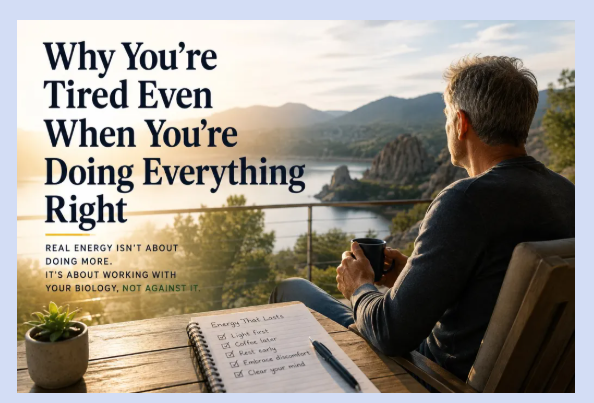
Real energy doesn’t always come from doing more. Sometimes it comes from working with your body, including resting earlier, getting natural light, clearing mental clutter, and giving your biology what it actually needs.
Curator’s Note: The post by Gary L. Fretwell emphasizes that true energy comes not from stimulation but from aligning with the body’s natural needs. It highlights misconceptions about energy management, particularly the detrimental effects of caffeine and the importance of resting before exhaustion. Instead of chasing quick energy boosts, practices like delaying coffee for natural light and incorporating brief periods of discomfort can improve energy efficiency. Furthermore, mental clutter drains energy; organizing unfinished tasks helps clear mental bandwidth. Ultimately, fostering real energy involves working with the body’s systems rather than against them, promoting sustainable vitality without reliance on supplements or rigid routines.
I slept eight hours. I had my coffee. I’m still dragging by early afternoon, wondering what’s wrong with me.
Nothing is wrong with me. I’m just solving the wrong problem.
Most of what I used to call “energy management” was really just stimulation management. I’d reach for caffeine, sugar, or a burst of adrenaline, and mistake the resulting jolt for actual vitality. But a jittery buzz and sustainable energy aren’t the same thing. One is my nervous system firing on borrowed time. The other is my biology running the way it’s supposed to. The distinction matters more than it sounds like it should, because chasing the wrong one is exactly how I ended up doing “everything right” and still feeling like I was running on fumes by 2 p.m.
I came across a piece on Medium, The Vitality Paradox, that makes this case well: the habits that restore real energy often look nothing like what’s marketed to us as “energy solutions.” Here’s the reasoning behind a few of them, and why they hold up for me.
My morning coffee might be working against me. While I sleep, my brain slowly clears out a compound called adenosine, the chemical responsible for that heavy, tired feeling. Caffeine doesn’t get rid of adenosine. It just blocks me from feeling it. So if I drink coffee the moment I wake up, before my brain has finished its own clearance process, I’m not solving the problem. I’m delaying it. That leftover adenosine catches up with me later, and it often looks like a random afternoon crash, one that feels unrelated to anything I did, when really it’s just the bill coming due for a debt I took out at 7 a.m. A simple fix has been pushing my first cup back by an hour or two and getting natural light instead, which does a lot of the alertness work for free. Light exposure helps regulate the same systems caffeine is trying to hijack, except without the crash on the back end.
Waiting until I’m exhausted to rest is backward. Once I’m truly depleted, my body has already shifted into a stress response that takes real effort to climb out of. Cortisol rises, my nervous system tips toward “get through this” mode, and a five minute break stops being enough to undo it. I used to think staying sharp all day meant being more resilient. Now I think it just means resting before I need to, in small, deliberate doses, rather than treating rest as something I’ve earned only after running myself into the ground. A two minute pause between tasks does more for me than a collapsed hour on the couch after I’ve already hit the wall.
A little discomfort is doing more for me than I gave it credit for. Constant comfort, climate control, soft everything, snacks on demand, quietly makes my body’s energy systems less efficient. When nothing ever asks anything of me, my cells stop bothering to adapt. Brief stress, a cold shower, a flight of stairs, a short stretch without food, pushes my cells to adapt and actually produce more energy over time. It’s a small dose of friction that pays off, the same way lifting a weight that’s slightly too heavy is what makes me stronger, not lifting one that isn’t.
And some of my fatigue isn’t physical at all. Every unfinished task or unmade decision sitting in the back of my mind takes up real mental bandwidth, even when I’m not consciously thinking about it. That quiet background noise burns energy I didn’t know I was spending. It’s the mental equivalent of leaving a dozen browser tabs open. Nothing crashes, but everything runs a little slower. Writing it down and sorting it, what needs action today, what can wait, what I can’t control, tends to free up more focus than I expect. It’s less about productivity and more about giving my brain permission to stop guarding the door.
None of this has required a new supplement or a rigid routine. It has mostly required not working against the systems my body already has. Real energy isn’t something I manufacture with the right stack of products. It’s something that shows up on its own once I stop interrupting it.
If you want the full breakdown, including the research behind each habit, it’s worth the five minute read: The Vitality Paradox
About the Author:
Gary L. Fretwell is a #1 international best-selling author blending neuroscience with Stoic philosophy to help people build a life of lasting significance. He’s the author of eight books on intentional living and retirement, including the #1 bestseller The Magic of a Moment and Intentional Retirement.
On Medium, Gary founded and edits Illumination: Retirement, Aging & Legacy.
📖 garyfretwell.com · 📬 The Wise Effort on Substack · ✍️ Follow on Medium
This question was also answered by Dr Mehmet Yildiz in his latest book, Answering the Hard Questions We Ask in Silence: Why We Feel Empty, Stuck, Tired, Anxious, or Disconnected, & What Cognitive Science Reveals


Leave a Reply