

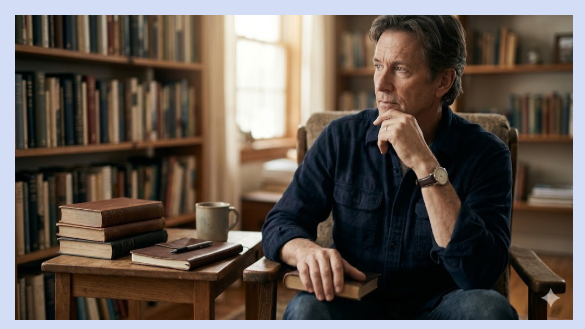
We are currently living through a strange, quiet crisis. It isn’t a crisis of information—we have more of that than we could ever consume. It is a crisis of identity.
Curator’s Note: The content discusses a modern crisis of identity exacerbated by the digital attention economy, where individuals often prioritize performance over genuine communication. The author, a writer and educator, shares a personal experience of a three-day silence aimed at reconnecting with his “unfiltered voice,” revealing the discomfort and loneliness that came with it. He critiques the optimization trap that leads to curating a safe version of oneself, which is no longer authentic. The piece emphasizes the importance of reclaiming one’s unique voice, promoting practices like strategic silence and prioritizing real-world connections, as a means to resist algorithmic influence and remain human. This story was written by Gary L. Fretwell, author of multiple bestselling books.
As a writer and an educator, I spend a significant amount of my time thinking about how we communicate. But recently, I realized that I had fallen into the same trap as everyone else: I was no longer communicating; I was performing. I was sanding down the edges of my thoughts to ensure they fit through the narrow slats of the digital gatekeepers.
So, I did something that felt genuinely risky in the “attention economy.” I went silent.
For three days, I stopped. No posts. No likes. No checking the metrics to see if my latest thought had “landed.” I expected the FOMO. I expected the anxiety of being forgotten. What I didn’t expect was the terrifying realization that my “unfiltered” voice had become a stranger to me.
The Optimization Trap
In my work with MBA students at WGU, we talk a lot about optimization. In business, optimization is a virtue. It’s about efficiency, reach, and conversion. But when we apply those same principles to our personal expression, something breaks.
We have become so adept at “feeding the beast” that we have begun to outsource our intuition to the algorithm. We ask ourselves: Will this headline perform? Is this photo “on brand”? Does this opinion fit the current trend? When you ask those questions long enough, you stop being a creator and start being a curator of a version of yourself that doesn’t actually exist. You become a reflection of what the machine wants to see.
Why Silence is a Diagnostic Tool
The three days of silence I experienced weren’t just a “digital detox.” They were a diagnostic test.
When you remove the immediate feedback loop of the “Like” button, you are left with the raw materials of your own mind. It’s uncomfortable. It’s quiet. And for the first few hours, it feels incredibly lonely. But in that silence, I started to hear the “human glitches”—the thoughts that weren’t optimized, the opinions that weren’t safe, and the observations that didn’t have a “call to action” attached to them.
This is the “Unfiltered Voice.” And it is the only thing the algorithm cannot touch.
The AI Paradox
We are currently obsessed with Artificial Intelligence. We worry about AI replacing writers, artists, and thinkers. But here is the irony: AI is trained on the very “optimized” content we’ve been churning out for the last decade. It is a mirror of our most average, most predictable, and most “performative” selves.
If you write like an algorithm, you will be replaced by one.
However, AI cannot simulate your specific brand of silence. It cannot replicate the way your personal history, your local community—like the high desert of Prescott or the halls of a non-profit—colors your perspective. It cannot mimic your lived experience of failure, or the specific way you see the world when no one is watching.
Reclaiming the Unfiltered
So, how do we get it back? How do we reclaim a voice that has been conditioned to seek validation from a line of code?
- Practice Strategic Silence. You don’t need a three-day fast to start. Try a “Silent Sunday” or even just an hour where you write something that you have absolutely no intention of publishing.
- Audit Your “Safety.” Look at your last three social media posts. If they feel “safe,” they are probably optimized. Where are the rough edges? Where is the part of the story that makes you feel a little bit exposed? That is usually where the value is.
- Prioritize the Analog. Read books that aren’t trending. Talk to neighbors. Engage in work that doesn’t have a “share” button—like community service or gardening. These activities ground your voice in reality rather than digital simulation.
The Future belongs to the Un-Optimized
The goal of the coming decade won’t be to see who can produce the most content; it will be to see who can remain the most human. The algorithm wants your data, but it doesn’t want your soul. It wants the predictable version of you because that version is easy to sell to.
Your power lies in being unpredictable. Your power lies in your unfiltered voice.
I’ve written a deeper reflection on this journey and the specific “terrifying” lesson I learned during those 72 hours of silence. If you’ve ever felt like you’re shouting into a void—or worse, like you’re becoming the void—I’d love for you to read it.
Read the full article on Medium: 👉 Your Unfiltered Voice Is the Last Thing the Algorithm Can’t Touch
About Gary L. Fretwell
I write at the intersection of human intuition and digital noise.
In a world increasingly governed by algorithms and automated “best practices,” I’m interested in the things a line of code can’t replicate: the messy, unpolished, and deeply human moments that define a life well-lived.
My perspective is shaped by a career in strategic marketing and my current role as Adjunct Faculty at Western Governors University, where I mentor MBA students navigating the future of business. But my most rewarding work happens on the ground in Prescott, Arizona, serving as Board President for Prescott Meals on Wheels and engaging with the community I call home.ntentional Retirement, arrives in 2026 — a definitive field guide for those ready to move from “Output” to “Influence.”

Retirement isn’t about the quantity of your years; it’s about the gold you find in the transitions. My upcoming book, Intentional Retirement, is a blueprint for those ready to stop “filling the jar” with busyness and start designing a Second Act of true significance./ Image created by Nancy Fretwell
Step into the Second Mile: Connect with Gary’s latest insights at garyfretwell.com.
The Deep Dive: For weekly strategies on cognitive clarity and the architecture of a meaningful life, subscribe to Gary’s Substack, The Wise Effort.
Follow the Journey: Read over 100 deep dives on transition and productivity at medium.com/@gary_fretwell.


Leave a Reply