

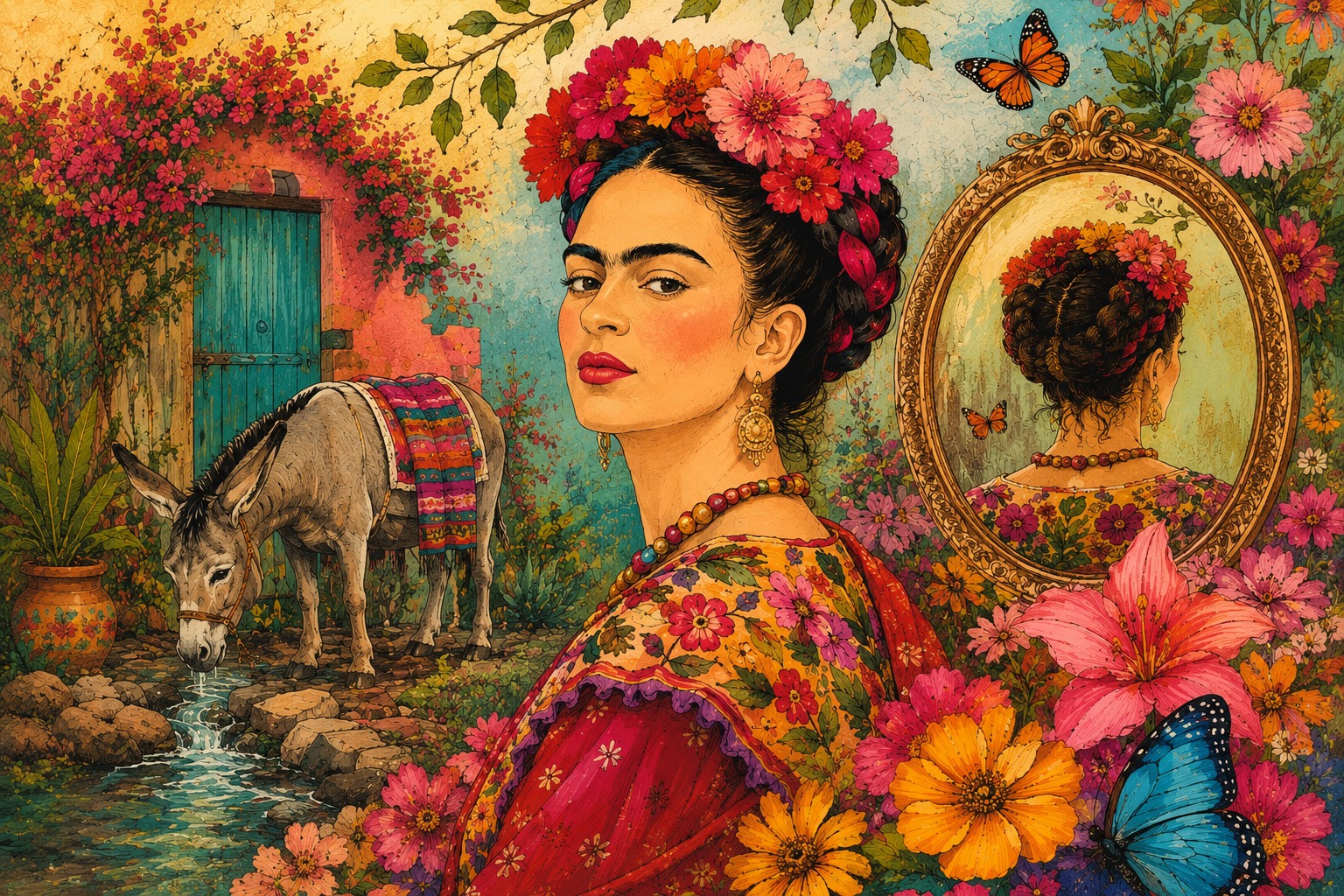
Frida Kahlo painted pain in every color.
Curator’s Note: Frida Kahlo’s art embodies a transformation of pain into vibrant colors and joyous expressions. The writer reflects on how colors represent personality and joy, contrasting a vivid scene filled with blooming flowers against a backdrop of personal struggle. The narrative illustrates a surreal journey through Kahlo’s experiences, where beauty and suffering coexist. It emphasizes her refusal to let pain dictate her identity, opting instead to express herself through flowers and art. The conclusion resonates with the idea that those who understand sorrow can create beauty from it, making their existence a form of resilience and celebration.
They say wearing very colorful clothes is not elegant.
But is that really true?
What if colors were a form of personality?
A way of saying who we are without having to open our mouths?
Or perhaps an attempt to bring some joy to a world that is sometimes so cloudy.
One spring morning, there were no flowers.
There was the smell of tortillas.
The air carried an ancient, familiar presence.
And, suddenly, a burrito appeared along the road, panting as if it had traveled a long way.
It stopped beside a small stream and drank slowly.
I stood there watching.
Something about that place made no sense.
Or perhaps it did.
The scene seemed to have escaped from a surreal painting.
My soul began to wander through the universe on its own.
It went in search of something I could not name.
Clinging to the strokes drawn with restless brushes.
There were flowers everywhere.
There were so many that I began to think spring was empty outside because everything had decided to bloom in there.
Branches and buds burst forth boldly.
In the ribbons.
In the lace.
In the patterned fabrics.
It was as if God’s palette had spilled itself across the canvas.
I emerged from my cocoon to follow my restless essence.
I needed to be whole.
I wanted to touch all of it.
Now I could smell the scents: the citrus of the tequila and the sweetness of the margarita.
It was melancholy and, at the same time, far too intense for my fragile wings.
Drunk with it, I crossed the horizon.
I persisted.
From above, I saw the sombreros.
The mariachis played guitarrones.
All around, lush dahlias were blooming.
Each one seemed to have chosen exactly where it should grow.
Some embroidered the courtyards.
Others climbed the walls.
There were flowers on the gates, on the dresses, in the hair.
And I danced in circles, enchanted by the beauty.
Where had they come from?
Who had scattered so much fragrance throughout that place?
Then I saw through the window of the Blue House.
A girl.
She was confined to her bed.
Lying on her back.
Polio had already left marks on her right leg.
Something about her did not match all that exuberance of color.
I flew a few years forward.
I searched among the folds of time.
I saw the young woman who was in the accident that once again returned her to her sickbed.
She carried a story I did not yet know.
But I could feel it.
ONLY FRIDA.
I drew closer.
And then I found the mirror.
I looked.
But the mirror seemed to deny what I was seeing.
It did not show only the wounded girl.
It showed a colorful girl.
Flowers in her braids.
Flowers all over her body.
Flowers in her eyes.
As if pain had been forced to share its space with joy.
As if suffering had learned to paint itself.
That was when I understood.
Perhaps the flowers had never been just flowers.
Perhaps the canvas held more than layers of paint.
Perhaps it was a silent revolt.
A way of saying:
You can hurt me.
Deny my womb its fruits.
You can leave your marks.
You can make me bleed.
But I refuse to offer you thorns.
If anything is born from me,
let it be flowers.
And that was how I understood the woman.
She was not trying to hide her pain.
She was doing something else.
She was choosing what to do with it.
Turning wounds into colors.
Loneliness into self-portraits.
And perhaps that was why everything there felt so alive.
Because she knew sadness deeply, but insisted on showing her own existence in her own way.
Among gardens, there she was.
ONLY FRIDA.
But also…
ONLY JOY.
Not because she had never suffered.
But because she refused to let suffering choose for her.
Perhaps that is what colors do.
They do not erase the gray.
But they remind us that we can still choose a color.
Or all of them.
I looked at the mirror again.
And she was still there.
Surrounded by flowers.
Her eyebrows, like my butterfly wings, arched, and she said to me:
“Why do I need feet if I have wings to fly…”
And then I saw beyond the painting: some people are not born to escape pain.
They are born to transform it into art.
This text, written by me, was inspired by the life and work of Frida Kahlo, especially her relationship with pain, colors, flowers, and Mexican culture. The narrative is a literary interpretation that blends elements of her story with imagination.


Leave a Reply