

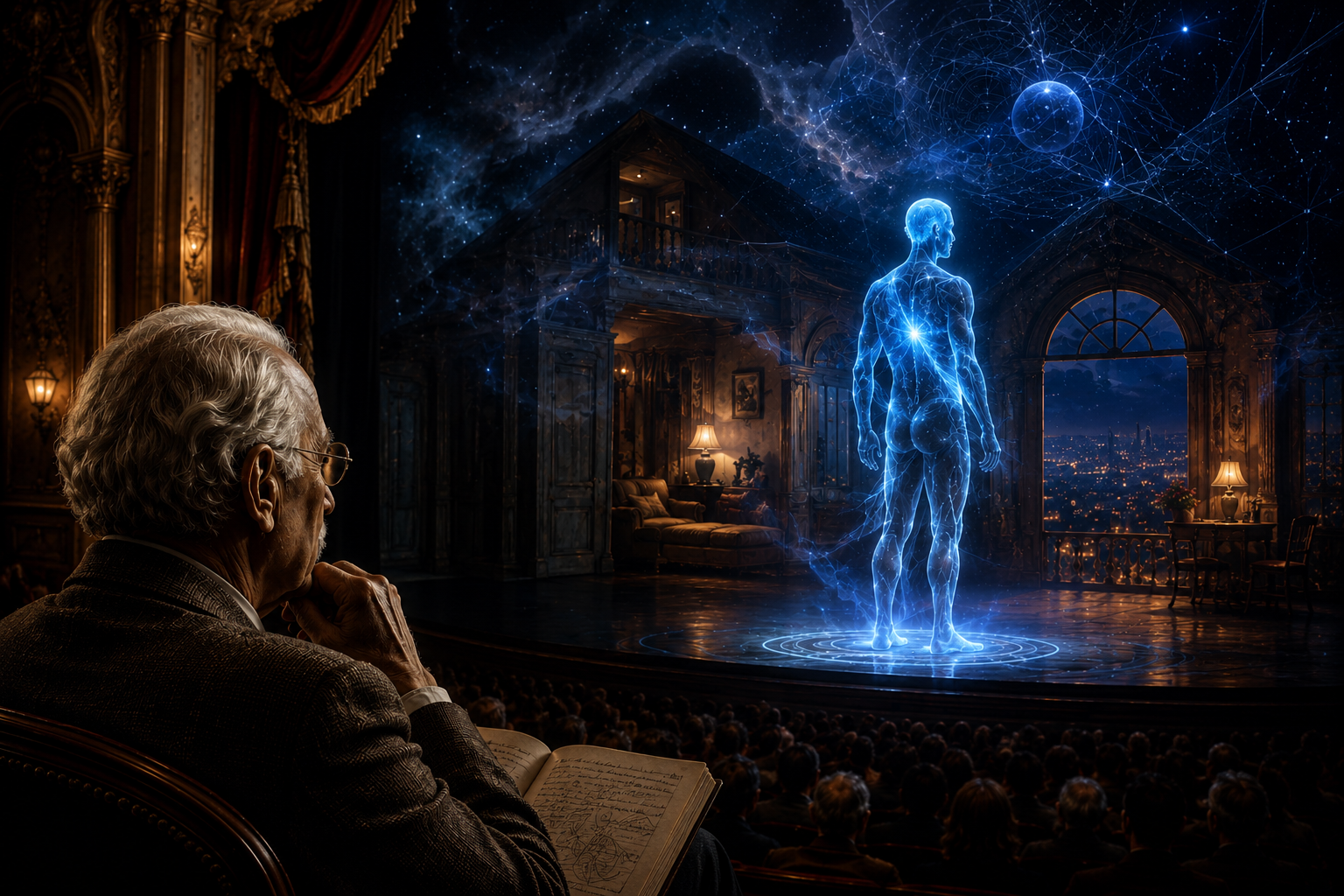
When the light we know encounters the worlds we have not yet learned to see.
Curator’s Note: The play centers on Carl Gustav Jung’s theories, unfolding in five acts that explore the concepts of consciousness, the unconscious, synchronicity, choice, and individuation. The protagonist, referred to as the Ego, initially believes he fully understands his world until he encounters forgotten memories and meaningful coincidences, represented by a photograph and a phone call from a former girlfriend. As the acts progress, the Ego grapples with the significance of these events, recognizing the interconnectedness of his experiences. Ultimately, he awakens to new possibilities and reflections on transformation, while Jung observes the performance, satisfied with its depiction of psychological insights. This story was written by Rosana Elizabet Schumaher for the Digitalmehmet Content Ecosystem audience as a literary contribution.
Act I — Consciousness
“The light reveals the world we believe we know.”
That night, among hundreds of spectators, a white-haired man quietly took his seat in the front row.
Resting on his knees was the manuscript of the play.
He reread the first page, closed the manuscript, and smiled discreetly.
His name was Carl Gustav Jung.
In a few moments, his theory would leave the pages and step onto the stage.
The curtains opened.
The stage was immense.
At its center stood a house.
Inside the living room walked a single actor.
His name was the Ego.
Convinced that he knew the entire house, he said to himself:
“This is my world.
I know exactly where I am.”
Act II — The Unconscious
“Not everything that happens is born before our eyes.”
The Ego could see only what the light revealed.
In the bedroom, a current of air moved the curtain.
It crossed the hallway.
On the living room shelf, an old book fell to the floor.
As it opened, it revealed a forgotten photograph hidden between its pages.
The audience saw.
The Ego did not.
At that same moment, something made him stop.
He approached the book.
He picked up the photograph.
For a few moments, he remained there, looking at that face.
Then he remembered his former girlfriend.
The phone rang.
It was her.
Act III — Synchronicity
“Some events are not connected by cause, but by meaning.”
At that moment, a presence crossed the stage.
It did not speak.
It did not touch anyone.
It simply brought together events that, apparently, had no connection.
The book.
The photograph.
The memory.
The phone call.
What only the audience had witnessed…
and what the Ego had just experienced.
It was Synchronicity.
It left.
With the same subtlety with which it had arrived.
Act IV — The Choice
“Every transformation begins with a question.”
The Ego remained still.
He looked at the photograph.
Then at the phone.
For a few moments, he remained silent.
Then he said:
“Coincidence…”
He closed the book.
Placed the photograph on the table.
Turned off the lights.
Entered the bedroom.
And went to sleep.
For the Ego, that day had come to an end.
But the house remained awake.
Act V — Individuation
“Each new light reveals only the next step.”
The Ego awakened.
He walked into the living room.
The photograph was still on the table.
The memory returned.
The phone call.
The exact moment.
He looked at the photograph and thought:
“Why did she call me exactly when I was thinking of her?”
At that moment, a small light came on inside the house.
He walked to the balcony.
Opened the door.
The wind touched his face.
The entire city stretched out before him.
Thousands of lights.
Thousands of possibilities.
Then he noticed a small flower growing between the cracks of the balcony.
He bent down.
He gently held it.
And remained there.
Looking at the horizon.
Epilogue
The curtains closed.
Jung remained seated for a few moments.
He closed the manuscript.
Stood up.
Looked one last time at the empty stage.
Smiled discreetly.
And walked away.


Leave a Reply