

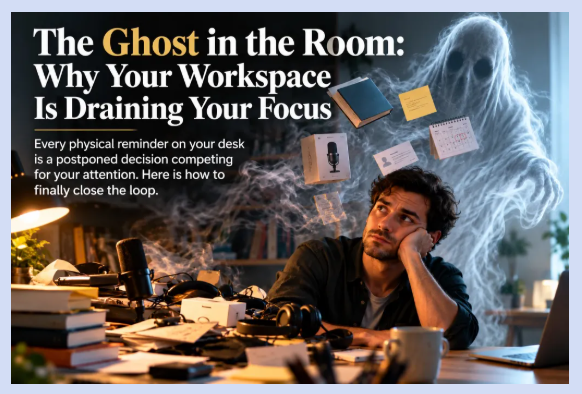
Every physical reminder on your desk is a postponed decision competing for your attention. Here is how to finally close the loop.
Curator’s Note: The clutter on your desk represents unresolved decisions that compete for your attention, often leading to cognitive overload. Items meant to remind you of tasks can become invisible distractions as you stop actively noticing them. This lingering “decision debt” can drain mental energy and create a sense of fatigue. Simply organizing clutter does not resolve the issue of indecision; instead, it may make it more visually appealing. A practical solution is to clear your desk of non-essential items, evaluate each one, and make definitive decisions on their fate. This approach helps regain focus and eliminates the distractions of unaddressed tasks. This story was written by Gary L. Fretwell for Digitalmehmet audience.
The clutter you stop noticing may still be competing for your attention.
Take a close look at your desk right now. Chances are, you have stopped seeing most of it.
There may be a book you started three months ago, a business card from an event you attended in the spring, a microphone still waiting to be configured, or a stack of papers you keep telling yourself you will deal with when you have more time. None of these things are trash. In fact, that is precisely the problem.
You put them there deliberately. They were supposed to remind you of something. The microphone was supposed to nudge you to start the podcast. The business card was supposed to remind you to send the email. The book was supposed to remind you to finish reading it.
Without realizing it, your desk slowly became a physical to-do list. Then something strange happened.
You stopped reading it.
When Reminders Stop Reminding
The human brain is remarkably good at adapting to repeated stimuli. Walk into a room with a ticking clock and you hear every tick. Twenty minutes later, you barely notice it. Something similar happens with visual clutter.
The objects remain in front of you, but they gradually disappear from conscious awareness. You no longer actively think, I need to do something with that microphone. You simply stop noticing it. But not consciously noticing something does not necessarily mean your brain has stopped processing it.
That distinction matters.
As professional organizer Barbara Hemphill famously observed, clutter is essentially postponed decisions. I would take that idea one step further. A reminder can become a postponed decision in disguise.
We leave something visible because we have not decided what to do with it, when to do it, or whether it deserves our attention at all. Instead of making the decision, we leave the object out and call it a reminder.
The Invisible Tax of Visual Noise
Research on visual attention helps explain why this matters. Work by neuroscientist Sabine Kastner and colleagues at Princeton has demonstrated that multiple objects in the visual field compete for neural representation. Your brain cannot give equal processing priority to everything you see. It must continually select what matters and suppress what does not.
That means a cluttered workspace creates competition. The stack of books competes with the screen. The unopened package competes with the document you are writing. The business card competes with the paragraph you are trying to finish.
You may not consciously think about any of them, but your attentional system still has to determine what deserves processing and what should be ignored. That filtering is not free.
I think of the result as decision debt.
Every unresolved object represents a small cognitive loan you have taken against your future attention. One object costs almost nothing. Thirty unresolved objects are different. The interest gets paid in distraction, low-level tension, mental fatigue, and the strange feeling that you are surrounded by things you should be doing.
This is why clutter can feel exhausting even when you are sitting perfectly still. The room is asking questions. You have simply stopped hearing them.
Why Organizing May Not Solve It
Our natural response is usually to organize. We buy trays, label folders, purchase attractive storage containers, and move things into carefully designated piles. It feels productive because the workspace looks better.
But organization can become another way of avoiding the real issue. If I move fifteen unresolved decisions from my desk into three beautiful baskets, I still have fifteen unresolved decisions. I have simply made my indecision more attractive.
The goal is not to organize the reminders. The goal is to eliminate the need for them.
The Single-Box Reset
There is a surprisingly simple way to do this. Take one large box and remove everything from your desk that does not need to be there for the work you are doing today. Put all of it in the box.
Then stop for a moment. Sit down and look at the empty surface. Notice what happens.
For many people, there is an almost immediate sense of relief. Nothing is asking to be read, fixed, filed, returned, contacted, installed, or finished. For the first time in perhaps months, the environment has stopped making demands.
Now comes the important part. Take one item out of the box. Only one. Hold it in your hand and make a decision.
Every object gets one of three outcomes:
- Discard or donate it.
- Give it a permanent home.
- Convert what it represents into a specific action with a date.
That business card? Either throw it away, file the contact information, or put “Email David” on your calendar for Tuesday at 10:00.
That microphone? Either return it, store it, or schedule “Set up microphone” for Saturday morning.
That book? Put it on the shelf or decide when you are actually going to read it.
What you cannot do is place it back on the desk because you “don’t want to forget.” That is how the ghost gets back into the room.
Your Desk Is Not a Memory System
A workspace should support the work in front of you, not display every intention you have failed to clarify. Your calendar can remember dates. Your task system can remember commitments. Your filing system can remember information.
Your desk does not need to remember anything.
When you remove those silent reminders, you are doing more than cleaning. You are closing loops and making decisions. You are taking dozens of tiny demands that have been whispering from the edges of your attention and giving each one an answer.
So look at your desk again and find one object you stopped seeing weeks ago. Pick it up and decide what it means.
Sometimes the fastest way to regain your focus is not to try harder to concentrate. It is to remove everything your brain has been working so hard to ignore.
This version feels much more like a polished Medium essay. The short paragraphs are now reserved for places where you actually want emphasis, particularly “You stopped reading it,” “That distinction matters,” and “I think of the result as decision debt.”
About the Author:
Gary L. Fretwell spent 43 years in higher education consulting, working with nearly a thousand institutions before retiring to Prescott, Arizona. He is a #1 international best-selling author blending neuroscience with Stoic philosophy to help people build a life of lasting significance. He’s the author of eight books on intentional living and retirement, including the #1 bestseller The Magic of a Moment, The Identity Ghost: Ancient Wisdom, Modern Neuroscience, and the Architecture of an Intentional Life and Intentional Retirement.
On Medium, Gary founded and edits Illumination: Retirement, Aging & Legacy and 8 other publications.
📖 garyfretwell.com · 📬 The Wise Effort on Substack · ✍️ Follow-on Medium · 📺 Follow-on YouTube


Leave a Reply