

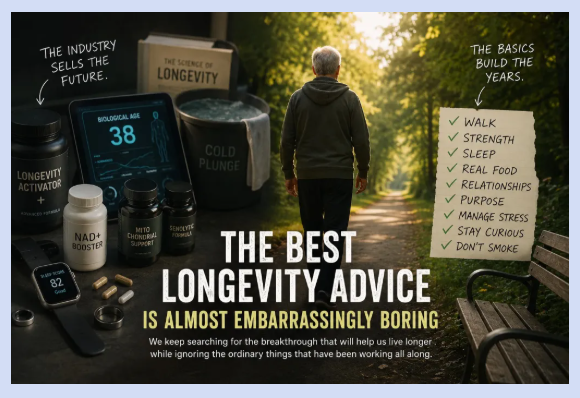
We keep searching for the breakthrough that will help us live longer while ignoring the ordinary things that have been working all along.
Curator’s Note: The longevity industry emphasizes breakthroughs for enhancing lifespan, often overshadowing simpler, effective habits that foster a longer, healthier life. Despite the allure of high-tech solutions and supplements, core practices like walking, maintaining relationships, and managing stress are accessible and inexpensive. Acknowledging that longevity is shaped over decades, the author encourages adopting beneficial habits now, irrespective of age. While the industry seeks the next major advancement, individuals can still significantly enhance their quality of life through consistent, ordinary actions. The author highlights the importance of focusing on what can be done today to improve wellbeing in later years. This story was written by Gary L. Fretwell.
The longevity industry sells breakthroughs. The habits that build a longer, more capable life are often simpler, cheaper, and available today.
Something strange happens whenever I look closely at the pursuit of longevity. I’ve turned getting older into a technology problem.
I track my sleep score. I’ve thought about measuring my biological age. I see supplements with names that sound like venture capital firms, cold plunges, glucose monitors, recovery protocols, and endless debate over which molecule might buy me a few extra years. There’s always a new device, a new test, a new stack of pills that promises to move the needle if I’m just willing to spend enough and try hard enough.
Some of this genuinely fascinates me. Some of it may eventually prove valuable. I’m not dismissing the science, and I’m not immune to the appeal. There’s something seductive about the idea that if I just find the right protocol, I can outrun the ordinary process of aging.
But I keep coming back to a much less exciting question.
What if I already know most of what would actually improve the years ahead of me?
That’s the uncomfortable idea behind my recent article, The Longevity Industry Is Selling You the Wrong Decade.
The longevity economy trains my attention on what I can do right now — especially once I have enough money to buy increasingly sophisticated interventions. It’s built around the present moment, because the present moment is where the purchases happen. But longevity doesn’t begin the day I turn 60. The foundations were laid decades earlier, quietly, in habits so unremarkable that nobody thought to charge me for them.
Walking. Strength. Sleep. Relationships. Purpose. Reasonably good food. Not smoking. Managing stress. Staying curious and engaged with life.
None of these make compelling advertisements, because most of them are inexpensive. Several are free.
There’s no subscription required to walk around my neighborhood. No lab test necessary to call a friend. I don’t need a biological-age test to know that sitting all day probably isn’t helping me. And most importantly, I didn’t need to be 35 to start.
That’s the part I don’t hear enough
Once I accepted that longevity is shaped across decades, it would have been easy to slide into fatalism.
I should have exercised more. I should have taken better care of myself. I should have started 20 years ago.
I think a lot of us carry some version of that list around. A stretch of years we didn’t move enough, a job that ran us into the ground, a decade where friendships quietly thinned out because nobody made the effort. It’s tempting to look at that history and conclude the window has closed, that whatever damage was done is now simply part of the ledger.
But regret might be one of the least useful longevity strategies available to any of us. It doesn’t undo anything, and it tends to crowd out the one thing that might actually help: starting from wherever I happen to be standing right now.
The remarkable thing about the human body is its capacity to respond, often later than we expect and further than we assume. Older adults can get stronger. Cardiovascular fitness can improve well into a person’s seventies and eighties. Balance can improve. Sleep habits can change. Social networks, even ones that have grown thin, can be rebuilt. New interests can be developed. Purpose, which can feel like something that either exists or doesn’t, can be rediscovered through something as ordinary as volunteering, learning an instrument, or simply showing up somewhere regularly.
I can’t go back and give my 40-year-old self better habits. But my 80-year-old self may someday be extraordinarily grateful for what I decide to do at 60, 70, or even later. The research on this is more encouraging than most people expect: the body doesn’t require youth to improve, only consistency.
That changes the question I ask myself.
Instead of “What should I have done?”, I’m trying to ask “What can I still do?”
That may be one of the most important questions in aging, and I think it’s the one the longevity industry has the least interest in helping me answer, because the answer usually doesn’t require a purchase.
Because longevity isn’t simply about the number of years between birth and death. I’m increasingly interested in something more practical: how many of those years I get to remain capable.
How long can I carry my own groceries, climb stairs, travel, think clearly, laugh with friends, learn something new, contribute to someone else’s life, and wake up interested in what happens next? That’s a different measure than a number on a wearable. It’s harder to graph, but it’s the one that actually determines what my life looks like at 75 or 85.
That kind of longevity is harder to package and sell. It’s also available to almost everyone, regardless of income, regardless of what year they decide to take it seriously.
The longevity industry will keep searching for its next breakthrough. I hope it finds one. Genuine advances in medicine and biology could meaningfully extend healthy years, and I don’t want to pretend otherwise. But while we wait, there’s an extraordinary amount I can do with the knowledge I already have, using tools that have been sitting in plain sight the whole time.
And the best time to have started may have been decades ago.
The second-best time is surprisingly close.
Today.
I explore the research — and the surprising importance of when we build these habits — in my full article:
The Longevity Industry Is Selling You the Wrong Decade
About the Author:
Gary L. Fretwell is a #1 international best-selling author and practitioner of Intentional Living, blending neuroscience with Stoic philosophy to help creators and leaders build a life of lasting significance.
He’s the author of eight books on intentional living and retirement, including the #1 international bestseller The Magic of a Moment, Intentional Retirement, Embracing Retirement, and Rewiring the Ring, which explores the cognitive science of tinnitus, and The Identity Ghost, a blueprint for designing a life of purpose through ancient wisdom and modern neuroscience. His latest releases are The Second Mile and The Linking Gap.
On Medium, Gary founded and edits Illumination: Retirement, Aging & Legacy and Illumination Beyond Identity, and serves as an editor across the broader ILLUMINATION network.
Off the page, he serves as Board President for Prescott Meals on Wheels and Mentors MBA students at Western Governors University.
📖 garyfretwell.com · 📬 The Wise Effort on Substack · ✍️ Follow on Medium
Interview with Dr. Mehmet Yildiz.


Leave a Reply