

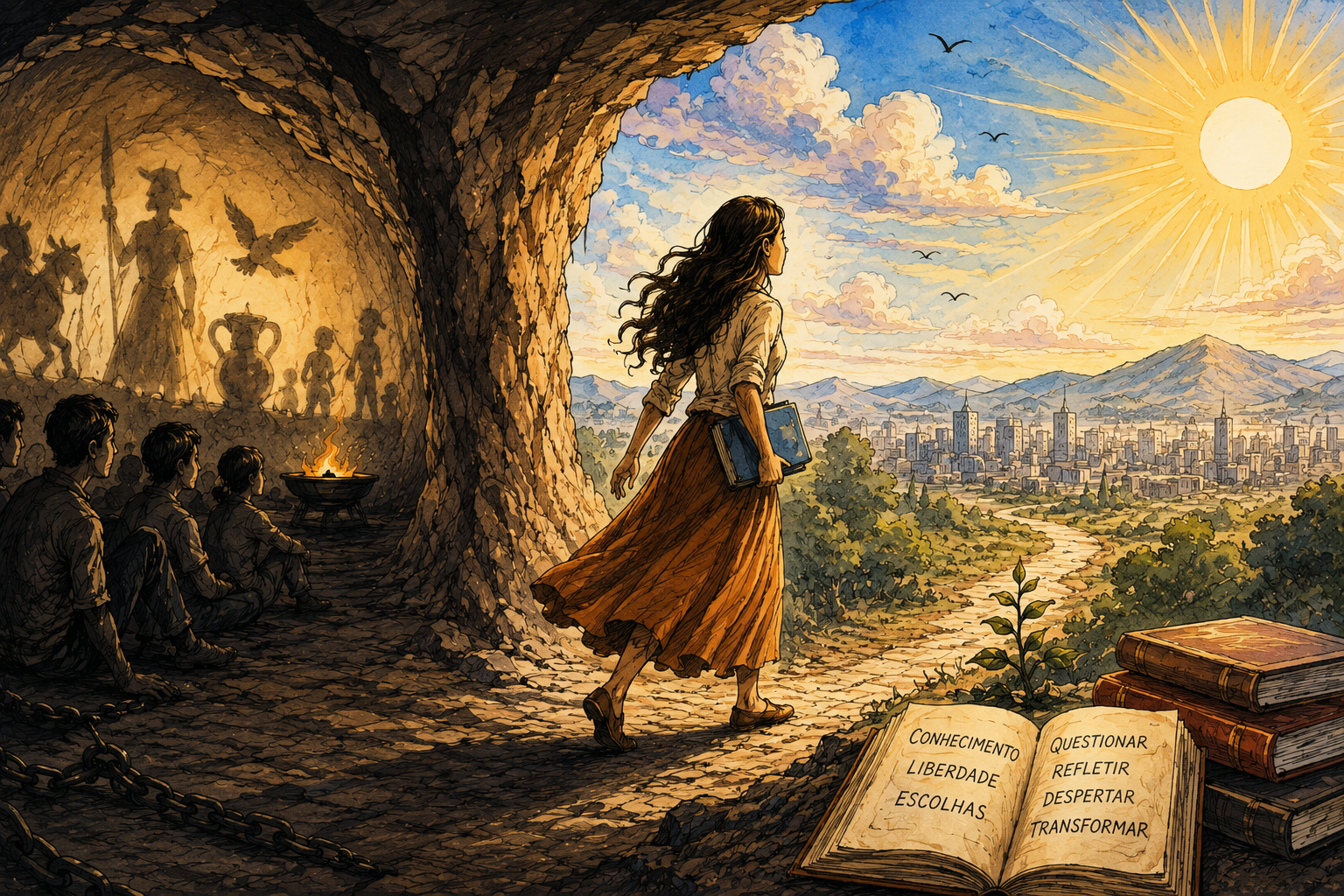
On consciousness, freedom, and the uneasiness of discovering that the world is larger than we were taught.
Curator’s note: Sophia, raised in a restrictive environment, discovers a wider world through a visiting cousin. Unlike her siblings, she feels a deep restlessness, leading her to leave her small town for the city, where she finds knowledge and possibilities in books. Ultimately, she learns to question societal boundaries, gaining freedom through awareness.
Sophia lived in a small town in the countryside, where the days seemed to repeat themselves.
She was the eldest daughter in a large family, eight voices competing for space inside a cramped home. From an early age, she learned to observe more than she spoke. Silence was her first school.
She had little formal education; her intelligence, however, had always been there, awake and alert. What she lacked was permission to use it. Even so, she read everything that fell into her hands: forgotten scraps of paper, labels, advertisements pasted on walls.
She read as though searching for cracks through which air could still pass.
She grew up in a dark universe, not because there was no light, but because there was no horizon. That home functioned like a cave: there, the world ended at its walls and at the commands of a strict father who believed discipline was a form of protection.
Education was not part of the rules. Dreaming was dangerous. Thinking beyond what was permitted was considered a transgression.
She and her siblings lived surrounded by invisible boundaries. They did not know how to name them, but they felt them in their bodies — silent chains tightening without causing wounds. Visitors were rare, and isolation seemed natural, almost like a destiny they had inherited.
Until the day a cousin from the capital walked through that door.
The difference was immediately apparent. It was not her clothes or the way she spoke — it was her eyes. Eyes that seemed to have traveled far and returned transformed.
The visitor spoke of places, choices, possibilities. She spoke of horizons that existed beyond that small world — horizons Sophia had never before dared to imagine.
At first, she felt afraid. Then curious. And then something new: a restlessness that did not hurt, but slowly began to burn.
Every word she heard awakened questions that asked no permission to exist.
When Mary left, she took more than their goodbyes with her.
She left behind a seed.
And inside Sophia, the ground was already ready.
Her siblings showed no interest. For them, the shadows were familiar and sufficient. They saw no reason to question what had always been presented to them as their destiny.
Sophia, however, could no longer inhabit her routine in the same way. Her spirit was a flame — and there was no way to extinguish the light burning inside her.
At night, she dreamed of roads, cities, unfamiliar voices. She began saving coins, small amounts earned from selling fruit and doing odd jobs, until one day, against her parents’ wishes, she bought a bus ticket and left.
As the bus pulled away from the town, her first revelation came: the universe was immense.
So full of light that it hurt her eyes. Its vastness frightened her. She felt small, out of place.
But wonder spoke louder — and her desire to discover became greater than her fear.
In the city, insecurity tried to hold her back. She thought about returning, going back to what was familiar, however narrow it might be.
But something inside her — now awakened — kept pushing her forward.
She found work as a cleaner at a school. One day, she walked into the library.
Standing before shelves filled with books, she understood that sleeping there were stories, ideas, and possibilities capable of breaking through any boundary.
Knowledge was a door — and once opened, no one could ever close it again.
She immersed herself in her studies. A year later, she returned to visit her family.
She needed to tell her siblings that the world was vast, that there were countless opportunities, that their home was not the only possible destiny.
But she had learned something else: there were chains in the big city, too.
Subtle rules, carefully designed systems, carefully calculated distractions.
She discovered that the media sometimes played the same story over and over, comfortably serving the maintenance of collective ignorance. That those in power created enough noise to keep people too busy to think.
And yet, something had changed forever.
She had learned to see beyond appearances.
She had learned to question — and to distrust ready-made truths.
To search for her own truth.
And once you see beyond the shadows,
you can never again become a prisoner.
This story was born from my desire to revisit Plato’s Allegory of the Cave through the language of fiction. More than retelling an idea, I wanted to give a human and tangible form to one of the reflections that has stayed with me most deeply: consciousness, freedom, and the price of seeing beyond the shadows.
https://digitalmehmet.com/author/rschumaher
Connect with me via my website, Medium, and LinkedIn


Leave a Reply