

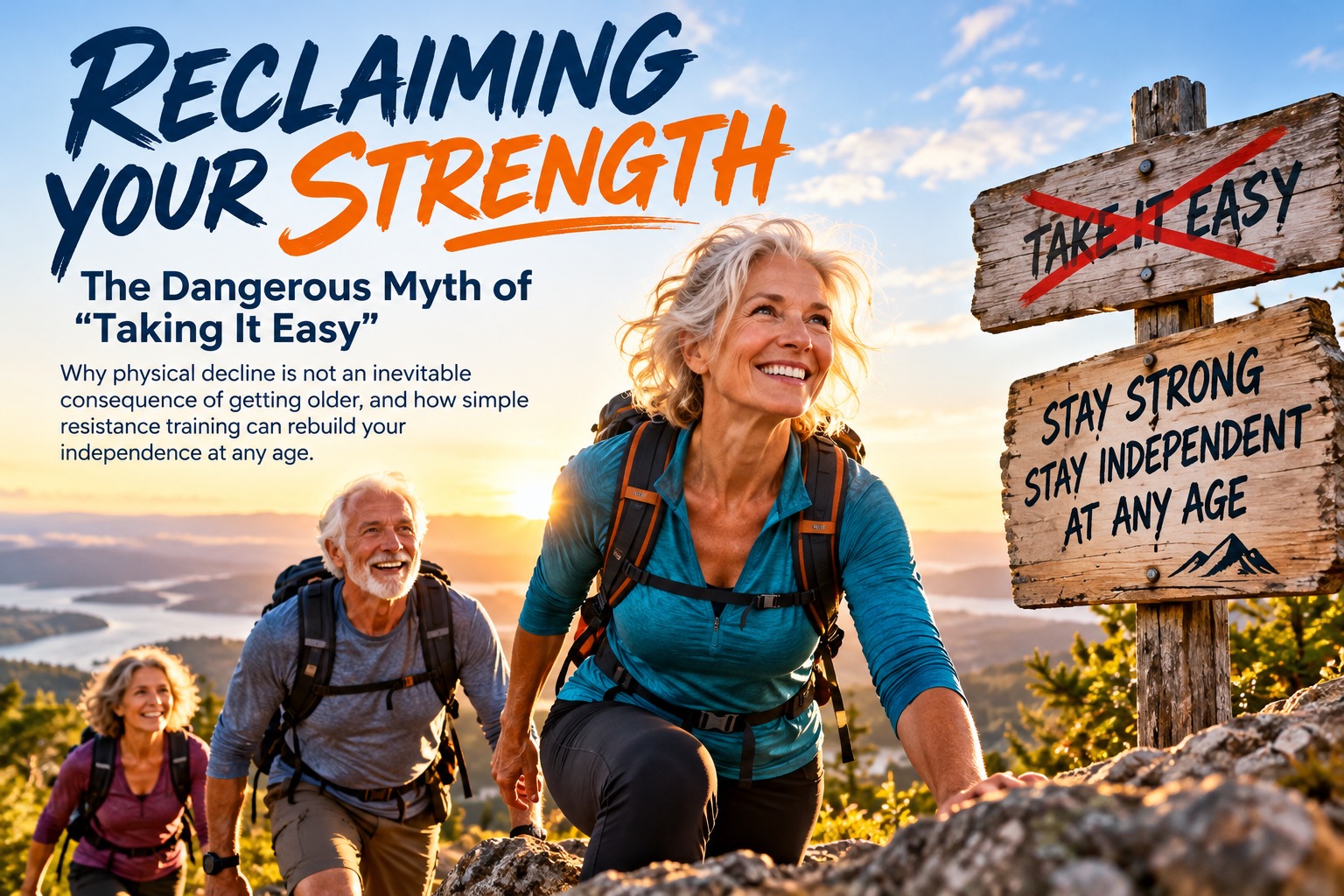
Why physical decline is not an inevitable consequence of getting older, and how simple resistance training can rebuild your independence at any age.
Curator’s Note: Aging does not inevitably lead to physical decline; rather, chronic inactivity often drives it, as Gary L. Fretwell emphasizes. Cultural attitudes encourage avoiding physical activity, creating a cycle of muscle atrophy and loss of independence. Research, including a pivotal study by Dr. Maria Fiatarone, shows that resistance training, even in older adults, significantly boosts strength and mobility. Moderate physical activity is linked to better longevity and health outcomes. A positive mindset towards aging can enhance life expectancy. Simple actions, like sit-to-stands and routine walking, can help reclaim physical resilience, proving it is never too late to rebuild strength.
Cross out ‘take it easy.’ Your strength is waiting for you at any age.
Somewhere in midlife, an unspoken script quietly takes hold. Your knees feel a bit stiffer in the morning, recovery from yard work takes a day longer, and well-meaning friends or relatives urge you to dial things back. “You aren’t as young as you used to be,” the common wisdom whispers. “Be careful. Take it easy.”
It sounds like sensible, compassionate self-care. In reality, it is often a slow-motion trap.
In an incisive piece titled The Lie That Makes Us Weak, author Gary L. Fretwell argues that much of what we casually write off as biological aging is simply chronic disuse wearing a convincing disguise. We absorb the cultural conviction that bodily frailty is an inescapable fate. Because we expect decline, we move less; because we move less, our muscles wither; and as balance degrades, everyday life begins to feel dangerous. The vicious cycle tightens until basic independence slips away entirely.
The baseline biology of muscle atrophy is genuine. Starting around age 30, adults naturally lose between 3 and 8 percent of their skeletal muscle mass per decade, a rate that accelerates sharply once we cross the threshold of 60. This condition, medically known as sarcopenia, is the primary engine behind lost mobility, diminished vitality, and crippling falls. Data from the Centers for Disease Control and Prevention paints a sobering picture: one in four Americans aged 65 and older falls each year, making accidental falls the leading cause of injury and accidental death across that demographic.
Yet, as Fretwell makes clear through clinical history, this decline is neither mandatory nor irreversible.
Consider the groundbreaking 1988 clinical experiment conducted at a Boston nursing home by geriatrician Dr. Maria Fiatarone. Researchers gathered ten of the facility’s frailest residents, whose average age was 90. Most relied on canes, walkers, or wheelchairs just to navigate the hallways. The researchers prescribed an intervention that initially sounded reckless: high-intensity resistance training on weight machines, three times per week.
Eight weeks later, the results stunned the medical establishment. Strength among the participants who completed the trial surged by an average of 174 percent. Thigh muscle mass visibly expanded. Heel-to-toe walking velocity jumped by nearly 50 percent, and several participants discarded their walking canes altogether. A subsequent 1994 randomized trial published in the New England Journal of Medicine confirmed the finding across 100 nursing home residents: participants gained over 113 percent in leg strength, climbed stairs with renewed power, and moved spontaneously throughout the day, while a control group receiving only nutritional supplements saw no meaningful improvement.
The conclusion is striking: our muscular system never stops listening to mechanical load. Whether an individual is 45 or 90, muscle tissue operates on an unyielding biological rule: use it or lose it, and challenge it again to rebuild it.
The longevity dividends of physical strength reach far beyond personal pride or physical appearance. A landmark 2022 meta-analysis published in the British Journal of Sports Medicine pooled data from 16 international studies and discovered that just 30 to 60 minutes of weekly muscle-strengthening activity correlated with a 10 to 20 percent drop in all-cause mortality, cardiovascular events, diabetes, and total cancer incidence. Meanwhile, a comprehensive 2018 study in JAMA Network Open evaluating over 122,000 patients revealed that poor cardiorespiratory fitness carries an early mortality hazard rivaling or exceeding cigarette smoking, hypertension, and coronary artery disease.
Crucially, your psychological outlook guides the outcome. Yale psychologist Dr. Becca Levy tracked hundreds of older adults over two decades and found that individuals holding positive perceptions of aging lived roughly 7.5 years longer than those with fatalistic, negative views. When people expect physical frailty, they behave passively, and their physiology dutifully conforms to that low expectation.
Fortunately, reclaiming physical resilience does not demand living in an athletic facility or lifting massive barbells. The most dramatic survival gains occur when transitioning from total inactivity to modest, consistent physical stress:
- Stand up with intent: Practice five slow sit-to-stands from a firm chair without using your hands for support.
- Carry deliberate loads: Pick up loaded grocery bags, heavy laundry baskets, or water jugs to challenge your grip and core posture.
- Add steady volume: Strive for an extra 1,000 to 2,000 steps daily, aiming for the 6,000 to 8,000 range shown to reduce all-cause mortality in older adults.
- Train dynamic balance: Stand on a single foot while brushing your teeth, keeping a countertop nearby for light balance checks.
Passive rest is not the safe path forward. Prolonged inactivity is the genuine hazard. You are never too old to rebuild functional power; you are merely out of practice. Start with five clean sit-to-stands today, and remind your body of what it is still capable of doing.
About the Author:
Gary L. Fretwell spent 43 years in higher education consulting, working with nearly a thousand institutions before retiring to Prescott, Arizona.
He is a #1 international best-selling author blending neuroscience with Stoic philosophy to help people build a life of lasting significance.
He’s the author of eight books on intentional living and retirement, including the #1 bestseller The Magic of a Moment,The Identity Ghost: Ancient Wisdom, Modern Neuroscience, and the Architecture of an Intentional Life and Intentional Retirement.
His newest book, The Liking Gap: The One Bias That’s Quietly Sabotaging Every Relationship You Have, unpacks the psychological blind spots that trigger social second-guessing and shows how to build effortless, genuine connections. Available for Pre-Order and will be released on November 3.
On Medium, Gary founded and edits Illumination: Retirement, Aging & Legacy and 9 other publications.
📖 garyfretwell.com · 📬 The Wise Effort on Substack · ✍️ Follow-on Medium · 📺 Follow-on YouTube


Leave a Reply