

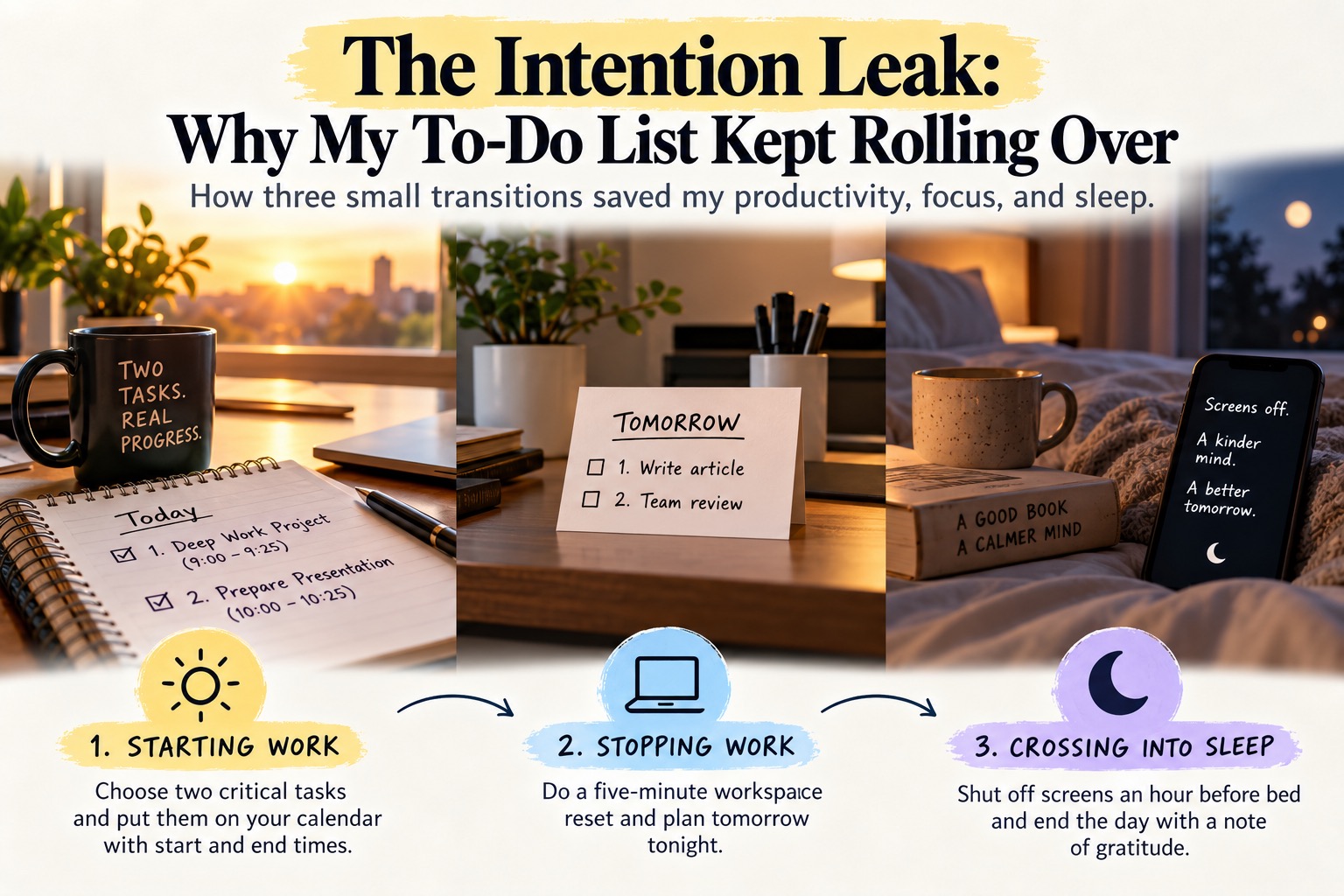
How three small transitions saved my productivity, focus, and sleep.
Curator’s Note: The essay by Gary L. Fretwell discusses how three intentional transitions can significantly enhance productivity, focus, and sleep by addressing the “intention-action gap.” The author identifies these transitions as starting work, stopping work, and crossing into sleep. To start work effectively, he advises focusing on two key tasks each day and setting firm time limits. For stopping work, he suggests a workspace reset and planning the next day’s priorities to reduce cognitive load. Lastly, for better sleep, he recommends disconnecting from screens an hour before bed and expressing gratitude. By protecting these edges, productivity and mental clarity improve throughout the day.
Productivity isn’t lost in the middle of the day. It leaks at the edges. Three intentional transitions can turn unfinished tasks into greater focus, calmer evenings, and better sleep.
About six months ago, I found myself sitting in my home office confronting an exhausting, quietly demoralizing ritual. I looked down at my digital task manager. Then I turned my head toward my leather notebook. Finally, I stared at the magnetic whiteboard mounted right beside my desk.
Three separate tools, yet all three told the exact same story. Every single afternoon, I was dragging ten to fifteen unfinished projects forward to “today.” And looking back, I had performed the exact same ritual yesterday, and the day before that.
The applications were not broken. The paper notebook was fine. The dry-erase board was doing its job. I had three functional systems and one quiet habit of giving myself permission to abandon my intentions.
Psychologists call the chasm between our plans and our actions the intention-action gap. For years, I assumed my gap lived right in the noisy middle of the workday, swallowed up by sudden emergencies, unscheduled phone calls, and incoming messages. But when I paid close attention to where my discipline actually slipped, I noticed something surprising.
My day was not unraveling in the middle. It was leaking at the edges.
The edges are the quiet thresholds of our schedule: how we transition into focused work, how we power down at the end of the afternoon, and how we cross the bridge into deep sleep. Each edge represents an intersection where momentum can easily slip away. When I set up firm guardrails around those three specific moments, the rollover stopped.
The First Edge: Starting Work
A to-do list with fifteen items is not a working strategy. It is merely a wish list with a date stamped at the top.
Gathering an endless inventory of tasks is often an unconscious way to evade the difficult work of prioritization. Choosing what truly matters requires friction, while writing down everything we might possibly accomplish feels productive without demanding a hard decision.
To break that cycle, I abandoned the endless list and embraced calendar containers. Every morning, I pick just two meaningful tasks. I ask myself a straightforward question: Which two items will genuinely move a client, a project, or another human being forward today?
Once selected, each task receives an explicit start time and, crucially, an immovable end time directly on my calendar. The finishing time matters every bit as much as the start time. When a project is permitted to sprawl without boundaries, it automatically expands to fill every minute available.
Inside those calendar blocks, I work in focused twenty-five-minute sprints. Every unrelated browser tab is shut, and incoming alerts are silenced. A simple kitchen timer achieves what pure willpower rarely can: it turns open-ended dread into a finite sprint. Starting becomes frictionless when you can plainly see the finish line.
The Second Edge: Stopping Work
For a long time, my workday concluded whenever I felt too exhausted to stare at the screen. I would stand up, walk away, and leave behind an untamed desktop. Unsurprisingly, my mind refused to disconnect.
To create an intentional stopping point, I implemented two practical evening anchors:
- The five-minute workspace reset: Right before stepping away from the desk, I file loose documents, return reference books to their shelves, and close every browser window. Walking into a cluttered workspace the following morning forces you to inherit yesterday’s mental baggage before you have even taken your first sip of coffee. Clearing the surface provides an immediate gift of calm to tomorrow’s version of you.
- Planning tomorrow tonight: Once the desk is tidy, I grab an index card and handwrite my top two priorities for tomorrow morning. In a well-known 2011 study, researchers E. J. Masicampo and Roy Baumeister discovered that our brains do not demand that we finish every lingering task to stop obsessing over it. Simply forging a clear, specific plan for when and how the task will be addressed quiets cognitive nagging. Placing those two items on an index card tells my brain that tomorrow is handled, freeing my evening from work-related anxiety.
The Third Edge: Crossing Into Sleep
How you conclude the night directly determines the cognitive clarity you bring to the following morning.
First, I disconnect from every glowing screen a full hour before bed. The science here is unequivocal: research published in the Proceedings of the National Academy of Sciences demonstrates that light-emitting screens disrupt the body’s natural melatonin curve, lengthen the time needed to fall asleep, and diminish morning alertness compared to reading physical print. I leave my devices plugged in inside my office and switch to a paperback novel.
Second, I send a short note of appreciation to someone in my life every evening. It might be a text to a former colleague, a word of encouragement to a student, or a quick note to an old friend.
Studies by Amit Kumar and Nicholas Epley show that we systematically underestimate how deeply people appreciate unexpected gratitude. Ending the night this way creates a quiet emotional shift. It takes my final thoughts off my personal checklist and replaces self-criticism with genuine connection.
Building Your Own Floor
Life will inevitably disrupt your best intentions. During chaotic travel days or high-stress deadlines, I do not abandon these edges; I simply lower the floor. Two tasks become one brief focus block. The desk reset shrinks to sixty seconds. The index card gets three handwritten words, and the gratitude note becomes a single appreciative sentence.
A smaller version preserves the momentum without forcing you into an all-or-nothing mindset.
Morning routines receive endless praise in modern culture, but real daily momentum is forged at the bookends. Protect the edges, and the middle will largely take care of itself.
Read the complete original essay on Medium:https://medium.com/illumination/the-day-is-won-or-lost-at-the-edges-3b4d13c8ca4d?sk=120d698c7b99d088ce5998884981b2ef
About the Author:
Gary L. Fretwell spent 43 years in higher education consulting, working with nearly a thousand institutions before retiring to Prescott, Arizona.
He is a #1 international best-selling author blending neuroscience with Stoic philosophy to help people build a life of lasting significance.
He’s the author of eight books on intentional living and retirement, including the #1 bestseller The Magic of a Moment,The Identity Ghost: Ancient Wisdom, Modern Neuroscience, and the Architecture of an Intentional Life and Intentional Retirement.
His newest book, The Liking Gap: The One Bias That’s Quietly Sabotaging Every Relationship You Have, unpacks the psychological blind spots that trigger social second-guessing and shows how to build effortless, genuine connections. Available for Pre-Order and will be released on November 3.
On Medium, Gary founded and edits Illumination: Retirement, Aging & Legacy and 9 other publications.
📖 garyfretwell.com · 📬 The Wise Effort on Substack · ✍️ Follow-on Medium · 📺 Follow-on YouTube


Leave a Reply