

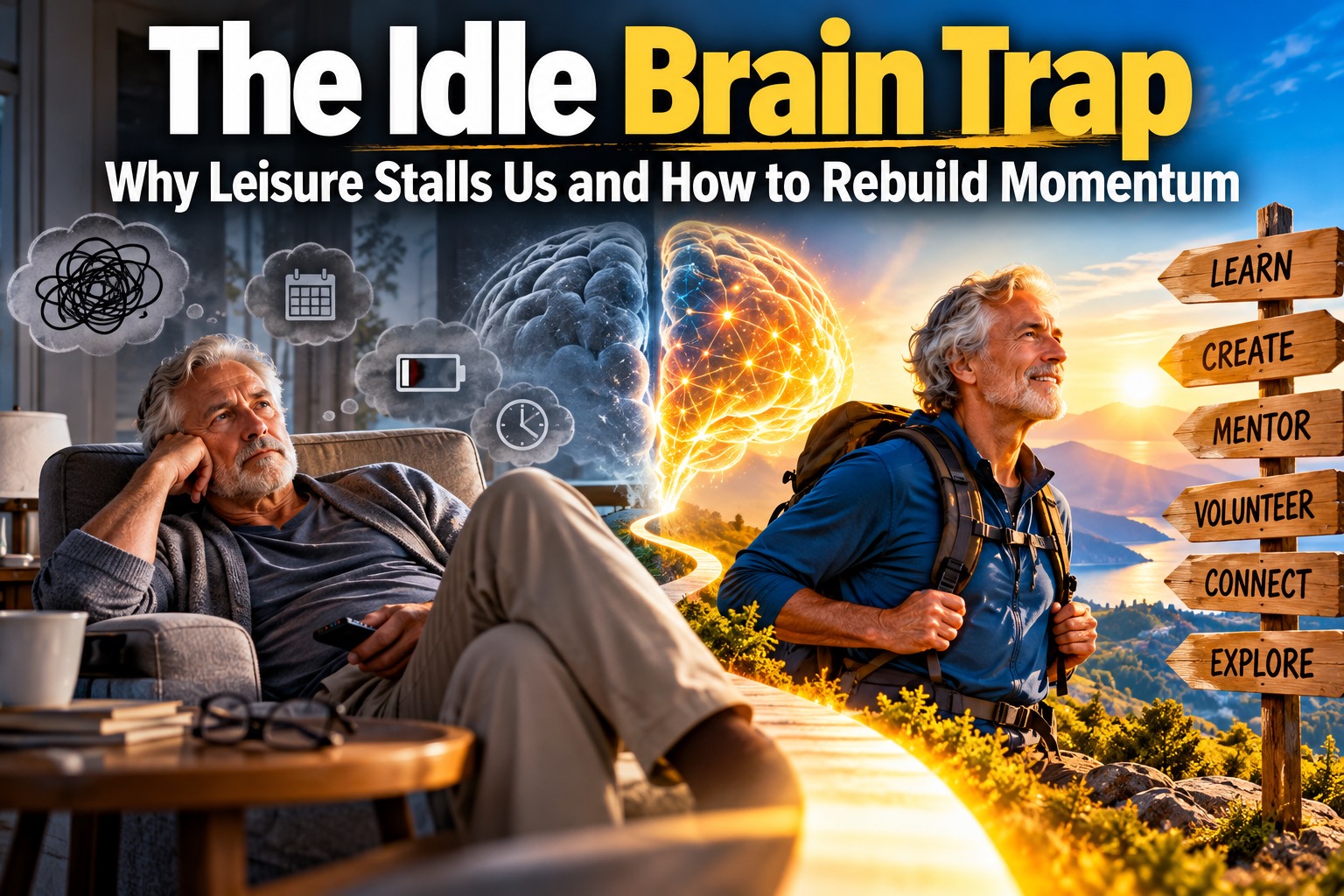
Endless free time does not recharge your mind. It removes the resistance that keeps you sharp, grounded, and alive.
Curator’s Note: Endless free time in retirement can lead to mental stagnation, rather than rejuvenation. Many envision retirement as a period of leisure, but it often leads to declining mental sharpness and a loss of purpose. As social interaction and cognitive challenges diminish, feelings of anxiety and loss of momentum can set in. To combat this, individuals should build structure by creating morning routines, pursuing creative interests, and fostering accountability through community involvement. Retirement shouldn’t mean passivity; instead, it offers a unique chance to shape one’s attention and purpose for a fulfilling life ahead.
Retirement doesn’t have to mean slowing down. Replacing passive leisure with purpose, challenge, and connection can reignite mental energy and restore momentum.
We spend decades envisioning retirement as the ultimate prize. We picture lazy mornings on the porch, open golf courses, unhurried travel, and an empty calendar. We obsess over the numbers, the portfolios, and the withdrawal rates, convinced that financial independence automatically yields peace of mind.
Then the quiet shock arrives.
For many high-performing adults, the shift happens around month six. The initial celebration wears off, replaced by a subtle mental fog. A low hum of anxiety begins to surface. Energy dips, days run together, and an uncomfortable question creeps in: Is this really all there is?
When this happens, the default reaction is self-blame. We assume we are losing our edge or simply feeling the inevitable march of old age.
That diagnosis is almost always wrong. You did not age a decade in six months. What you are experiencing is an acute crisis of under-demand.
The Hidden Cost of Lost Friction
A demanding career provides an invisible scaffolding. Deadlines, high-stakes decisions, and collaborative friction force the brain to remain vigilant, active, and organized. When you step away from the workforce, that scaffolding collapses instantly across three vital fronts:
First, your social frame contracts. Hallway chats, team lunches, and casual camaraderie disappear with the job title.
Second, your cognitive load plummets. The brain is an energy-conserving organ. Without complex problems to solve, it downshifts, leaving your thinking sluggish.
Third, your structural anchors evaporate. When you no longer have an external schedule, a Tuesday afternoon feels identical to a Saturday morning. Without external resistance, internal momentum quietly drains away.
Treating the brain like an athlete clarifies the issue. If an elite runner stops training entirely, conditioning quickly fades. Nobody blames natural aging when their legs feel weak after months on the couch. The exact same principle applies to your mind.
Designing Deliberate Structure
Endless leisure does not relax the human brain; it starves it. The cure is not booking another vacation or returning to work you have outgrown. The solution lies in building intentional friction back into your days.
Here are three practical anchors to regain your footing:
1. Anchor the morning. Wake up at a steady hour, step outside for natural light, and accomplish a single, non-negotiable mental task before noon. Early focus creates momentum that carries through the rest of the day.
2. Choose your friction. Passive consumption numbs the mind. Replace it with creation. Write, mentor, take on a craft, or tackle an unfamiliar subject. Embracing the discomfort of being a novice again is what keeps neural pathways growing.
3. Ensure someone is waiting on you. Mutual accountability is the ultimate antidote to stagnation. Join a volunteer effort, take on a team project, or commit to a community where your absence is noticed and felt.
Custody of Your Attention
Retirement is not a passive waiting room where you run down the clock. It is the very first time in your adult life where you hold total custody of your own attention.
The way you invest that attention determines your vitality, mental clarity, and purpose for the decades ahead.
Read the full deep-dive and watch the accompanying video here:https://medium.com/illumination-retirement-aging-legacy/the-retirement-shock-nobody-warns-you-about-f39551887cf3?sk=24f68bf56c55be278709992412fabc91
Want the full conversation? Watch the video :The Psychological Shock of Retirement Nobody Warns You About
About the Author:
Gary L. Fretwell spent 43 years in higher education consulting, working with nearly a thousand institutions before retiring to Prescott, Arizona.
He is a #1 international best-selling author blending neuroscience with Stoic philosophy to help people build a life of lasting significance.
He’s the author of eight books on intentional living and retirement, including the #1 bestseller The Magic of a Moment,The Identity Ghost: Ancient Wisdom, Modern Neuroscience, and the Architecture of an Intentional Life and Intentional Retirement.
His newest book, The Liking Gap: The One Bias That’s Quietly Sabotaging Every Relationship You Have, unpacks the psychological blind spots that trigger social second-guessing and shows how to build effortless, genuine connections. Available for Pre-Order and will be released on November 3.
On Medium, Gary founded and edits Illumination: Retirement, Aging & Legacy and 9 other publications.
📖 garyfretwell.com · 📬 The Wise Effort on Substack · ✍️ Follow-on Medium · 📺 Follow-on YouTube


Leave a Reply