

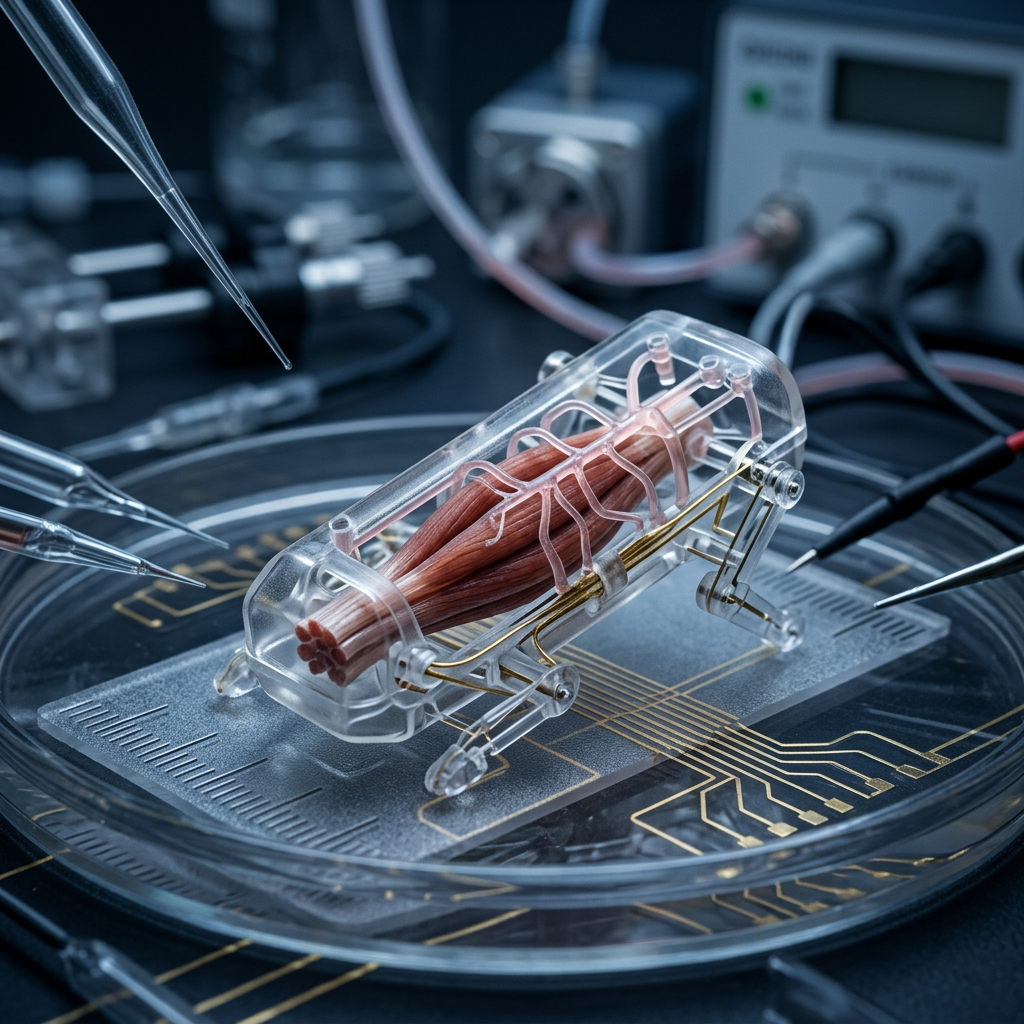
At the intersection of biology, robotics, and medicine, scientists are building machines powered by living tissue. The technology is still in its infancy, but its implications reach far beyond the laboratory.
Curator’s Note: Scientists are exploring biohybrid robotics, which combines living tissue with engineered materials to create machines that utilize biological muscle for movement instead of electric motors. While still in early development, these technologies could have far-reaching implications in medicine, rehabilitation, and human-machine interaction. Recent research from ETH Zurich highlighted miniature robots powered by living muscle tissue, showcasing enhanced movement capabilities. However, significant challenges remain, such as sustaining living tissue and ensuring compatibility with artificial components. The future of biohybrid robotics is in effectively integrating biology and engineering, potentially transforming applications in healthcare and beyond while addressing ethical concerns. This story was written by Dr. Michael Broadly, a retired scientist and technology advisor to scientists.
When a machine moves because muscle contracts
Now, I invite you to imagine a machine that doesn’t rely on an electric motor to move its limbs, but on living muscle. It doesn’t just imitate the movements of an animal. It borrows one of nature’s most remarkable inventions: biological tissue that converts chemical energy into mechanical force.
This isn’t a scene from a science-fiction blockbuster. Researchers are already developing machines that combine living muscle cells with engineered materials, creating a new class of technology known as biohybrid robotics.
Early prototypes are tiny, fragile, and dependent on carefully controlled laboratory conditions. Nobody is about to replace a hospital nurse with a muscle-powered robot, nor are we on the verge of growing artificial humans in a laboratory. Yet something significant is happening at the intersection of biology, materials science, and robotics.
For centuries, engineers have borrowed ideas from nature. Aircraft took inspiration from birds, underwater vehicles from fish, and robotic limbs from the human body’s mechanics. Biohybrid robotics takes this relationship a step further. Instead of simply copying biological design, researchers are beginning to incorporate living biological components into machines themselves.
That raises a question worth considering: if tomorrow’s machines can contain living tissue, how might this change the future of medicine, rehabilitation, and human-machine interaction?
A tiny leap with a surprisingly big message
A fascinating example emerged from ETH Zurich in October 2026. Researchers developed miniature biohybrid robots powered by living skeletal muscle tissue grown from mouse cells and integrated with a soft, water-rich material called hydrogel.
Their findings, published in Nature Communications, demonstrate how much the arrangement of muscle and artificial material matters. Rather than designing the muscle first and constructing its supporting structure afterwards, the team used computer simulations to optimise both components together.
The resulting muscle actuators, approximately 1.5 centimetres long, achieved a range of motion up to eleven times greater than earlier systems containing a comparable amount of muscle tissue. One prototype jumped approximately five millimetres following a single contraction. Others demonstrated walking, swimming and grasping movements.
For a creature of that size, a five-millimetre jump is quite an achievement. For an engineer, the more important discovery lies in understanding how the living and artificial components work together.
Muscle contraction alone does not guarantee useful movement. Force must transfer efficiently to a supporting structure, whose geometry determines how that force becomes motion. The ETH Zurich team used computer-aided design and a specialised three-dimensional printing technique to engineer this interaction.
In other words, the breakthrough wasn’t simply adding more muscle. It was learning how to make the muscle and its artificial partner function as one system.
The distinction matters because it illustrates a broader principle of biomedical engineering: biological performance depends not only on the properties of individual tissues but also on their architecture and interaction with their surroundings.
The original research is available here: Balciunaite A, Michelis MY, et al. (2026), Co-optimized volumetric muscle design for large dynamic deformations in versatile biohybrid robots. Nature Communications, 17, 10732. DOI: 10.1038/s41467-026-77655-1.
What exactly is a biohybrid robot?
The term sounds technical, but its meaning is straightforward. A biohybrid robot combines living biological components with engineered materials to produce a functional system.
The biological component might be skeletal muscle, cardiac muscle or, in other experimental designs, living cells capable of responding to environmental signals. The artificial component may include a flexible scaffold, sensors, electrodes, microelectronics or other structures that support and control movement.
Think of the arrangement as a partnership. Biology supplies some of the functions, while engineering provides the architecture and the means of controlling them.
Conventional robots generally use electric motors, hydraulic systems or other mechanical actuators. These can be powerful, reliable and precisely controlled. However, rigid components may be unsuitable for some tasks requiring delicate contact, flexible movement or adaptation to changing environments.
Living muscle offers a different set of properties. It contracts, responds to stimulation and can operate as part of a soft structure. Researchers hope to exploit these characteristics to create machines capable of interacting more gently with their surroundings.
A review by Webster-Wood and colleagues in Bioinspiration & Biomimetics examines the rapid development of biohybrid robots and the challenges that remain before they can become autonomous, practical systems.
The field is broader than muscle-powered machines. Some researchers investigate microorganisms, living sensory cells and biological components that respond to chemical or physical signals. Nevertheless, tissue-engineered muscle is particularly interesting because it offers a direct way to generate mechanical force.
There is a useful distinction here. A robot made from artificial materials that imitates a human hand is biomimetic. A robot that incorporates living muscle tissue to move its components is biohybrid. The latter doesn’t merely copy biology; it recruits biology to do part of the work.
Why not simply build a better electric motor?
That is a fair question, especially for engineers who have spent careers improving mechanical efficiency, precision, and reliability.
Electric motors already outperform biological muscle in many applications. They can generate substantial power, run for long periods with proper maintenance, and be controlled with impressive accuracy. There is no compelling reason to replace them wholesale with living tissue.
Biohybrid robotics appeals because different applications have different requirements.
A machine designed to handle delicate biological samples, manipulate fragile tissues or move through a confined environment may benefit from compliant structures and biologically derived functions. Living components may also offer opportunities to study how cells respond to mechanical forces, electrical stimulation, and changes in their environment.
But we should be careful with claims about energy efficiency. Muscle is remarkably efficient in biological contexts, yet a biohybrid system’s overall performance must account for the energy and infrastructure required to maintain living cells. A device that depends on a nutrient supply, temperature regulation, and laboratory equipment cannot be compared with an electric motor by looking only at muscle contraction.
The real question isn’t whether living muscle is universally superior. It is whether combining biological and engineered systems can solve particular problems better than existing technology. That is a more modest claim, but a much more scientifically useful one.
The medical possibilities: where the story gets interesting
For readers interested in health and aging, the most compelling question is what this technology might eventually contribute to medicine.
We must distinguish between applications already demonstrated in laboratory research and clinical benefits that remain hypothetical. Biohybrid robotics is an emerging field, not an established treatment platform.
Nevertheless, several research directions deserve attention.
Rehabilitation and assistive technology
Researchers are investigating soft robotic devices for rehabilitation, movement assistance, and physical interaction with the human body. Biohybrid approaches could eventually offer new ways to generate adaptable forces or study muscle function.
Imagine a future device that helps a patient practice a carefully controlled movement after injury. Its soft structure might be engineered to respond to changing resistance rather than imposing a rigid movement pattern.
That is a research vision, not a claim that living muscle-powered rehabilitation devices are ready for clinical use. Conventional powered exoskeletons and rehabilitation robots already exist, but their capabilities should not be confused with those of experimental biohybrid prototypes.
Understanding muscle disease and aging
An especially promising direction may be less glamorous than a walking robot but more immediately relevant to health science.
Engineered muscle tissues can serve as experimental models for investigating muscle contraction, cellular responses and disease mechanisms. Researchers can study how tissues behave under controlled conditions and explore how candidate treatments affect their function.
This could help scientists investigate aspects of muscle weakness and age-related loss of function. However, a laboratory-grown muscle construct does not reproduce the full complexity of an ageing human body, with its nervous system, circulation, hormones, immune responses and other interacting processes.
Even so, better experimental models could help researchers ask more precise questions about muscle biology and evaluate some treatments before moving to more complex studies.
Drug testing and tissue engineering
Biohybrid systems may also help researchers investigate how living tissues respond to drugs and physical stimulation. Muscle constructs that contract in response to controlled signals could provide useful measurements of tissue performance.
The broader opportunity is to integrate tissue engineering with robotic platforms, allowing biological materials to function as both experimental models and active components.
Ritu Raman’s review, Biofabrication of Living Actuators, published in the Annual Review of Biomedical Engineering in 2024, examines this growing intersection between engineered tissues and functional machines.
DOI: 10.1146/annurev-bioeng-110122-013805.
These possibilities are worth watching, but we should resist the temptation to jump from a successful laboratory demonstration to promises of better patient outcomes. Clinical translation requires independent evidence of safety, effectiveness, durability and practical value.
The biological catch: keeping the machine alive
Here is where the futuristic vision meets the hard realities of physiology.
A conventional electric motor can be switched off, stored, and restarted later. Living muscle is rather less accommodating. It requires suitable conditions to remain viable and functional.
The ETH Zurich prototypes currently depend on a nutrient solution to sustain their muscle tissue. For larger systems, researchers would need ways to deliver oxygen and nutrients throughout the tissue and remove metabolic waste.
In living organisms, the circulatory system performs these functions through an intricate network of blood vessels. Reproducing an effective artificial vascular supply for engineered tissues remains a substantial challenge.
Researchers must also address the variability of living cells. Two muscle constructs manufactured using similar procedures may not behave identically. Their development, maturity, and responses to stimulation can differ.
Then there is durability. How long can a biohybrid actuator function before its performance deteriorates? Can it withstand repeated contractions? How reliably can its movement be controlled? Can the biological and artificial components remain securely connected?
These aren’t minor technical details to be tidied up after the exciting discoveries. They are central to determining whether the technology will ever become practical outside a laboratory.
And if a device is intended for medical use, additional questions arise about contamination, immune compatibility, tissue sourcing, and material safety.
Biology offers extraordinary capabilities, but it also brings biological constraints. Engineers will have to accommodate both.
Are we creating living machines with minds of their own?
The phrase living robot is guaranteed to attract attention. It may also encourage misunderstandings.
A machine containing living muscle is not necessarily conscious, intelligent or capable of experiencing sensations. Muscle tissue can contract in response to stimulation without possessing the integrated neural processes associated with conscious experience.
Nevertheless, some researchers are exploring systems that combine biological components with sensors and electronic control. Future work may investigate more complex interactions between neurons, muscle and artificial systems.
This raises legitimate questions about how we define biological function, autonomy and intelligence. It does not justify assuming that a tissue-engineered robot has feelings or awareness.
The ethical considerations are important even without such speculation. Where do the cells come from? What animal-derived materials are used? How should researchers evaluate the welfare implications of the source tissue? What safeguards are appropriate when human cells or more complex neural components are involved?
The answers will depend on the specific technology. A mouse-cell muscle actuator raises different ethical questions from a system incorporating human-derived neural tissue.
Responsible innovation requires these distinctions rather than treating every biohybrid device as though it belonged to the same moral category.
Looking towards 2040: prediction without crystal-ball science
What might biohybrid robotics look like in the next decade or two?
It would be tempting to picture humanoid machines walking around hospitals with artificial skin, living muscles and human-like reflexes. Such an image might make a cracking science-fiction illustration, but it would be a poor scientific forecast. A more credible possibility is gradual progress in specialized applications.
Researchers may develop more reproducible muscle constructs, better methods for stimulating and controlling them, improved artificial scaffolds, and more effective ways to sustain living tissues. Some systems may become useful as laboratory platforms for drug testing, disease modeling or investigations into tissue function.
Other biohybrid devices might eventually find applications in soft robotics or specialized biomedical technologies, provided they can overcome challenges in reliability, control, maintenance, and safety.
Integrating living components with electronics could also enable more sophisticated responses to environmental signals. Yet complex autonomous behavior will require advances well beyond making a muscle contract or a tiny robot jump.
We should not attach confident dates to breakthroughs when the underlying obstacles remain unresolved. Scientific progress rarely follows a tidy timetable, and successful laboratory demonstrations do not guarantee commercial or clinical success.
The most useful forecast is therefore conditional: if researchers can improve tissue longevity, vascularisation, control and reproducibility, a wider range of applications may become feasible. If those problems prove difficult to solve, the field may remain valuable primarily as a research platform.
Either outcome could teach us something important about the relationship between living systems and engineered machines.
The future is not just mechanical.
Biohybrid robotics reminds us that technological progress does not always mean replacing biology with increasingly sophisticated machinery.
Sometimes it means learning how to work with biological systems, using their properties while acknowledging their limitations.
The ETH Zurich study matters not because it brings us closer to artificial humans, but because it shows how carefully engineered interactions between living tissue and synthetic materials can produce substantially improved movement.
For health researchers, the broader opportunity lies in the questions this technology lets us investigate: how muscle generates force, how tissues respond to their environment, how engineered biological models can improve experiments, and whether living components can eventually perform useful tasks in carefully defined settings.
The challenges remain considerable. Living tissue is variable, vulnerable and demanding to maintain. Medical applications must meet standards far beyond those required for an impressive laboratory demonstration. Ethical considerations must develop alongside the technology, not trail behind it.
But the direction of travel is genuinely thought-provoking. For generations, we have built machines to imitate the movement and capabilities of living organisms. Now, researchers are beginning to integrate living components into machines themselves.
The most important question may not be whether robots will become more human. The key question is whether we can combine biology and engineering in ways that improve human health without confusing technological possibility with medical promise.
The next revolution in robotics may not come from making machines more human. It may come from discovering how much of biology we can responsibly bring into the machines we build. And that, fellow scientists, is a future worth examining with both curiosity and a healthy dose of skepticism. Here is an interesting news item related to this topic.
Thanks for reading my thoughts. Stay healthy and happy!
I started a new series called the World Is Fucked Up. Here are three stories that might entertain and educate you:
In a World F@cked Up, Here’s What Medical Gaslighting Taught Me About Public Health
The World Is F@cked Up: The AI Race Finally and Unsurprisingly Has Entered Its Industrial Espionage Era
If you are interested in sex, I have started a sex education series that might educate, inspire, or even entertain you. Here are the links to some sample stories:
The 8 Habits of Sexually Satisfied Couples With Any Sexual Orientation
When Your Libido Says “Come Here” and Your Partner Says “Not Tonight”
What Most People Were Never Taught About Female and Male Orgasm
The Neurobiology of Sexual Pleasure and Meaningful Human Connection.
Human Libido: What Most People Were Never Taught About Sexual Desire
Neurocognitive and Affective Differences Between Erotic and Pornographic Stimuli in the Brain [Warning: This one is scholarly!]
What Science Reveals About Anal Pleasure and Orgasm for Both Women and Men [Free access via my community blogs]
Cheers, Mike!
About Me
I’m a retired healthcare scientist in my early 80s now. I have several grandkids who keep me going and inspire me to write on this platform. I am also the chief editor of the Health and Science publication on Medium.com. As a giveback activity, I volunteered as an editor and content curator for Illumination publications, supporting many new writers. I will be happy to read, publish, and promote your stories. You may connect with me on LinkedIn, Twitter, and Facebook, where I share stories I read. You may subscribe to my account to get my stories in your inbox when I post. You can also find my distilled content on Substack: Health Science Research by Dr Mike Broadly.
Here is my latest curated collection: Mike’s Favorite Stories on ILLUMINATION Publications — #277
More stories in my reading list:
List: Reading list | Curated by Dr Michael Broadly, DHSc | Medium
My Favorite Articles Which I Published & Read · 7112 stories on Mediummedium.com


Leave a Reply