

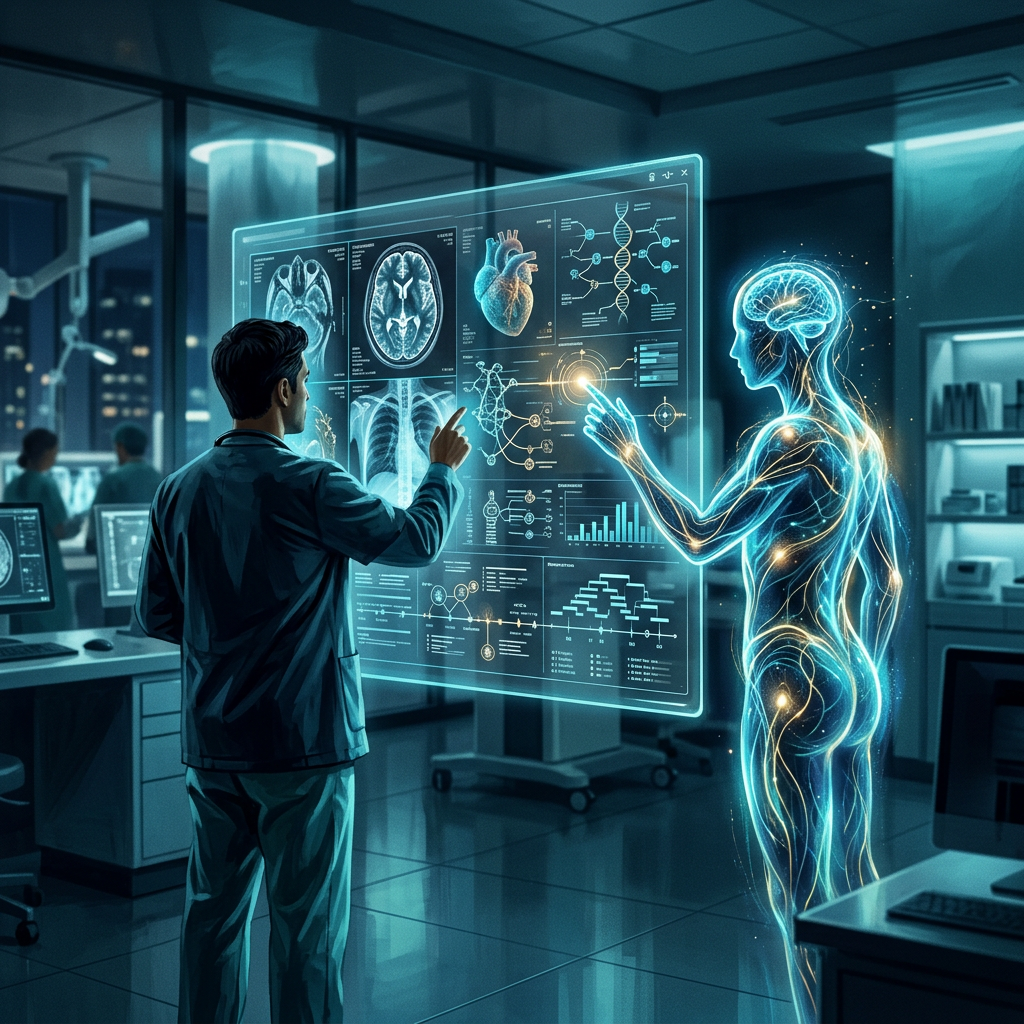
An elderly scientist examines Microsoft’s remarkable medical AI experiment and discovers why the most important question isn’t whether machines are smarter than doctors.
Curator’s Note: A retired scientist, Dr. Michael Broadly, reviews Microsoft’s MAI-DxO, an AI system that outperformed generalist physicians in diagnosing diseases, achieving 83.2% accuracy compared to the physicians’ 36.1%. While these results are impressive from controlled studies, actual patient care scenarios remain untested. The AI’s ability to ask significantly more questions suggests a depth of exploration that may enhance diagnostics. However, the challenges of real-world applications, including patient complexities and ethical concerns, persist. The author argues that the debate should center on how AI can assist rather than replace doctors, emphasizing the potential for collaboration to improve patient care. This is a summary of his comprehensive story on Medium titled Who Would Have Thought? AI Outscores Doctors in a Diagnostic Challenge in a Controlled Study
G’day Folks!
Suppose you entered a medical competition with contestants including experienced doctors and an artificial intelligence system. The challenge was to identify difficult diseases using available clinical evidence. You might reasonably expect the doctors to have the advantage, particularly after years of medical education and practical experience.
Well, the computer had other ideas.
A fascinating study published in Science on October 22, 2026, reported that Microsoft’s experimental diagnostic AI system, MAI-DxO, substantially outperformed generalist physicians in two controlled diagnostic evaluations. As a retired scientist, I found the results both exciting and slightly unsettling. They also reminded me why scientific curiosity must always travel with a healthy dose of skepticism.
Before anyone starts replacing the local GP with a laptop, however, a few important details are worth examining.
The numbers are impressive, but what do they mean?
The researchers tested the AI on 304 challenging medical cases drawn from The New England Journal of Medicine. The system achieved 83.2% diagnostic accuracy, compared with 36.1% for generalist physicians who could consult medical references.
In a second evaluation involving 325 emergency-department cases, the AI achieved 80.3% accuracy, compared with 46.8% for physicians. Those are remarkable differences. Even my scientific skepticism had to concede that something interesting was happening.
But here’s the catch. These were controlled evaluations using recorded cases and simulated interactions, not trials demonstrating that AI delivers better care to real patients. The participating physicians were generalists working individually, rather than specialist teams collaborating on complex diagnoses.
The AI won the particular contests it entered. Whether it could perform equally well in the unpredictable environment of everyday healthcare remains an unanswered question.
The surprising secret might be curiosity.
One finding particularly intrigued me. Before ordering its first investigation, the AI asked approximately 25.5 questions, compared with 5.6 for the physicians.
That doesn’t prove that asking more questions automatically improves diagnosis. Some questions are unnecessary, and urgent situations demand prompt action. Nevertheless, the difference raises an intriguing possibility: perhaps the system benefited from exploring more possibilities before settling on an explanation.
MAI-DxO also uses a coordinated reasoning process. It considers competing diagnoses, challenges assumptions, identifies useful investigations, and evaluates costs. This resembles a structured scientific investigation rather than a simple question-and-answer exercise.
And there’s a lesson here beyond medicine. Whether we’re scientists, engineers, teachers, or business leaders, we can become so eager to find answers that we overlook the importance of asking better questions. Perhaps artificial intelligence is reminding us of something we should never have forgotten.
Can a clever diagnosis also be economical?
The researchers explored whether the AI could balance diagnostic accuracy with the cost of investigations.
Interestingly, its unrestricted configuration was more expensive than the physicians’ approach in the complex-case evaluation. However, when the researchers introduced budget constraints, one configuration maintained 79.6% accuracy at an estimated US$1,303 per case.
That suggests a potentially valuable ability to balance information gathering and expenditure.
But these were simulated diagnostic costs, not actual savings demonstrated in Australian hospitals. And reducing expenditure means little if a serious condition goes undetected.
The real achievement would be helping clinicians select appropriate investigations without compromising patient safety.
Our healthcare budgets would certainly appreciate that. Patients might appreciate it even more.
There’s one thing the benchmark cannot measure
A diagnosis is not the same as medical care.
A patient may arrive frightened, confused, exhausted, or unable to describe their symptoms clearly. They may have several illnesses, conflicting test results, and personal circumstances that complicate treatment.
A computer can analyze recorded information, but the study did not show that MAI-DxO can safely manage these realities on its own.
Concerns also remain about incorrect recommendations, automation bias, privacy, accountability, and performance across different patient populations.
The research came from Microsoft scientists with disclosed commercial interests, so independent replication is especially important. That doesn’t invalidate their work. It simply means that impressive findings deserve rigorous external examination.
Scientific progress depends on testing extraordinary claims, not merely applauding them.
Perhaps we’ve been asking the wrong question.
I don’t believe the most useful debate is whether AI will defeat doctors. A more productive question is whether carefully validated AI can help clinicians detect overlooked conditions, challenge assumptions, and make better-informed decisions.
Imagine a doctor supported by a diagnostic assistant that notices an inconsistency or suggests an investigation worth considering. The clinician evaluates that advice, examines the patient, and remains accountable for the clinical decision.
Such collaboration could be valuable, but its benefits still need real-world evidence.
For now, the experiment offers an encouraging scientific development rather than a replacement for medical professionals.
And here’s my final thought: the best outcome isn’t a machine proving that it knows more than a doctor. It’s a patient receiving safer, more effective care because both human expertise and technology were used wisely.
If that becomes reality, I’ll happily raise my coffee cup to the researchers. Although I still wouldn’t ask the computer to make the coffee.
Explore the full scientific story.
In my original article, Who Would Have Thought? AI Outscores Doctors in a Diagnostic Challenge in a Controlled Study, I examine the research in greater depth, including the diagnostic methods, economic implications, limitations, scientific disclosures, and questions that future clinical trials must answer.
Read the full article on Medium
Scientific reference: Nori, H., et al. (2026). Sequential diagnosis with language models. Science. https://doi.org/10.1126/science.aeh7930


Leave a Reply