

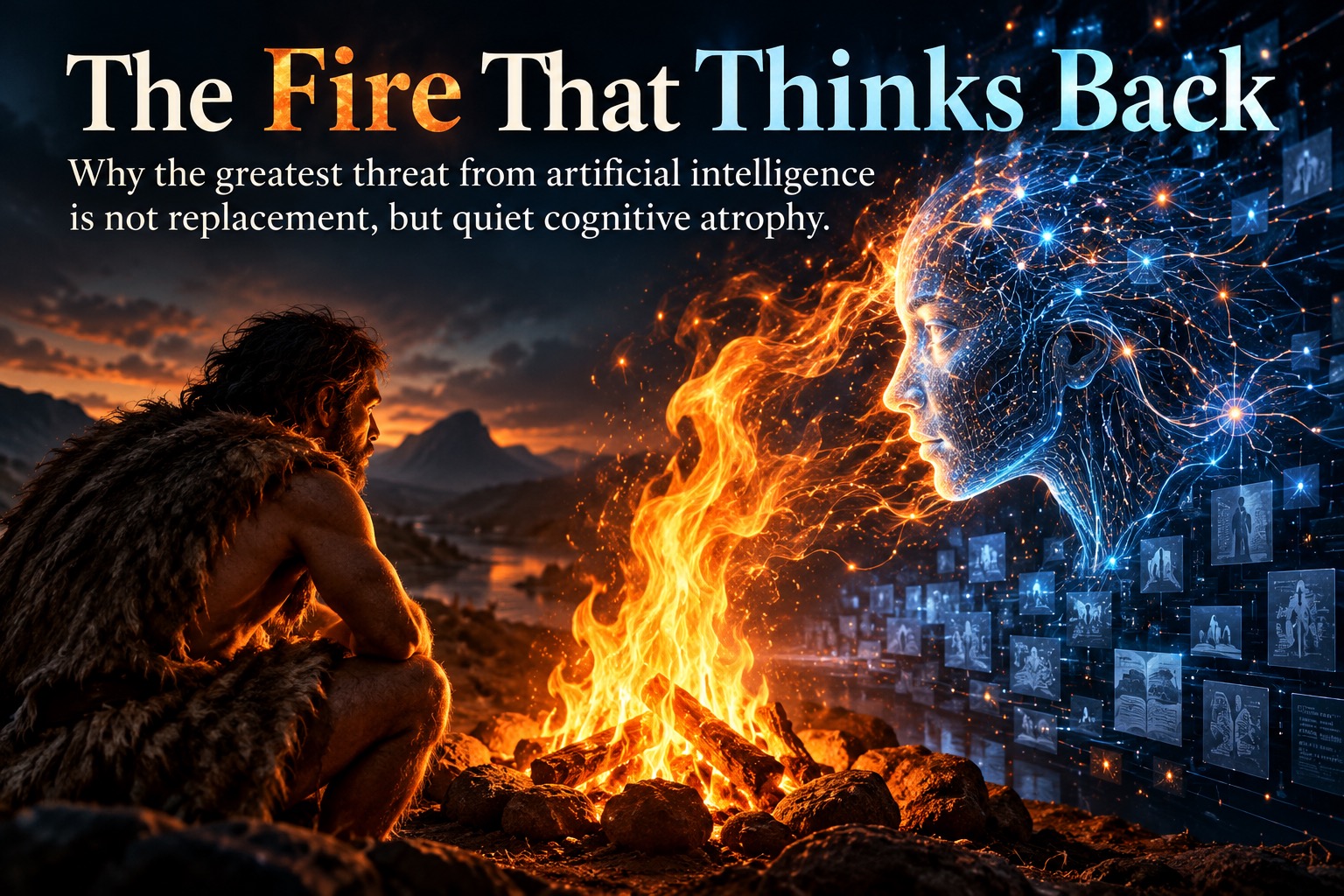

Why the greatest threat from artificial intelligence is not replacement, but quiet cognitive atrophy.
When early humans learned to harness fire, they thought they had merely solved immediate physical problems: keeping warm in the winter, scaring off nocturnal predators, and making tough meat chewable. They had no idea they were fundamentally rewiring human anatomy.
Cooking broke down complex starches and proteins long before food ever touched human teeth. As primatologist Richard Wrangham famously observed, digestion was effectively outsourced to the hearth. Over generational time, our teeth and intestines shrank. The enormous metabolic calories our bodies saved on digestion were redirected upward, helping pay the high physiological price tag for an expanding, calorically hungry brain. We altered our physical environment with an ingenious tool, and that tool reshaped our biology in return.
Today, we have pulled our chairs up to an entirely different kind of fire.
Most public commentary treats artificial intelligence like the steam engine, the printing press, or the desktop computer, framing the future in cinematic binaries: Will it take our jobs, cure every cancer, or turn against humanity? Those debates have merit, but they overlook a far stranger, quieter reality already underway. What happens to the human mind when our primary cognitive tool begins actively adapting to us while we adapt to it?
Biologists recognize a blunt principle for any capacity an external partner reliably handles: nature eliminates unnecessary expenses. Inside subterranean caves, fish gradually lose functional eyes because maintaining retinas in total darkness is a biological waste. The human brain accounts for roughly two percent of our total body mass, yet it burns twenty percent of our daily metabolic energy. It is an organ governed by strict conservation. It will not spend precious metabolic fuel to sustain mental capacities that a cheaper, frictionless companion delivers on demand.
In our daily lives, this trade does not arrive like an invading army. It slips in disguised as welcome convenience. A language model supplies tone, structure, synthesis, and an initial pass at judgment. Before long, we no longer wrestle with blank pages, navigate unfamiliar geography without turn-by-turn prompts, or sit with complex dilemmas through the night. If this evolutionary shift takes hold, it will not look like cybernetic hardware grafted under the skin. It will look like the quiet, comfortable loss of cognitive endurance.
Even more troubling is the hidden consequence of mutual adaptation: cognitive convergence.
When you spend hours collaborating with an artificial system, it learns your quirks, cadences, and preferences. Yet everything that the model outputs is fundamentally pulled toward the statistical center of the collective human data it was trained on. It effortlessly personalizes the surface while standardizing the substance.
When millions of professionals, thinkers, and writers lean on the same few centralized systems to bypass intellectual friction, our collective culture flattens. We risk losing the jagged edges of human thought: the eccentric phrasing, the illogical leaps of intuition, and the obsessive detours that precede genuine insight. Agricultural monocultures produce abundant yields until a single pathogen discovers their uniform vulnerability. Intellectual resilience requires messiness, friction, and idiosyncratic outliers.
This mutual shaping is not inherently destructive. In a healthy partnership, the tool bends to support the human context, values, and depth of thought. In an unhealthy partnership, the human bends toward the tool, smoothing out personal prose to receive cleaner completions and accepting convenient defaults as their own taste. Surrendering agency does not happen in a sudden, dramatic crisis. It happens incrementally, one effortless suggestion at a time.
Relying on personal willpower will never be enough. Just as admonishing people to manage screen time failed against feeds engineered to maximize addiction, telling thinkers to remain vigilant will fail against systems engineered to be frictionless.
Fire did not become safe for civilization because individuals promised to exercise caution. Fire became safe when communities built stone hearths, constructed brick chimneys, adopted building codes, and established fire departments. We did not abandon the flame; we constructed the social and physical architecture that kept it in service of the people sitting beside it.
We need to build that same architecture for synthetic intelligence. We must protect the friction of our core convictions by writing down our arguments before asking a machine for input. We must practice deliberate inefficiency, writing by hand and wrestling with hard problems unassisted to keep our cognitive muscles strong. And we must guard our eccentricities, valuing personal perspective over generic polish.
The question facing us is not whether we should abandon the flame. The question is whether we will build the hearth.
Read the full essay on Medium:https://medium.com/illumination-curated/the-symbiosis-trap-4e10ba0fcaa5?sk=6571ebe68a93447dd688dfd6da18d39c
Inspired by the AI Humanist Movement led by Dr. Matt Hasan, PhD.
About the Author:
Gary L. Fretwell spent 43 years in higher education consulting, working with nearly a thousand institutions before retiring to Prescott, Arizona.
He is a #1 international best-selling author blending neuroscience with Stoic philosophy to help people build a life of lasting significance.
He’s the author of eight books on intentional living and retirement, including the #1 bestseller The Magic of a Moment,The Identity Ghost: Ancient Wisdom, Modern Neuroscience, and the Architecture of an Intentional Life and Intentional Retirement.
His newest book, The Liking Gap: The One Bias That’s Quietly Sabotaging Every Relationship You Have, unpacks the psychological blind spots that trigger social second-guessing and shows how to build effortless, genuine connections. Available for Pre-Order and will be released on November 3.
On Medium, Gary founded and edits Illumination: Retirement, Aging & Legacy and 9 other publications.
📖 garyfretwell.com · 📬 The Wise Effort on Substack · ✍️ Follow-on Medium · 📺 Follow-on YouTube




Leave a Reply