

The Presence Behind Matter
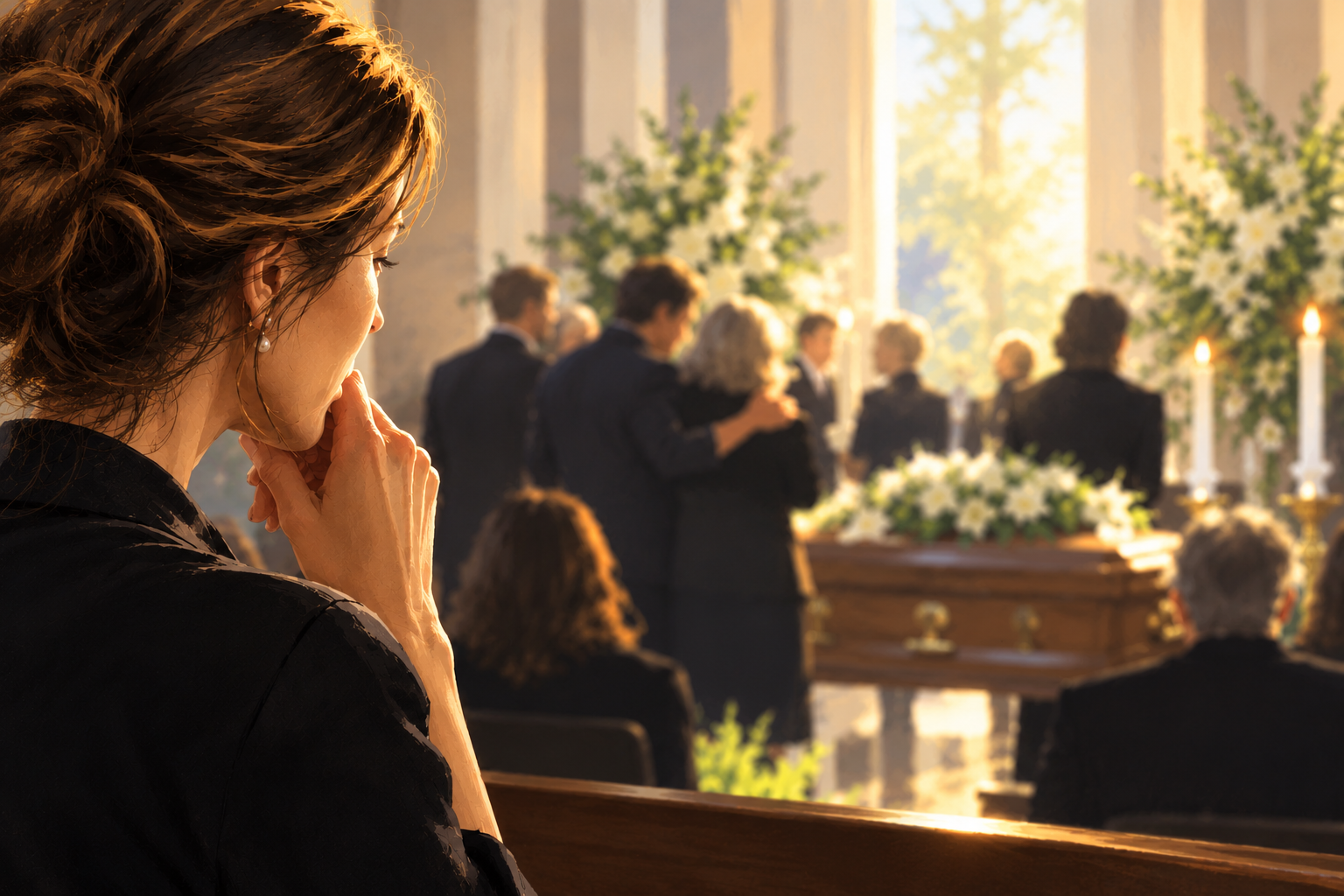
The hall was quiet, although people were everywhere.
Conversations were hushed. Every now and then, there was a sob, the sound of footsteps on the floor, or the quiet movement of someone arriving to pay their final respects.
There were flowers. Their fragrance drifted through the room, while the soft glow of candles illuminated the faces of those gathered there.
At the center of it all lay a body.
People approached, looked at her, and moved away. Some wept. Others seemed unable to find the words. Some gently caressed the deceased woman’s face, while others lingered for a few moments, as though waiting for something to happen.
The woman watching the scene decided to do the same.
Standing before the coffin, she began to notice something that, although seemingly obvious, she had never considered in quite that way before.
When someone died, their eyes remained in their sockets. Their arms and legs, nose and ears… everything stayed in its place, at least for a while. Nothing disappeared immediately. No part was removed. Nothing evaporated before the eyes of those who could still see the body.
And yet, something had changed forever.
What caused that whole structure to stop functioning? What prevented that apparently complete body from moving again?
Was the source of its life something invisible that simply departed at a certain moment?
And if so, where did it go?
Her thoughts began to wander along paths she had never imagined.
She thought of a stone that could remain in the same place for centuries. It could be warmed by the sun, battered by the rain, or thrown into the fire.
Exposed to extreme temperatures, it might darken, crack, or change its appearance. But it would remain there, still existing, even if transformed.
Why didn’t it die?
She felt that a stone, too, had a life of its own, although in a way she was unable to recognize. Or was the very idea of life far more complex than she had ever imagined?
She thought of a rose.
Once plucked from the ground, it could remain beautiful for a few hours. Its petals still retained their color, and its fragrance continued to drift through the air. To anyone looking only at the surface, it seemed alive. But gradually, its freshness faded, its stem lost its firmness, and everything began to wither and fall away.
The rose was still there, but it was no longer the same. Something had slipped away from it.
She thought of animals. They were born, grew, and experienced hunger, fear, pain, and pleasure. They moved through the world guided by their senses, just as she did. And one day, they died.
But if animals did not question their lives, why did she?
What, after all, set her apart from an animal that could also see, hear, smell, touch, and taste? Was it the ability to think about its own existence? The awareness of being alive? Or was there something more that she still could not name?
She looked at the body before her.
Around her, people comforted one another. They recalled stories, trying to find words that might ease the sense of loss. They spoke of what the deceased woman had done and what she would no longer do.
The past-tense verbs sounded strange in her mind.
Because, somehow, everything still seemed present.
The face was still there. The features were the same as those of someone who, until recently, had smiled, spoken, and shown surprise, impatience, and affection.
What was it that had ceased to exist?
Where was the link that had held that relationship together and was now broken?
Someone told a funny story. Another mentioned a trip, a kind gesture. For a few moments, she noticed a smile amid the tears.
She could not accept that such a radical change could have taken place without any visible element being removed. It was as though something that gave life to the body had departed, even though everything that made it perceptible remained there.
But where exactly was the thing that had departed?
Inside the heart? In the brain? Distributed throughout the body, like something that could not be located in a single place?
And why was it impossible simply to repair whatever had stopped working, put everything back where it belonged, and make the body move again?
She felt someone touch her shoulder.
“Are you all right?”
She turned to answer, but before she could utter a word, she became aware of the touch of that hand. There was a gentle, pulsing warmth.
Where did that warmth come from?
The hand was not connected to any wires. There were no visible switches or mechanisms. And yet that body produced heat, moved, spoke, and responded.
Her mother came closer and embraced her.
She felt the comfort of the embrace. But there was something beyond those sensations that could not be fully explained by what her five senses had to offer.
It was a feeling of being embraced, of belonging, of a profound connection. She did not need to see to recognize it. She did not need to hear her mother’s voice to know that something was there, a feeling that words could never fully express.
The embrace stirred sensations that seemed to reach beyond the physical.
Was it possible to feel something that the senses alone could not explain?
Perhaps there were experiences that used the body as a means of expression, even though their origins could not be found entirely within it.
For the first time, she did not try to push the question away. She allowed it to remain.
She began to imagine that everything responsible for keeping an organism functioning might not be fully understood simply by observing its structure. There were organs, cells, electrical impulses, and chemical reactions. But there was also the experience of being alive: perceiving the world, recognizing someone she had never seen, longing for someone she had never touched, loving, questioning her own existence.
How did all these things come together?
Was consciousness the result of what happened in the brain? Or might there be some dimension of human experience that we had not yet fully understood?
She had no answers. Only the strange certainty that the mystery did not necessarily lie in what could be seen, but also in what, though invisible, manifested itself through the visible.
Then she began to consider the possibility of a connection.
A bond between what she could touch and what she could not reach with her hands. A connection that could not be seen, made no sound, and could not be measured by the instruments she knew, at least not in the way she had learned to understand the world.
She wondered what she expected to feel. Perhaps she simply wanted confirmation that it was all real, that the person she had known was truly there before her.
At last, she stepped closer and gently touched the deceased woman’s hand.
There was an absence wrapped in rigidity and cold.
The hand was there, before her, within reach of her fingers.
But there was no response.
And it was precisely that lack of response that made the gesture so difficult to comprehend.
It was a gesture without return, without any reaction that could turn it into an encounter.
Then she thought of someone she had never physically touched, yet whose presence she could feel with an almost tangible intensity. All it took was thinking of that person for an energy to surge through her soul, as though an invisible closeness could bridge the distance and warm her skin. At times, the sensation was so intense it seemed to burn her.
How could she feel someone so deeply when that person had never been within reach of her hands?
There, standing before that body, she sensed a contradiction she could not understand: she could touch someone who no longer responded, yet she could also feel the presence of someone she had never touched.
In one case, there was contact without response. In the other, a presence that needed no contact.
Perhaps the question was greater than anything she could comprehend. The words used to speak about life were not enough to explain the experience of what people called death.
She knew that body had once been alive. She knew it was now dead. But between those two realities lay a boundary that, in that moment, logic alone could not cross.
It was becoming clear that something reached beyond what her eyes could perceive.
All she could see now was matter. Without light.
And yet the person she was trying to recognize no longer manifested herself through it.
She stepped away from the coffin.
She left carrying a question unlike any she had asked before.
During life, the body was the form through which we recognized someone.
After death, it remained there, without responding.
So what, exactly, did it mean to be alive?
https://digitalmehmet.com/author/rschumaher
Connect wih me via my website, Medium and LinkedIn
Discover more about my journey as a writer in my interview with Dr. Mehmet Yildiz.


Leave a Reply