

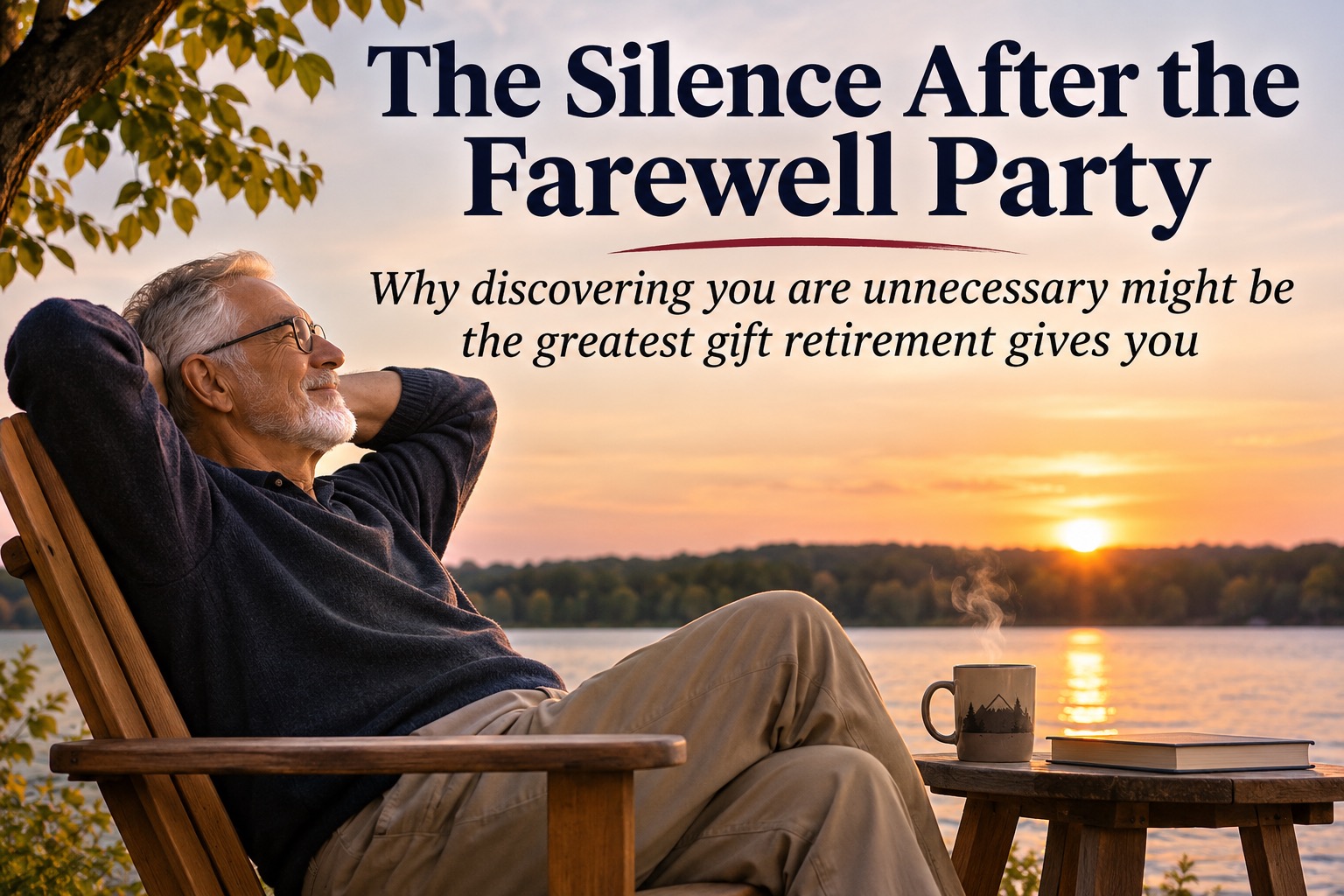
Why discovering you are unnecessary might be the greatest gift retirement gives you
Curator’s Note: The essence of retirement may be realizing you’re not needed in the workplace. After years of contributing significantly, many retirees face the quiet shock of discovering their organization continues to thrive without them. This humbling realization can sting at first, but ultimately becomes liberating. It teaches that significance is not tied to being needed. Instead of clinging to past roles, retirees should embrace an ‘ancestral’ mindset, fostering growth in others while stepping back. Transitioning this way lets retirees find new purpose in mentoring and volunteering, proving their success lies in building resilient systems and ultimately freeing them for fulfilling pursuits ahead.
The world keeps turning without us. Discovering that may be one of retirement’s greatest gifts.
When I retired, I carried a quiet, stubborn illusion: I was convinced the place would wobble without me.
After spending more than four decades solving crises, shaping programs, and steering teams through turbulent waters, it felt impossible that all that hard-won knowledge could vanish into a tidy transition binder. In the back corners of my mind, I waited for the ring of the telephone. I expected my successor to hit a wall only my institutional memory could solve, or at least call to ask what I would do in a bind.
Months drifted past. Nobody called.
When I met an old colleague for lunch, I caught myself listening just a fraction too closely, scanning for subtle hints that the wheels were beginning to wobble. They were not. Deadlines were met on schedule. The annual budget balanced to the penny. The new leadership team quietly shelved two multi-year initiatives I had fought fiercely to establish, and the institution carried on as sturdy and indifferent as ever.
That silence stings. Popular culture warns that upon stepping away, you will mourn the loss of your corporate title, the boardroom prestige, or your reserved parking space. But that is rarely what cuts the deepest. What catches you off guard is discovering that the machine continues to function smoothly without your hands on the wheel. You are forced to confront an uncomfortable reality: you were never truly indispensable. You were merely taking your allotted turn at the counter.
Yet once the ego absorbs that humbling blow, something unexpected occurs. That very same silence stops feeling like an injury and begins to feel like liberation.
Throughout our careers, many of us fall into a common mental trap: we confuse being needed with living a life of significance. We tether our entire sense of self-worth to whether others require our approval to make a move.
Consider how absurd that reasoning sounds when applied to family life. If a thirty-year-old child still relied on their parents to navigate daily financial dilemmas or personal choices, nobody would applaud that dynamic as exemplary parenting. We would recognize it for what it is: crippling codependency. The entire objective of raising children is to teach them to think, decide, and thrive without parental intervention. The ultimate triumph of a parent is becoming happily obsolete.
Why should our professional legacies operate under an opposite standard?
If the organization you gave your life to continues to flourish long after your departure, do not take it as an insult. Take it as absolute proof of your success. It proves you constructed a genuine foundation rather than a fragile altar to your own ego. The bridge held firm after you crossed, and keeping travelers safe was the entire purpose of building it in the first place.
The real danger lies in resisting this reality. Retirees frequently take three wrong turns when trying to dodge this truth.
Some become bitter sideline critics, scoffing at younger peers and complaining that modern standards are falling apart. It is a sad attempt by a bruised ego to manufacture relevance through disapproval. Others shrink their kingdoms down to size, channeling their old executive authority into homeowners associations, lawn care turf wars, or disputes with neighbors. And a third group simply refuses to step off the stage, hovering around the edges as board members or informal advisors. They think they are helping, but studies show an outgoing chief executive lingering on the board often paralyzes new leaders and restricts the fresh innovation an organization desperately needs.
A healthy transition demands moving from an indispensable mindset to an ancestral one.
The indispensable leader grips the levers of power until their knuckles turn white, demanding a final stamp on every document and constant reminders of past glory. The ancestral leader steps completely off the playing field. They take a comfortable seat in the bleachers, watch the rising generation test their own plays, and smile when the team scores using a playbook they never helped write.
Stepping away from the need to be needed is not an act of disappearing. It does not mean abandoning purpose, connection, or service. In fact, research demonstrates that older adults who direct their energy toward mentoring, volunteering, and community thrive physically and emotionally far more than those who cling to their former positions.
It simply means laying down an exhausting burden you were never designed to hold forever. Once you release the levers of control, your hands are finally free for what lies directly ahead of you today, entirely unburdened and entirely your own.
Read the original essay here:https://medium.com/illumination-retirement-aging-legacy/the-quiet-relief-of-becoming-unnecessary-d77f65436a6c?sk=612a6ce816383a4bf19819c3cab23692
About the Author:
Gary L. Fretwell spent 43 years in higher education consulting, working with nearly a thousand institutions before retiring to Prescott, Arizona.
He is a #1 international best-selling author blending neuroscience with Stoic philosophy to help people build a life of lasting significance.
He’s the author of eight books on intentional living and retirement, including the #1 bestseller The Magic of a Moment,The Identity Ghost: Ancient Wisdom, Modern Neuroscience, and the Architecture of an Intentional Life and Intentional Retirement.
His newest book, The Liking Gap: The One Bias That’s Quietly Sabotaging Every Relationship You Have, unpacks the psychological blind spots that trigger social second-guessing and shows how to build effortless, genuine connections. Available for Pre-Order and will be released on November 3.
On Medium, Gary founded and edits Illumination: Retirement, Aging & Legacy and 9 other publications.
📖 garyfretwell.com · 📬 The Wise Effort on Substack · ✍️ Follow-on Medium · 📺 Follow-on YouTube


Leave a Reply