

Bedbugs, Escapes, and the Magic of the Projector Room
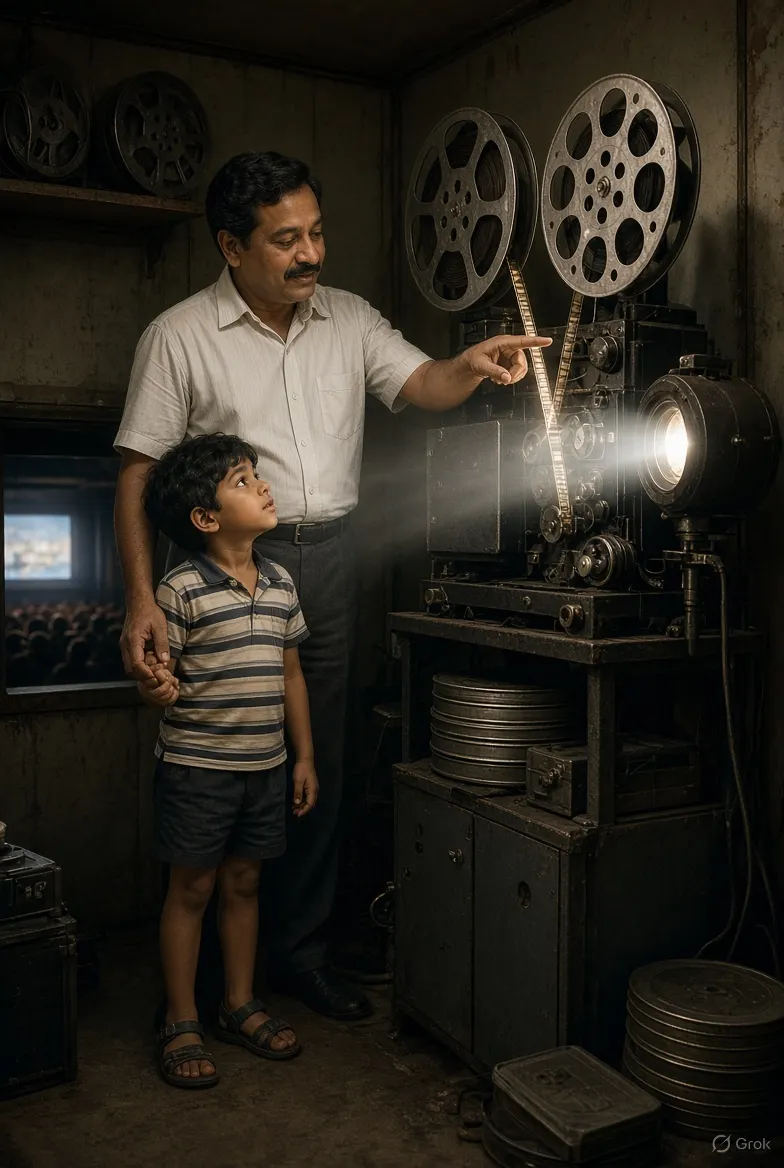
“Look here — what you see on screen is just a moving shadow picture.” A father showing his son the inner mechanics of the cinema projection room. (Image generated with Grok).
Author’s Note:
Girisaṁ’s Coffee Shop, nestled under the cool shade of a sprawling tree, is a sanctuary for minds and souls to relax and unwind after a rigorous trek up the steep slopes of scholarly, educational, and technical stories. Here, there are no three-minute quick fixes for losing weight or gaining riches.
Enjoy a piping-hot cup of coffee paired with delicious snacks—where humor is the main ingredient, seasoned with a splash of high-seas maritime adventures, tales of Bhishma, and timeless mythology. No action is expected or required from you.
Pause to take in the panoramic view of the hills and cascading waterfalls before resuming your trek toward knowledge! Dr Mehmet Yildiz and Dr Michael Broadly would surely recommend a healthy dose of humor as the perfect complement to a nutritious diet and exercise regimen. Humor is the best medicine!
The Bedbug Colonies of Poorna Theatre
My very first memory of watching a feature film in a proper cinema hall was the mythological classic Vinayaka Chavithi. My three brothers and I went to the theater together to catch an afternoon show. In those golden days of cinema, moviegoers were treated almost like cattle by theater management. Creature comforts, safety features, and basic ergonomic design were certainly not priorities for theater owners.
The old Poorna Theatre in town was fitted with primitive wooden chairs and long wooden benches that harbored vast, thriving colonies of hungry bedbugs. These bugs were remarkably attentive, constantly biting every patron to ensure no one accidentally fell asleep during the feature! Furthermore, the wooden chairs were constructed with only a single, thin wooden strip for a backrest, leaving a massive, open structural gap between the seat and the frame.
Midway through the movie, I leaned back too far, slipped entirely through the gap in the back of my chair, and tumbled backward onto the dusty floor of the row behind me! I began screaming and crying at the top of my lungs.
I was far more terrified by the sudden fall than actually injured. My eldest brother quickly scooped me up, carried me out of the dark hall into the bright lobby, and pacified my frayed nerves with a generous spread of potato chips, ice cream, and cold drinks.
The Great Chair Escape and a High-Speed Chase
That cinema incident serves as the crucial backstory for what happened next.
A few months later, while I was busily engaged in my daily routine of household destruction, I noticed my second older brother behaving very strangely. He kept checking the wall clock every two minutes and darting nervous, anxious glances in my direction.
Something suspicious is definitely afoot, I whispered to myself, instantly adopting a quiet, undercover posture and pretending not to notice his odd behavior.
After a few tense minutes, Tata Rao appeared quietly at the front door and made a subtle hand gesture, signaling my brother to step outside. My brother immediately tiptoed across the room silently like a cat sneaking past a sleeping guard. The moment they cleared the front door, both of them broke into a full sprint down the staircase!
I abandoned my toys instantly and shot out of the house like an arrow released from a bow, sprinting down the stairs just in time to see Tata Rao mounting his bicycle with my brother perched on the carrier rack. They pedaled hard, attempting to vanish down the street, but I pursued them barefoot with the terrifying speed of Usain Bolt. Realizing they could not outrun my desperate sprint — and knowing they would face a brutal cross-examination from Mother if they left me stranded in the middle of nowhere — they reluctantly pulled over and allowed me to climb onto the handlebars.
It turned out my brother had planned a secret outing to see a hilarious Laurel and Hardy comedy film in total peace. He had been terrified that after my dramatic, screaming fall during Vinayaka Chavithi, bringing me along would turn his comedy movie experience into a chaotic nightmare. Fortunately, the venue this time was the modern Leela Mahal theatre, which featured proper, solid upholstered seats without wide gaps for children to fall through. The movie proved to be wildly entertaining, and I kept my promise, allowing my brother to watch and enjoy the slapstick comedy without a single interruption.
A Father’s Engineering Logic Inside the Projection Room
As I mentioned earlier, Mother came from a large family, which meant she frequently had to travel to nearby towns to attend family weddings, naming ceremonies, and religious functions. Managing my well-behaved older brothers was child’s play, so she would routinely take them along, leaving me behind under Dad’s supervision for a few days at a time. To keep me entertained and out of trouble while she was away, Dad would routinely bribe me with trips to the cinema and boxes of imported chocolates.
On one such occasion, Dad took me to see the action-packed film Daivabalam. In one particularly intense scene, the legendary actor N.T. Rama Rao (NTR) was chained and being thrashed mercilessly by the movie villains. NTR was howling in pain on screen, and seeing my onscreen hero suffer, I burst into loud, inconsolable tears right in the middle of the crowded theater.
Now, any other typical father in his position would have simply escorted the crying child out to the lobby, bought him some ice cream and chips, waited for the violent scene to finish, and then brought him back to his seat. But my father was an engineer with a deeply practical, rational mind.
He took me by the hand, climbed up the stairs straight to the projection room. He knocked firmly on the door of the projection room. He politely introduced himself and requested the theater operator to give us a brief tour of the projection booth. Dad then patiently showed me the heavy, whirring projector apparatus, explaining how the transparent film reel spun on massive spools, how the intense arc light projected the tiny frames through a glass lens, and how the images expanded onto the giant white screen outside.
“Look here,” Dad explained gently, pointing to the celluloid film strip passing through the light. “What you are seeing out there on the screen is just a moving shadow picture. NTR is completely fine and healthy in real life. In fact, right now, he is probably sitting comfortably at home in Madras, enjoying a delicious dinner with his family!”
That short visit to the projection room was a profound, life-changing lesson in media literacy. From that exact day forward, I was completely desensitized to movie violence and onscreen terror. Years later as a young man, I could easily watch bone-chilling horror classics like Dracula, A Nightmare on Elm Street, and The Exorcist without batting an eye, calmly walking back alone through pitch-black streets to my college hostel late at night after a midnight show.
The Tearjerker, the Outburst, and Mind-Cleaning Cinema
A few weeks after that revelation, it was time for the next installment of father-son movie bribery. My Dad took me to the theater to watch the celebrated dramatic masterpiece Chivaraku Migiledi? (What Remains at the End?).
This time, however, we were not alone. A half-dozen of my Dad’s close friends and professional colleagues had tagged along to join us for the evening show.
This particular film featured no violent fight scenes or terrifying monsters, and the musical soundtrack was exceptionally beautiful. Since there was no physical conflict to worry about, I spent most of the show happily ignoring the plot, instead staring up at the brightly glowing red EXIT signs, watching the fast-whirring ceiling fan blades, looking at the glowing projector light beam, and occasionally glancing at the black-and-white screen.
During a particularly somber moment in the second half, I happened to turn around in my seat and glance over at my Dad’s group of friends.
My jaw dropped open in absolute, stunned disbelief!
These big, strong, adult professional men were in a state of complete emotional collapse. Some were desperately wiping away rolling tears with the backs of their hands, others were blowing their noses loudly into linen handkerchiefs, and all of them were weeping openly in the dark!
Using the naturally loud, echoing voice that all small children possess, I shouted at the top of my lungs: “Dad! Look at them! They actually think all of this is real! Take them to the projector room right now and show them the light machine!”
My booming voice cut straight through the silent, heartbreaking climax of the scene, echoing loudly across the front rows of the dead-silent auditorium. Several patrons turned around to stare at our group in utter shock.
Without uttering a single word, my father quickly grabbed my hand, hauled me out of the row, and marched me straight out to the lobby snack counter for an immediate, high-volume bribe of fresh potato chips, cold soda, and ice cream!
Looking back with mature eyes, Chivaraku Migiledi? is truly a masterclass in emotional cinema — a genuine, unforgettable tearjerker that remains deeply worth watching. If anyone watches that brilliant film without interruption, their eyes are bound to become moist, regardless of how tough, cynical, or hard-hearted they claim to be.
In my personal philosophy, I classify such profound works of art as “dry-cleaning” movies. Over time, our minds, souls, and hearts accumulate vast amounts of emotional dirt, stress, and cynicism from watching mindless action blockbusters, cheap horror flicks, and endless, dramatic TV serials. Every once in a while, sitting down to watch a soul-stirring masterpiece like Chivaraku Migiledi? acts as a deep chemical wash for the human spirit — purifying the mind, refreshing the soul, and leaving the heart overflowing with the warm milk of human kindness and noble thoughts.
Tail piece
(The movie was originally in Bengali, titled Deep Jele Jai; it was later remade in Hindi as Khamoshi and in Telugu as Chivaraku Migiledi. The tear-jerker I saw was the Telugu version. Three of the finest actors in Indian cinema played the heroine’s role: Suchitra Sen (Bengali), Waheeda Rehman (Hindi), and Savitri (Telugu).)
The story centers on a dedicated nurse working in a psychiatric asylum who takes on a unique and agonizing form of therapy. She is assigned to treat a young man who has lost his sanity after being cruelly jilted by his lover. To draw him back from the abyss, the nurse acts as though she is deeply in love with him, showering him with the affection he lost. Her compassionate deception works — he slowly recovers, thanks her, and eventually goes on to marry the very woman who had spurned him.
The tragedy, however, cuts far deeper than a broken heart. Having poured her soul into the performance, the nurse genuinely falls in love with him, leaving her profoundly depressed and fragile. When the chief physician asks her to take on a second patient with a nearly identical case, she fiercely refuses, but the doctor insists, citing her unmatched empathy. Reluctantly, she agrees, once again playing the part of a loving partner to heal a shattered soul. The second young man is successfully cured — but the crushing emotional toll breaks her entirely, and she slips permanently into insanity, becoming a patient in the very asylum where she once served as a healer.
You truly must watch the final five or seven minutes of Chivaraku Migiledi and other two versions (Links are given above), only then will you fully empathize with my Dad’s weeping friends in that dark auditorium. If you are able to walk out and forget that haunting scene five minutes after the credits roll, then you are indeed “super cool” — and perhaps missing the “super-sensitivity” gene that plagued the rest of the theater that night!
Enjoyed this story?
You can support my independent writing and get access to the full library, exclusive digital bundles, and art prints on Patreon:
- Join Tier 1 ($3.00/month): Get full access to this story plus all past and upcoming essays, mythological retellings, and e-book collections.
- Buy this single story ( 3 parts) ‘My ‘Dennis the Menace’ days ‘ ($3.00): Download the complete file to keep forever.
Explore My Books on Amazon:
- ⚓ Trapped on an Unseaworthy Ship: Memoirs of a Chief Engineer
- 🔱 Bhishma: The Legend (Volume 1)
- 🌟 [Follow My Official Amazon Author Page] A.K.Girisam Amzon Author Page


Leave a Reply