

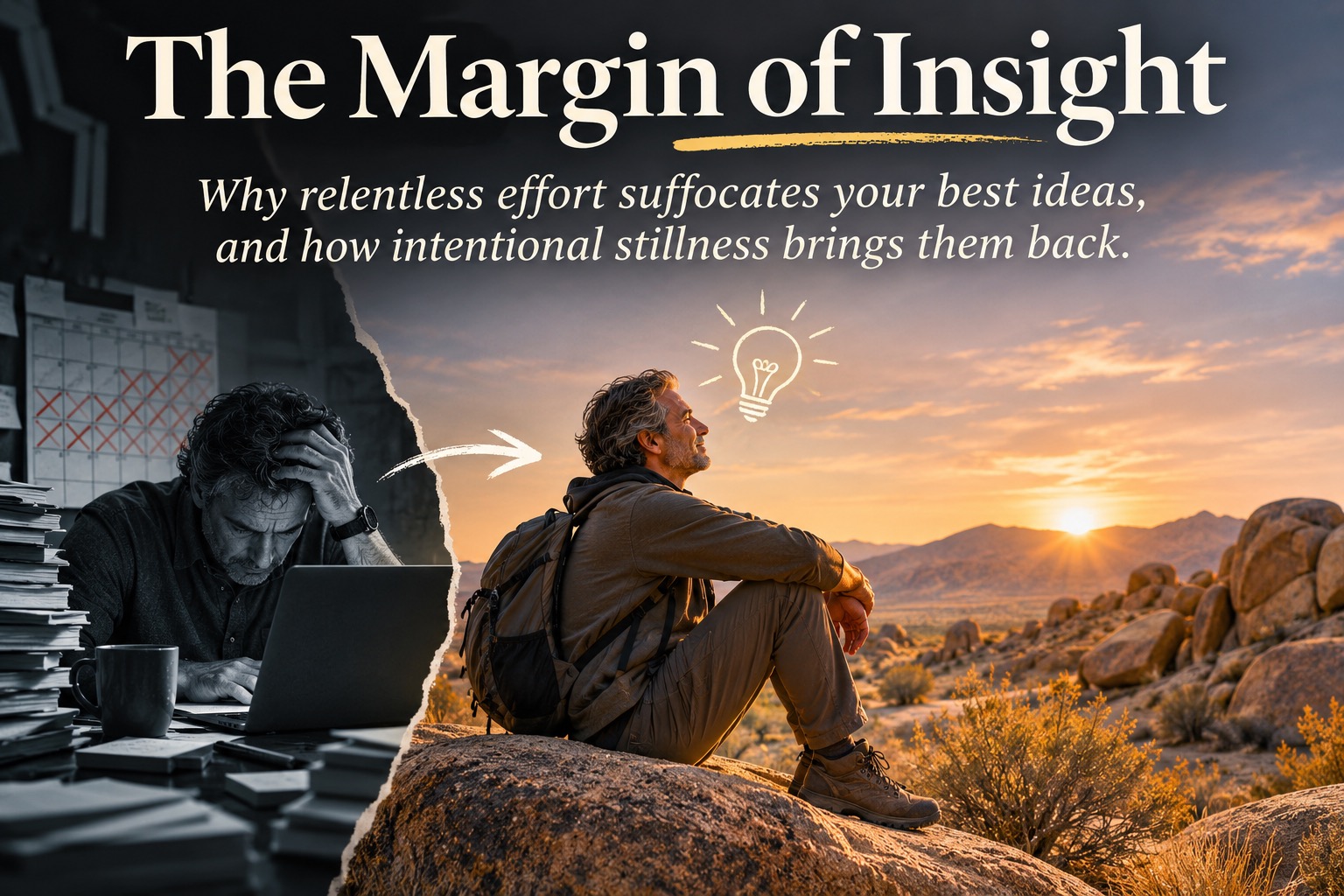
Why relentless effort suffocates your best ideas, and how intentional stillness brings them back.
Curator’s Note: Relentless effort can suppress creativity instead of producing better results. Continuous mental strain quickly exhausts the prefrontal cortex, narrowing perspective, weakening memory, and pushing predictable solutions over insight. Breakthroughs often emerge during quiet, unstructured moments when the unconscious mind can connect ideas and recognize patterns. The Japanese concept of ma—deliberate negative space—illustrates how pauses create room for meaning and creativity. To restore this space, protect daily periods of unstructured downtime, avoid filling silence with digital content, and step away from difficult decisions before forcing solutions. Intentional stillness is not wasted time; it is essential mental infrastructure for clearer thinking, deeper reflection, and original ideas. This insightful story was written by Gary L. Fretwell for Digitalmehmet members and visitors.
Your best ideas rarely arrive when you push harder. Sometimes the breakthrough begins when you finally step away./ Author created image using ChatGPT
My best breakthroughs never seem to arrive while I am hunched over a desk, furiously typing, or willing an answer into existence through sheer determination. They arrive unbidden on a quiet desert trail, in the shower, or during those few unscripted moments when I let my gaze wander away from the screen and toward the stillness of the granite boulders outside my window.
For more than four decades in executive leadership and institutional consulting, my default reflex to any stubborn obstacle was identical: push harder. If a strategic initiative stalled, I scheduled another meeting. If an essay or presentation felt flat, I ground out another sixty minutes at the keyboard. If an organizational dilemma resisted a neat resolution, I forced myself to sit until the answer yielded. Like most high achievers, I lived under the pervasive modern illusion that cognitive output scales linearly with applied muscular force.
It does not. Brute-force productivity hits a rigid biological ceiling very quickly.
When you continually push through mental exhaustion, you do not produce excellence. You produce frantic, low-grade noise. Modern cognitive neuroscience confirms what experienced leaders eventually discover the hard way: executive function is an expensive metabolic resource. The prefrontal cortex, responsible for focused attention, analytical reasoning, and deliberate decision-making, fatigues rapidly under continuous load.
When you deplete that reserve, your brain naturally downshifts into survival mode. Your perspective narrows. Your working memory shrinks. You fall back on reflexive, conventional answers because your nervous system simply lacks the fuel required for lateral thinking. In that state of chronic cognitive fatigue,the subtle, quiet intuition required to resolve complex problems is completely suffocated. The mind requires idle cycles to cross-reference memories, recognize distant patterns, and synthesize meaning. By cramming every minute of your day with frantic activity, you crowd out the very insights you are desperate to find.
Your best thinking happens in the margin you intentionally leave for it.
In classical Japanese aesthetics, there is a profound concept known as ma. It is often loosely translated as negative space, the interval, or the pause between notes that gives music its shape and beauty. In traditional architecture, ma is not merely the absence of walls; it is the deliberate space that allows life, light,and movement to happen. In a conversation, it is the silence that allows words to resonate rather than collide. Without that empty space, a musical composition is merely a wall of overwhelming sound.
Our professional schedules and mental lives suffer from the exact same distortion. We pack our calendars edge to edge, treat every brief pause in the day as an intolerable vacuum to be filled with digital stimulation,and then wonder why our deeper creative instincts have evaporated. We have constructed lives with plenty of furniture, but no room to walk between the pieces.
Reclaiming that necessary stillness does not require abandoning your responsibilities or retreating to an isolated cabin. It requires establishing three modest, non-negotiable boundaries:
First, guard unstructured white space. I protect thirty minutes of deliberate downtime every single day. I do not use that window to catch up on correspondence, review outlines, or organize notes. I treat that empty half-hour with the exact same non-negotiable respect I would accord an essential boardroom session or an appointment with a trusted colleague.
Second, cut off passive consumption. Our culture has conditioned us to treat silence like a personal emergency that must be instantly smothered with a podcast, an audiobook, or an endless social feed. When I walk or attend to simple physical tasks, I leave the headphones behind. The mind requires periods of true sensory silence to digest experience and quiet its background processes. If you never stop consuming other people’s thoughts, you will never hear your own.
Third, step away before you decide. When wrestling with a knotty problem, a difficult interpersonal dynamic, or a major life direction, spending more hours staring at a bright screen rarely produces clarity. I force myself to stand up, step away from the desk, and allow the unconscious mind to do what it does best. Physical distance untangles knots that willpower only pulls tighter.
Stop working harder. Give your mind the quiet architecture it needs to breathe, reflect, and discover what was waiting for you all along.
Read the companion essay here:https://medium.com/illumination/stop-working-harder-ec13d4e67d69?sk=2a23c51f314043a6d71cfa5627a9c044
About the Author:
Gary L. Fretwell spent 43 years in higher education consulting, working with nearly a thousand institutions before retiring to Prescott, Arizona.
He is a #1 international best-selling author blending neuroscience with Stoic philosophy to help people build a life of lasting significance.
He’s the author of eight books on intentional living and retirement, including the #1 bestseller The Magic of a Moment,The Identity Ghost: Ancient Wisdom, Modern Neuroscience, and the Architecture of an Intentional Life and Intentional Retirement.
His newest book, The Liking Gap: The One Bias That’s Quietly Sabotaging Every Relationship You Have, unpacks the psychological blind spots that trigger social second-guessing and shows how to build effortless, genuine connections. Available for Pre-Order and will be released on November 3.
On Medium, Gary founded and edits Illumination: Retirement, Aging & Legacy and 9 other publications.
📖 garyfretwell.com · 📬 The Wise Effort on Substack · ✍️ Follow-on Medium · 📺 Follow-on YouTube


Leave a Reply