

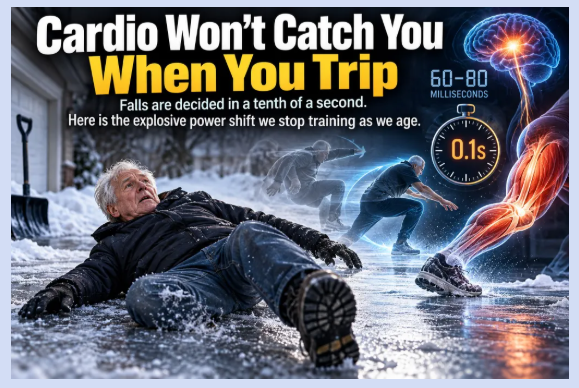
Falls are decided in a tenth of a second. Here is the explosive power shift we stop training as we age.
A strong heart can carry you for miles, but it takes explosive muscle power to catch you when you stumble. Falls happen in milliseconds.
Two winters ago, I bundled up, grabbed a shovel, and walked out onto my driveway. A thin glaze of black ice had formed over the concrete, completely invisible against the gray morning light. Before I could plant my feet, both legs slipped out from under me, and I slammed flat onto my back. I was 70 years old.
Lying there on the frozen ground, staring up at the winter sky, the physical shock was secondary to an overwhelming sense of frustration. At that exact moment, I was riding a 300-day consecutive streak of at least thirty minutes of daily cardio. My resting heart rate sat comfortably in the fifties. My lungs were clear,my endurance was solid, and my routine was consistent. Yet when the pavement gave way, none of that metabolic efficiency meant a single thing. A decade earlier, my nervous system would have whipped my legs back underneath my center of gravity before my conscious brain even realized I was in trouble. This time,there was only empty air.
Many thoughtful, health-conscious people build their longevity playbooks around pure stamina. We diligently hit our 10,000 steps, log time in Zone 2 on a stationary bike, track our metrics, and opt for the stairs instead of the elevator. Cardiovascular health is vital for arterial elasticity and cognitive longevity, but treating it as a total safeguard creates a dangerous blind spot. Catching your toe on a raised slab of concrete or sliding across a slick tile is not an endurance test. It is an emergency decided in less than 100 milliseconds. When balance falters, your cardiovascular capacity is entirely absent from the equation.
The mechanics of a fall highlight where conventional fitness guidance falls short. Researchers at VU Amsterdam intentionally tripped younger and older adults in a controlled laboratory setting to examine the reaction pathway. Surprisingly, both groups initiated neurological responses at nearly identical speeds, with leg muscles firing electrical signals within 60 to 80 milliseconds. The alarm arrived at the muscles right on schedule. The critical breakdown occurred in what happened next. In older adults, muscular force ramped up far too slowly and failed to reach the peak threshold needed to project a recovery foot forward. The brain dispatched the distress signal, but the physical system could not produce the necessary torque in time.
Scientists call this specific failure dynapenia: the age-related loss of muscle strength and speed, distinct from sarcopenia, which is the loss of muscle mass. Landmark investigations by Brian Clark and Todd Manini demonstrate that peak power vanishes twice as fast as muscle volume. You can maintain reasonable muscle size and look fit in the mirror, yet still lack the velocity to stabilize yourself during a sudden stumble.
Our bodies rely on two primary varieties of muscle fibers. Type I fibers are slow-burning workhorses designed for posture, walking, and steady endurance. Type II fibers are fast-twitch sprinters built to produce immediate, intense force. As the decades advance, fast-twitch fibers shrink, and inactive neural pathways quietly go dark. If you never demand rapid movement from your body, your nervous system decides it no longer needs to maintain that machinery.
What protects your hips and spine is something sports scientists call the rate of force development: the amount of explosive power you can generate within the opening fraction of a second. Hip and hamstring studies show that while peak strength declines by roughly 40 percent in older age, the velocity of force output plunges by more than 60 percent.
Unfortunately, standard exercise advice often accelerates this decline. Older trainees are routinely steered toward timid, slow machine circuits. Controlled movement protects joints, but when every exercise is performed at a grinding crawl, your fast-twitch fibers remain asleep.
At 72, I refuse to train like antique china.
True structural resilience requires moving with explosive intent. You do not need dangerous box jumps or high-impact plyometrics to wake up your nervous system. You simply need to sit on a sturdy chair, brace your trunk, and drive upward to a full stand as quickly and forcefully as possible, lowering down with slow control. When paired with deliberate speed drills and simple baseline assessments like the five-times sit-to-stand test, you actively rebuild the emergency brakes your body needs.
Endurance gives you the capacity to go the distance, but explosive power is what keeps you upright.
Read the full breakdown, clinical study citations, and complete testing protocol here:https://medium.com/health-science/my-300-day-cardio-streak-couldnt-stop-a-fall-fc6db848c090?sk=876e04dd94fe959f355c43f6fbe4f260
About the Author:
Gary L. Fretwell spent 43 years in higher education consulting, working with nearly a thousand institutions before retiring to Prescott, Arizona.
He is a #1 international best-selling author blending neuroscience with Stoic philosophy to help people build a life of lasting significance.
He’s the author of eight books on intentional living and retirement, including the #1 bestseller The Magic of a Moment,The Identity Ghost: Ancient Wisdom, Modern Neuroscience, and the Architecture of an Intentional Life and Intentional Retirement.
His newest book, The Liking Gap: The One Bias That’s Quietly Sabotaging Every Relationship You Have, unpacks the psychological blind spots that trigger social second-guessing and shows how to build effortless, genuine connections. Available for Pre-Order and will be released on November 3.
On Medium, Gary founded and edits Illumination: Retirement, Aging & Legacy and 9 other publications.
📖 garyfretwell.com · 📬 The Wise Effort on Substack · ✍️ Follow-on Medium · 📺 Follow-on YouTube


Leave a Reply