

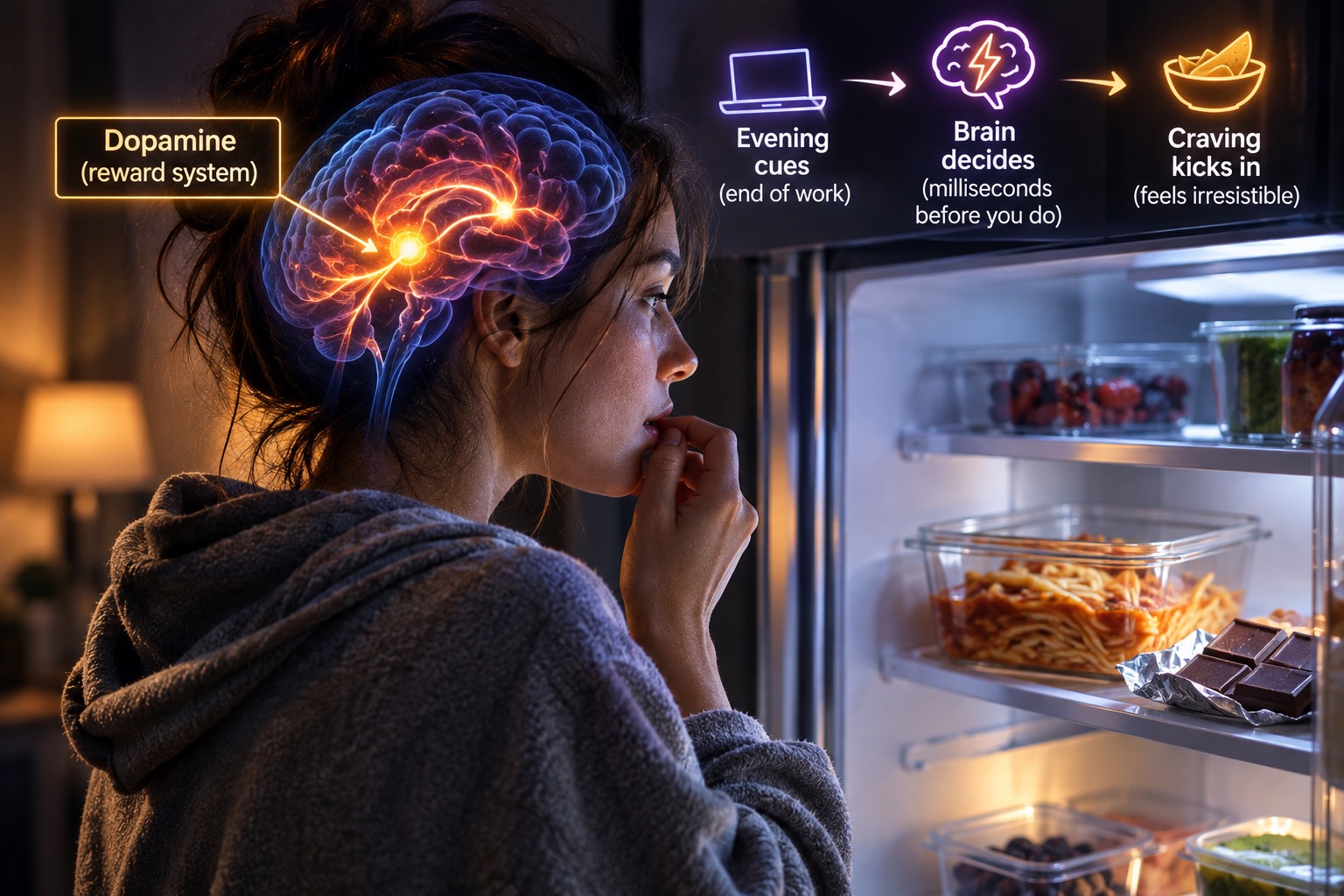
Neuroscience proves your brain decides to raid the kitchen long before your conscious mind ever clocks in.
Curator’s Note: In this essay by Gary Frettwell, late-night snacking is presented not as a willpower failure but as an automatic, brain-driven habit. Neuroscience shows that dopamine responds to environmental cues—such as relaxing after work, dimming lights, or sitting on the couch—by predicting food rewards before conscious hunger appears. Because decision-making is weakened by fatigue, cravings can lead to action before deliberate thought intervenes. To interrupt this cycle, identify the underlying cue, remove tempting foods from sight, delay action with a ten-minute pause, and replace eating with soothing alternatives such as herbal tea, stretching, or reading. Understanding and redesigning the environment makes behavior change more practical than relying on discipline alone.
Your brain may be running the show, but you can learn to change the script.
We have all been there. It is 9:15 p.m., the living room is quiet, and the day’s work is finally done. The house is starting to settle down, and you are starting to relax. Suddenly, without thinking, you find yourself standing in front of the open refrigerator. The cold, bright light illuminates shelves of yesterday’s leftovers, the last of the yogurt, and that half-eaten chocolate bar you were saving.
You blink, step backward, and a wave of familiar frustration hits. The sting of a specific, stinging question echoes in your mind: Why am I doing this again? Where did my willpower go?
We tend to treat late-night snacking as a character flaw, a personal moral failure. We view ourselves as undisciplined, weak, or lacking the necessary mental toughness to stick to our health and diet goals. But modern neuroscience suggests we are pointing the finger at entirely the wrong culprit. The daily, 9 p.m.battle isn’t being lost by your conscious mind or your logic; it is being bypassed entirely by an ancient, non-conscious neural machinery that makes decisions milliseconds before you even realize you are hungry.
To understand why those evening cravings feel utterly irresistible and automatic, we have to look past the superficial concept of willpower and examine how the human brain actually processes information and constructs desire.
The Pre-Conscious Cravings Machine
For decades, behavioral and fitness advice centered around a very simple model: temptation arises, and you fight it through sheer mental force. If you just tried harder, and focused more, you could successfully resist the bag of chips. Yet, neuroscience reveals that your brain’s reward system operates on a much deeper, faster level, far ahead of your conscious awareness. We operate largely on autopilot, especially when tired.
A critical molecule in this process is dopamine. For a long time, we thought dopamine was just the “pleasure molecule,” released only after we consume a reward. But we now know that dopamine pathways do something far more insidious: they predict the reward. Long before you feel a physical rumble in your stomach or consciously think about food, your brain is actively detecting environmental cues that have been associated with a reward in the past.
Think of your typical evening routine. Maybe the cue is the dimming of the living room lights, the closure of your laptop after the last work task, or the simple transition from “productive mode” to “relaxation mode” on the couch.
These subconscious triggers fire off rapid-fire prediction signals. Your brain decides, based on historical data, that a dopamine reward (the texture of fat, the sensation of sugar) is imminent and manufacturers the craving as a motivating tool, nudging your body toward the source. By the time your conscious mind wakes up to what is happening, you are already gripping the handle of the pantry door. Your brain already made the choice seconds ago, dressing it up as a conscious desire just in time to watch you reach for the wrapper.Your willpower arrived late to the scene of the crime.
Rewiring the Automatic Loop
Once you shift your perspective and realize that late-night snacking is largely an automated neural habit loop rather than a statement about your discipline, the entire strategy for dealing with it changes. You stop trying to fight biology with sheer willpower, which is a limited resource that is always exhausted by 9 p.m.anyway. Instead, you start to act like an engineer, changing the environmental inputs that trigger the automated loop in the first place.
Here is how you begin to break the loop:
First, you must identify the exact cue. Are you actually physically hungry, or is your brain simply seeking a transition ritual to signal the end of a stressful day? We use food to mark transitions. Often, evening cravings are a disguised search for psychological comfort or a brief hit of mental stimulation after hours of cognitive fatigue and decision-making.
Second, redesign your immediate environment. Our brains are incredibly susceptible to visual prompts. If visual cues like a clear cookie jar on the counter or brightly labeled bags of snacks in the pantry keep sparking automatic dopamine prediction loops, physically remove them from your sight. “Out of sight, out of mind” is a powerful biological reality when your decision-making center (the prefrontal cortex) is tired at the end of the long day.
Third, intentionally build a pause into the wave. When a craving hits, recognize that the initial, intense surge is not a reflection of true hunger but a biological reflex. It is just an automated prediction signal. Commit to a simple “10-minute rule.” When the craving strikes, look at the clock and wait ten full minutes before you act.This small, deliberate gap gives your slower, conscious prefrontal cortex enough time to catch up, assess the situation, and decide whether you are actually nourished or just looping in an automatic routine.
Finally, substitute the reward itself. If your brain is seeking a psychological breather or a soothing sensory experience after a hard day, replace the sugary, fatty snack with a non-food dopamine hit. A cup of warming herbal tea, a few minutes of stretching, or reading a chapter of a book can all satisfy the nervous system’s need to decompress and soothe itself, without involving a single calorie.
Stop beating yourself up over a lack of discipline you think you are “supposed” to have. The problem isn’t your motivation; it is the machine you are operating. Recognize how your brain actually works, and work with that biology instead of trying to fight it every single night.
Read the full, detailed breakdown on why your brain makes snack decisions before you do:https://medium.com/illumination/your-brain-decides-you-want-a-snack-before-you-do-9d7a1ce87ed0?sk=cf1f3605e5cdedcabc7c8a8e663c11e6
About the Author
Gary L. Fretwell spent 43 years in higher education consulting, working with nearly a thousand institutions, before retiring to Prescott, Arizona. A #1 international best-selling author, he blends neuroscience with Stoic philosophy to help people build lives of lasting significance. His eight books include The Magic of a Moment, The Identity Ghost, Intentional Retirement and his newest, The Liking Gap. He founded and edits Illumination: Retirement, Aging & Legacy and 9 other publications on Medium.
📖 garyfretwell.com · 📬 The Wise Effort on Substack · ✍️ Follow on Medium · 📺 Follow on YouTube


Leave a Reply