

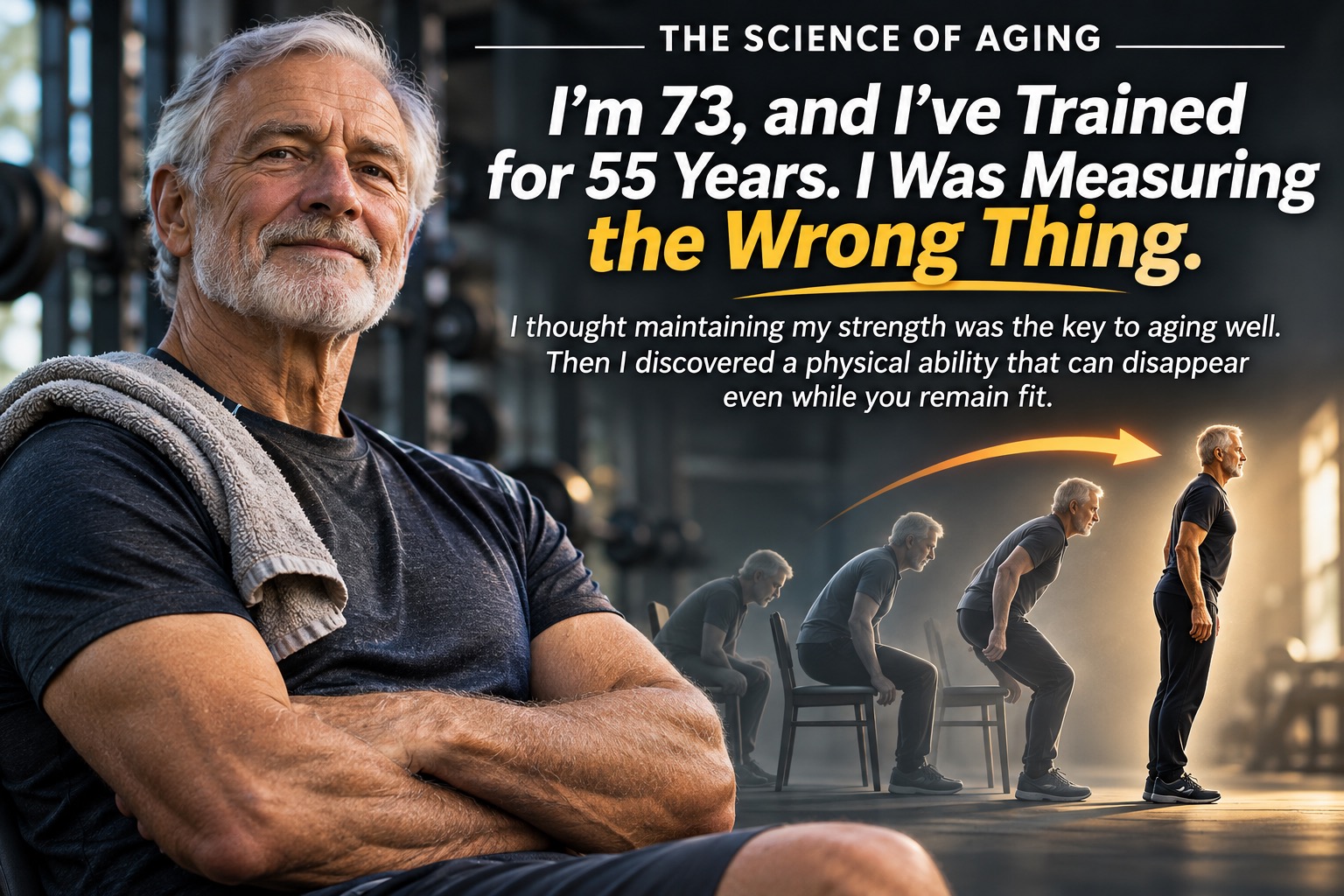
For 55 years, I chased the wrong metric. Here is what I learned about aging, fitness, and the physical ability we forget to measure.
Curator’s Note: After 55 years of strength training, 73-year-old Gary L. Fretwell realized he had focused too heavily on strength as the key measure of healthy aging. While muscle, endurance, and resistance training remain essential, longevity also depends on balance, agility, coordination, recovery, and the ability to adapt to unpredictable physical situations. Traditional workouts often use stable, controlled movements that do not prepare the nervous system for real-world challenges such as uneven surfaces or sudden changes in direction. Fretwell argues that aging well requires expanding fitness beyond lifting and endurance to include cognitive-motor engagement and unfamiliar movements that preserve independence, resilience, and confidence.
After 55 years of strength training, I discovered that longevity isn’t just about how much we can lift. It’s about how well we can balance, adapt, recover, and navigate the physical challenges of everyday life.
For decades, my relationship with fitness was built on a very simple premise: strength is the ultimate insurance policy. If you can lift the weights, push through the fatigue, and maintain muscle mass, you are doing everything right. As a 73-year-old who has trained consistently for 55 years, I felt confident in that formula. I tracked my weights, monitored my recovery, and assumed that staying strong meant I was staying young.
Then I realized I was measuring the wrong thing.
It is a humbling experience to realize that a lifetime of discipline can leave you with a blind spot. Fitness culture tells us that as long as we avoid the physical decline of muscle wasting, we are bulletproof. We focus heavily on how much we can lift, how far we can run, or how many hours we spend in the gym. But there is a completely different dimension of physical capability that quietly degrades in the background, untouched by traditional workouts.
You can maintain a high level of raw strength and still find yourself vulnerable to sudden lapses in physical resilience. This hidden capability governs how our bodies respond to unexpected shifts, how quickly we recover our equilibrium, and how gracefully we navigate the unpredictable physical demands of daily life. It is not about brute force. It is about adaptability, coordination, and the subtle mechanics of movement that keep us upright and confident.
When we talk about longevity, the conversation almost always revolves around numbers on a barbell or years on a calendar. We treat aging as a battle of attrition where the goal is simply to lose as little as possible year after year. But true healthspan requires a shift in perspective. It invites us to look beyond the mirror or the gym log and examine how we move through the world when no one is watching.
Think about how we spend our time in fitness environments. We rely on stable machines, predictable paths,and controlled resistance. While these methods build wonderful muscle tissue and protect bone density, they rarely challenge our nervous system in ways that mimic real life. Real life is uneven, unpredictable, and full of micro-adjustments. A sidewalk crack, a slippery floor, or a sudden change in direction requires an entirely different set of physical reflexes.
If your training only focuses on linear strength, you are essentially building a powerful engine for a car with compromised steering. You can accelerate forward with great force, but navigating a sharp turn becomes hazardous. This realization forced me to rethink my entire approach to physical culture. I had to look past my gym statistics and confront the reality that capability is multi-faceted.
As we grow older, the cost of overlooking these subtle attributes rises. We begin to value safety and comfort,which often leads us to narrow our physical repertoire even further. We stop doing the awkward, exploratory movements that keep our nervous systems sharp. We gravitate toward comfort and predictability, inadvertently accelerating the very decline we are trying to prevent.
Reversing this trend does not require abandoning traditional exercise. Resistance training remains an essential cornerstone of healthy aging. Instead, it requires an expansion of our definition of fitness. It asks us to integrate balance, agility, and cognitive-motor engagement into our routines. It asks us to embrace movements that feel slightly clumsy or unfamiliar, because adaptation lives at the edge of our comfort zone.
Discovering this missing piece changed how I view my daily routine. It made me realize that training for longevity isn’t just about adding plates to a bar or maintaining endurance. It is about cultivating a deep,functional awareness that preserves our independence and vitality for the long haul. Aging well is not just a test of how much weight you can move against gravity. It is a measure of how fluidly you can converse with the physical world around you, no matter what surprises it presents.
If you want to dive deeper into what I discovered after more than half a century of training and why shifting this single focus can transform how you age, you can read the full piece here:https://medium.com/health-science/im-73-and-i-ve-trained-for-55-years-i-was-measuring-the-wrong-thing-4d20c237a491?sk=75ee9e70aa69bc769ed65a90d283ada3
About the Author
Gary L. Fretwell spent 43 years in higher education consulting, working with nearly a thousand institutions, before retiring to Prescott, Arizona. A #1 international best-selling author, he blends neuroscience with Stoic philosophy to help people build lives of lasting significance. His eight books include The Magic of a Moment, The Identity Ghost, Intentional Retirement and his newest, The Liking Gap. He founded and edits Illumination: Retirement, Aging & Legacy and 9 other publications on Medium.
📖 garyfretwell.com · 📬 The Wise Effort on Substack · ✍️ Follow on Medium · 📺 Follow on YouTube


Leave a Reply