

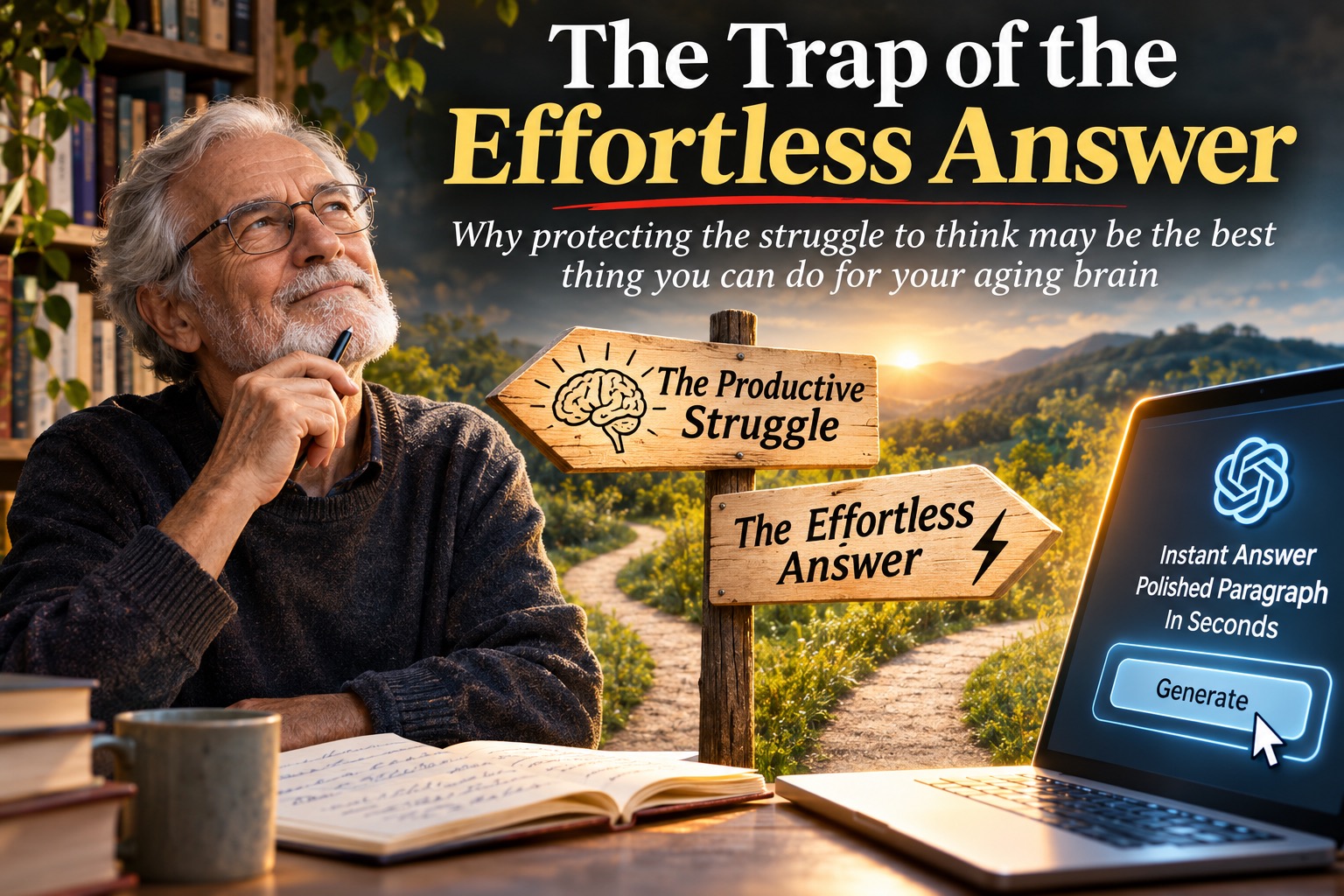
Why protecting the struggle to think may be the best thing you can do for your aging brain
Curator’s Note: The article by Gary L Fretwell argues that mental struggle is essential for maintaining cognitive sharpness, especially in later life. While AI can quickly improve writing and provide answers, relying on it too heavily may weaken curiosity, creativity, memory, and independent reasoning. Drawing on neuroplasticity and the concept of “desirable difficulty,” the author explains that wrestling with complex ideas strengthens understanding and can produce unexpected insights. AI should therefore handle repetitive tasks while people preserve challenging intellectual work for themselves. Older adults can use technology as a learning guide or intellectual sparring partner, embracing beginnerhood and demanding new skills to remain mentally agile, curious, and open to growth.
The fastest answer isn’t always the one that helps us grow. Sometimes, the struggle to think is precisely what keeps our minds sharp.
A few days ago, I found myself staring at a stubborn paragraph in my next book. I knew the point I wanted to make, yet the words refused to cooperate. After several clumsy rewrites, each one drifting further from the core idea I was trying to capture, my cursor hovered near an open AI window on my screen.
Within seconds, the technology could have untangled my thoughts, sharpened my phrasing, and handed me a polished paragraph. It probably would have sounded remarkably smooth. The temptation was real. Why spend another twenty minutes wrestling with a single block of text when a machine could fix it almost instantly?
Then a quiet, unsettling thought stopped me: What if the struggle to find the right words is not an obstacle to good writing? What if it is the very process through which I discover what I actually want to say?
After more than four decades working in higher education, organizational consulting, and writing, I have noticed a consistent pattern. My most valuable insights rarely arrive fully formed. They emerge only after a period of genuine friction.
When you force yourself to explain a complex idea from scratch, you uncover hidden assumptions, spot weak logic, and occasionally arrive at a conclusion entirely different from where you started.
The struggle changes the thinking.
At seventy-three, I am no longer interested in simply producing more output or getting faster answers. My priority is staying curious, mentally agile, and open to ideas that reshape how I see the world. That shift in perspective made me realize something crucial about artificial intelligence.
The greatest danger of this technology is not that it will eventually outsmart us. It is that we will become so comfortable receiving instant answers that we gradually lose our appetite for discovering them.
For generations, scientists and society viewed the aging brain as a finished product in slow, inevitable decline. Modern neuroscience tells a far more hopeful story. Through neuroplasticity, our brains retain the capacity to strengthen neural pathways, form new connections, and learn demanding skills well into our seventies, eighties, and beyond.
While processing speed and certain aspects of working memory may slow down over time, accumulated knowledge, vocabulary, and judgment remain formidable strengths.
Think back to who you were at thirty. Your younger self may have worked longer hours and processed raw data faster, yet lacked something speed alone can never provide: the lived experience to recognize how often the obvious answer turns out to be wrong. Certainty is not the same thing as wisdom.
However, those hard-won cognitive strengths only stay sharp if we refuse to outsource our curiosity.
Cognitive psychologists refer to this principle as “desirable difficulty.” Decades of research show that meaningful mental effort, such as retrieving information from memory or wrestling with a complex problem,builds durable understanding in a way passive consumption never can.
Preliminary research from the MIT Media Lab even suggests measurable differences in brain engagement and recall when writers rely heavily on AI versus doing the cognitive heavy lifting themselves. A polished paragraph generated in three seconds is simply not the same thing as a mind that has grown through the effort of creating it.
None of this means we should abandon artificial intelligence. In fact, when used intentionally, it can spark a second intellectual renaissance in later life. For much of human history, serious learning was restricted by access to teachers, libraries, money, and time.
Today, an eighty-year-old can explore astronomy with a patient guide available at midnight, or a retiree can practice conversational Italian whenever curiosity strikes.Studies like the Synapse Project have shown that older adults who take on demanding new skills experience meaningful improvements in memory function.
The secret lies in drawing a clear boundary between convenience and growth.
We should let technology handle repetitive administrative tasks, organize clutter, and remove unnecessary busywork, while fiercely protecting the creative struggles that stretch our minds. Even more importantly, we must overcome our reluctance to become beginners again.
After decades of building expertise, it can feel uncomfortable to step into territory where we are inexperienced. Yet one of the greatest freedoms of growing older is the ability to learn purely for the joy of discovery, without needing to prove anything to anyone.
I eventually went back to that troublesome paragraph in my manuscript. It did not turn into a masterpiece,and the process took far longer than asking a machine. Yet by the time I finished, my understanding of the idea had deepened in ways an automated shortcut never could have delivered.
In my full Medium essay, I dive deeper into the science of desirable difficulties, share my three practical rules for using AI as an intellectual sparring partner rather than a crutch, and explore why your most exciting discoveries may still lie ahead.
Read the full article here:At 73, I Refuse to Let AI Do My Growing for Me
About the Author
Gary L. Fretwell spent 43 years in higher education consulting, working with nearly a thousand institutions, before retiring to Prescott, Arizona. A #1 international best-selling author, he blends neuroscience with Stoic philosophy to help people build lives of lasting significance. His eight books include The Magic of a Moment, The Identity Ghost, Intentional Retirement and his newest, The Liking Gap. He founded and edits Illumination: Retirement, Aging & Legacy and 9 other publications on Medium.
📖 garyfretwell.com · 📬 The Wise Effort on Substack · ✍️ Follow on Medium · 📺 Follow on YouTube


Leave a Reply