

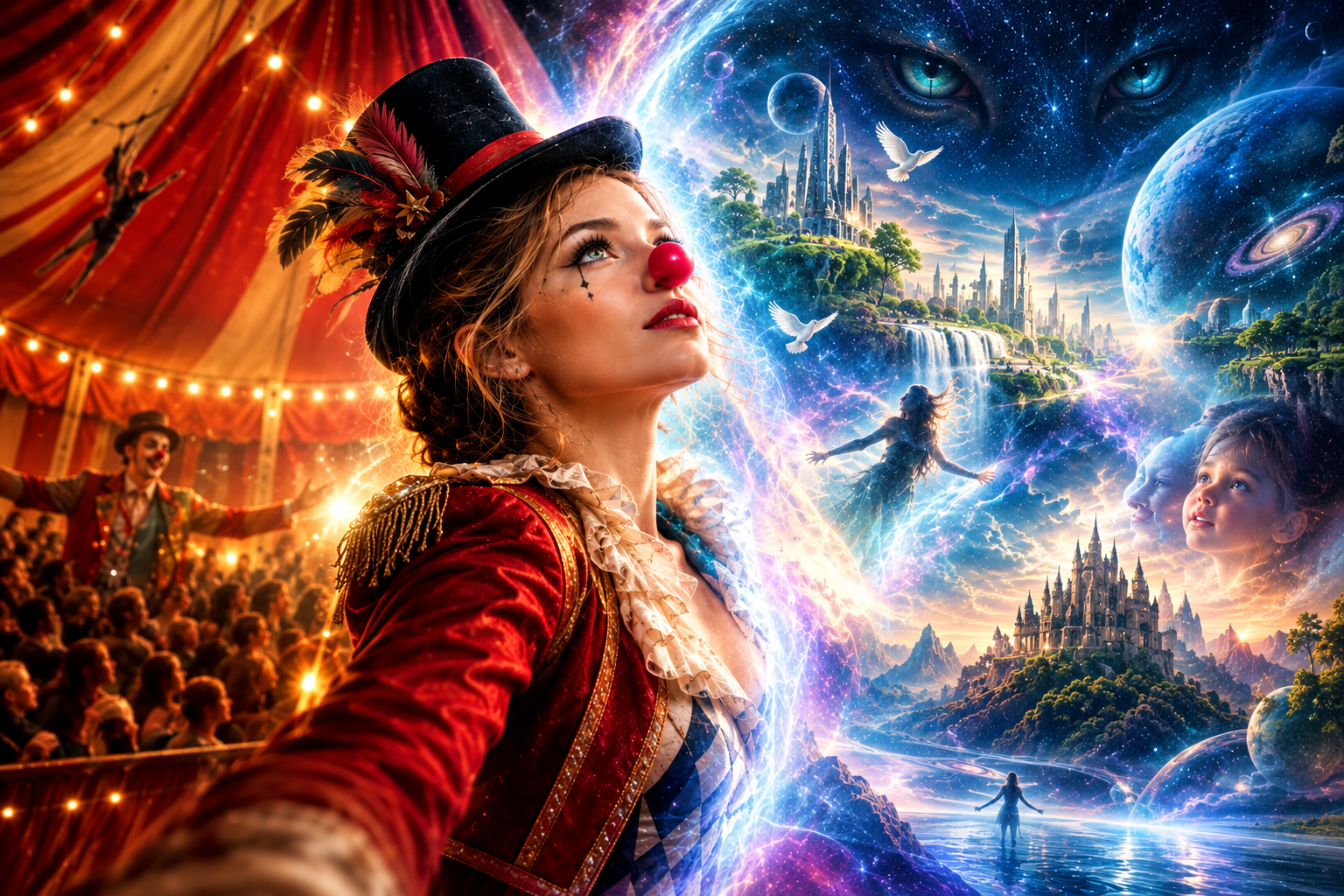
What if the reality we see were only part of the spectacle?
She looks into the mirror, and the image staring back at her is that of a sad woman, in stark contrast to the vibrant costume she is wearing. Desperate, she fights back her tears, afraid they will smudge her makeup.
A sharp sound announces the arrival of Xereta the clown, who squeezes his red nose, sets off his funny horn, and says:
“Come on! The audience is excited tonight. What about you?”
Holding her emotions in check, the young woman replies:
“Of course!”
Eva grew up without roots. After losing her mother, the death of her father had left her horizon clouded — he had been her only connection to something stable: family.She began working at the circus as a child. She lived a nomadic life on the wheels of a trailer she called home, with no foundations to anchor her. Each month brought different landscapes beyond the windows; the roads introduced her to new faces as she searched for her own identity.
Together with Xereta, she heads for the ring. The curtains open; music and applause echo through the air, and for a moment, the magic hides the anguish.
Xereta steps forward, stretches out his arms, and, with a sweeping bow, announces:
“Jujuba, our beautiful clown!”
The air smells of popcorn and caramel; the drummer punctuates the moment with an enthusiastic roll. Dressed in joy, she wears a wide smile and a red rubber nose. Children, their eyes wide with wonder, gasp with anticipation. The parents feel a flutter in their stomachs, pleased that they have managed to save up all month to see their children happy.
Eva had taken on the clown’s persona ever since her father’s sudden death. The costume had become the perfect mask to conceal her sadness and reveal a manufactured joy. But behind the colors of the spectacle, something vibrated on another frequency.
Xereta and Jujuba perform their antics, somersaulting, walking on stilts, stumbling over their own feet and falling on purpose. Their baggy trousers, held up by suspenders, threaten to slip down. They interact with the audience, tell jokes, and provoke bursts of laughter. With unexpected tricks, they advance toward the first rows, letting out loud fart noises that leave the area partially clouded in a white mist of talcum powder.
Between one act and another, Eva inhabits different characters. As Pandora, she wears a short metallic-green jumpsuit. A flowing black cape completes the look. Fishnet stockings and high-heeled boots accentuate her figure. Her blond hair is pulled into a low bun beneath her top hat. Her makeup replaces Jujuba’s laughter with the enigmatic gaze of a Columbine.
Facing the audience, she remembers the circus director and the responsibility he had left in her hands. Her inner voice screams at her to run, but the impulse is suppressed. The roll of the drums announces the magic act.
Pandora covers the cage with a black cloth. The audience holds its breath. With a swift movement, the birds disappear, and the next instant, six white doves cut through the air. Children run after them. She bows in gratitude and disappears for a few seconds behind the red curtain.
As she changes costumes and retouches her makeup, new thoughts arise.
She loved the colorful clothes and the glow of the dressing room. She loved bringing new characters to life — a way of bringing to the surface what lay dormant within her. Watching people’s behavior during the show was part of the enchantment. Drawing gasps and laughter from them gave her profound satisfaction.
She was aware that her work was a link between reality and fantasy, between the purity of a child and the greed of an adult. She wanted Jujuba to awaken feelings as sweet as her very nature — a way of transforming tears of sadness into moments of joy.
Whenever she opened Pandora’s box, she dreamed that all the evils of humanity would dissolve. She wanted to touch people’s hearts with her magic wand, so they could feel that everything can change its appearance when we move away from a superficial view.
She hoped to transform the circus into a grand project, but her thoughts gave her no respite, and her emotions swung like a roller coaster. Keeping the tent standing required the complicity of all the artists who worked there — pillars balancing the great canvas structure, with her as its central mast.
She navigated her many roles using the very tools of the circus. Sometimes the mask took the place of the stilts; at other times, the stilts took on the function of a mask.
The stilts, which allowed her to see the world from above, offered her a unique perspective, but also a distance from what many believed to be reality. The mask, with its forced smile, concealed her fear — the fear of moving forward, of carrying on her father’s legacy, with all its demands and expectations. She felt lost between these two elements: between who she needed to be for the audience and what truly pulsed within her.
The stilts gave her height, but inside, she felt small. The mask gave her an identity, but at the same time, it stole her own.
Ravel’s Boléro begins to play. Eva appears. She wears a black leotard embroidered with rhinestones; silver ballet slippers lend lightness to her movements. Her hair is adorned with a small tiara of shimmering crystals.
She climbs the ladder while Tony waits for her high above on the aerial fabric. The performance begins. The lights go out. Spotlights focus on the two artists.
In perfect synchronization, the pair dances, spins, and turns upside down. Eva swings while seated on the metal hoop. But, defying the laws of physics, she wraps herself around the rope. Her free mind interacts with the coexisting multiverses that carry fragments of her within them. Her partner embraces her, and together they soar beneath the illuminated ceiling. The acrobat realizes that caution is necessary, because sometimes the law of “every person for themselves” applies. But she rejects that theory because she believes everything vibrates and everything is connected.
Tony walks across the tightrope, and Eva takes advantage of the fact that no one is watching her. Mystery inhabits the moment. She looks at the fabric and passes through the double slit. Like a wave, she plunges into infinite possibilities while her physical body remains bound to matter.
The performance continues. The crowd is completely absorbed by the image of the acrobat and sees only the reflection the circus has shaped for her. But within her, reality folds and spreads into the Whole. While her physical body remains there, leaping from the trapeze or balancing high above the ground, her essence dances among invisible worlds, finding passage beyond the reach of the audience’s eyes. Every applauded leap is more than acrobatics. It is an interdimensional journey.
Suddenly, everything dissolves. Logic shatters, and she becomes energy, scattered through a vortex of light. Her body follows the rhythm of the performance, but her soul has already crossed the boundaries of the stage — free to experience what the eyes cannot perceive.
She drifts through the void, among different frequencies. She regains consciousness. She is standing before beings from Sirius, in the constellation Canis Major. They observe her with luminous, feline pupils. Without the need for words, she understands and sees her own fractal, carrying out lessons in energy healing and belonging to a group of guardians of planet Earth. There, reality transcends everything she has ever known.
But when her thoughts shift, another whirlwind carries her away.
“Why don’t you strangle me now?”
Her heart races. She is no longer merely an observer. She is him. And he is her.
Before she can understand, another spin pulls her away. Walls rise before her. Cold cuts through her skin. A medieval castle materializes; there is a dungeon. The sound of incessant whistling echoes through the air. A brutal soldier strangles a prisoner. The terrified young man’s eyes meet hers. A shock surges through her body — there, she witnesses the origin of her own misophonia.
The realities overlap. She is a teacher in Andromeda, teaching children about freedom and justice. Then she is a cabaret dancer. An old man on his deathbed. A helpless child. She travels across galaxies and realizes that her life unfolds across parallel planes.
Finally, she arrives at a place her heart recognizes. A city where advanced technology and nature exist in harmony. She glimpses vertical gardens, quiet streets free of pollution, and wireless electricity. Before a three-dimensional hologram, she learns about the power of the mind and the care we must take with our thoughts, since everything we think manifests itself. She becomes certain that she is part of the Whole. Creator and creation.
The loving gaze of a boy meets hers.
“Mommy, are you home from work already?”
And then love explodes in her chest. Her oxytocin rises, and her neurotransmitters cross the threshold into unconditional love, granting her the greatest power. Her vibration reaches unimaginable levels and tears through the veil of illusion. She becomes light, she flows… She experiences the fullness of receiving what she had already given without realizing it. Another memory, no less intense, emerges. But then, the moment dissolves.
She feels a hand on her shoulder. It is her father.
“Reality also exists beyond dense matter,” he says.
“Time is a trick. You need to see beyond the spectacle that keeps the masses distracted.”
Fear pulses through her. A flash of light surrounds her, and in an instant, she is back in the show. The audience remains enchanted by her performance, unaware that what they are seeing is only a fraction of what is truly happening. They do not know that, while they applaud, the artist is crossing the fissures of time and space, exploring dimensions invisible to ordinary perception. What they see is an illusion. Eva is living the truth of what she is, beyond matter.
She leaps onto the trapeze, plunges into chaos, defies gravity. Her mind echoes through the multiverse, feeling itself to be part of each one.
Tony catches her in midair. Shouts and applause echo through the circus. But she no longer hears them.
Her eyes find something in the crowd sleeping below.
In a quantum leap, she leaves the trapeze, lands on the trampoline, and touches solid ground. Her partner runs to catch her. He fears that something has gone off script.
“What’s happening?” he asks, breathless.
Eva simply stares into the void. She sees that her eyes have just left the circus, stamped onto the face of a little girl, and vanished into the crowd.
Now she knew: reality was not just one. It was all of them. And none of them, at the same time.
https://digitalmehmet.com/author/rschumaher
Connect wih me via my website, Medium and LinkedIn
Discover more about my journey as a writer in my interview with Dr. Mehmet Yildiz.


Leave a Reply