

Deck Officers, Engine Room Antics, and the Golden Era of Automation
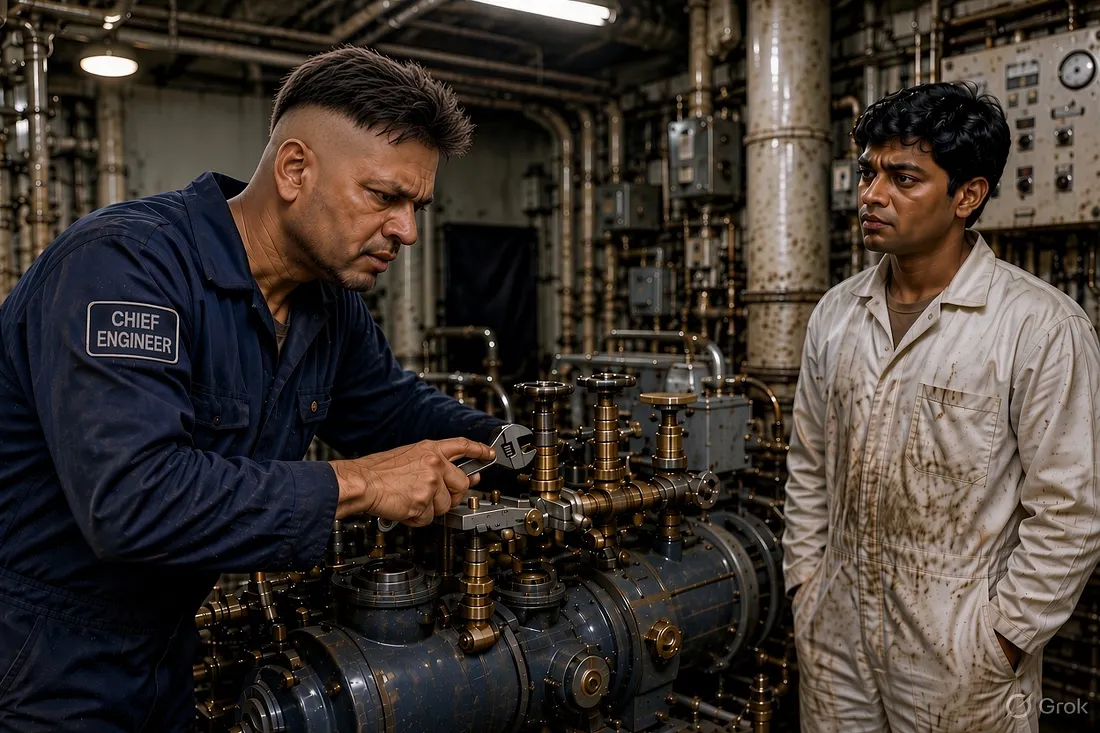
The Chief Engineer adjusting valves during his secret late-night operation in the A/C plant room. (Image Credit: AI-generated via Grok)
Midnight Sabotage in the A/C Room
Gathering the requested tools, I faced an immediate hurdle: I had no idea where the A/C plant room was located, only that it sat somewhere up in the accommodation decks outside my domain. I hunted for Patel, but he had prudently relocated to a new, secret hiding spot to avoid being roped into midnight labor.
I hurried up the companionway ladders to the crew recreation room, where a late-night movie flickered on the TV screen, and an off-duty fitter was dozing on a vinyl couch. I tapped his shoulder lightly and moved quickly to a safe distance, out of range of his swinging arms. He started awake with a sudden gasp, blinking in confusion. I offered a quick apology and asked for directions to the A/C room. He pointed vaguely up a deck, gave me the door number, and instantly drifted back to sleep.
When I pushed open the heavy steel door of the A/C plant room, the Chief Engineer turned around and beamed approvingly at my grime-streaked boiler suit and disheveled hair.
“I didn’t expect to see you so quickly,” he chuckled, snatching the flashlight and spanner from my hands. “I fully expected you to spend the next hour walking in useless circles trying to find this room.”
He bent over the compressor manifold, tweaked a couple of bypass valves with calculated precision, listened attentively to the hiss of freon, and nodded with immense satisfaction.
As he worked, I tried desperately not to stare at his head. He wore a wig, but it was a complete disaster — crooked, lopsided, and sitting precariously at a bizarre angle on his scalp. I quickly dragged my eyes away to the deck plates as he turned around.
“Now, listen to me very carefully,” he warned, his eyes narrowing sternly. “You do not breathe a single word of this to anyone on this ship. Do you understand?”
I didn’t have the slightest clue what mischief he had just committed, but I nodded obediently.
“If I hear even a whisper,” he added, emphasizing the absolute secrecy of his operation, “I’ll behead you and hand your head over to my son as a football.”
I assured him my lips were sealed forever, though I remained completely baffled as to why the Chief Engineer of an ocean-going vessel was sneaking around in the dead of night sabotaging his own machinery.
The mystery unravelled the following morning when chaos erupted across the accommodation decks. All engineers and engine crew occupied cabins on the port side of the vessel, while the deck officers and navigation crew were housed on the starboard side. While port-side cabins enjoyed an arctic, refreshing chill, the starboard cabins had inexplicably turned into suffocating saunas overnight.
Since I had been the junior officer on watch, I was promptly summoned by the Captain and Chief Officer for a thorough interrogation. I was quickly cleared of suspicion when I truthfully — and bewilderedly — admitted I hadn’t even known where the A/C plant room was located.
For three straight days, the phantom malfunction persisted: starboard cabins remained pleasantly cool during daytime inspections, only to mysteriously bake their occupants after midnight. The Chief Engineer must have left instructions to the E/O to adjust to the original setting in the morning during his rounds. Eventually, the Chief Engineer grew bored of his prank once the novelty wore off — and perhaps because sneaking through narrow alleyways at midnight every night was proving far too tiresome for a man of his seniority.
Cats, Dogs, and Maritime Rivalries
The Chief Engineer’s midnight sabotage was merely one small skirmish in an age-old naval war. Engineers and navigating officers (deck officers) make for remarkably strange bedfellows. Much like cats and dogs coexisting under one roof, they harbor a deep-seated, historic rivalry, losing no opportunity to trade insults, deride each other’s credentials, and blame one another for every operational hiccup on board. Yet, deep down, both departments recognize the other as an unavoidable, necessary nuisance.
This professional animosity traces its roots back to the Industrial Revolution, when majestic sail-powered vessels were abruptly replaced by dirty, noisy ships powered by coal, steam, and heavy diesel engines. The traditional deck officers, accustomed to the quiet elegance of wind and canvas, suddenly had to share their sanctuaries with soot-covered engineers.
Navigating cadets traditionally joined the merchant fleet right after completing their tenth-standard school exams. Consequently, their academic qualifications were a frequent target of ridicule among university-educated engineers. Yet engineers — chief engineers included — constantly had to swallow their pride, as the Captain maintained ultimate, undisputed command of the vessel under maritime law.
Furthermore, engineers frequently harbored a quiet, simmering jealousy over the glamorous public image enjoyed by deck officers. In popular literature, maritime journalism, and cinema, the heroic figures are invariably deck officers outfitted in immaculate white uniforms with glittering gold epaulets. The engineers — sweating in oil-drenched boiler suits deep down in the dark bilges — are completely ignored by the public eye.
The single notable exception in pop culture was the classic film The Sand Pebbles, starring Steve McQueen. I watched that movie repeatedly as a young man, purely because the protagonist was a proud, resourceful engineer rather than a polished deck officer.
Conversely, deck officers deeply envied the long-term career flexibility enjoyed by engineers. Marine engineers could easily transition to shore-based industrial roles — power plants, manufacturing facilities, and heavy machinery firms were always hungry for their technical expertise. Deck officers, on the other hand, possessed highly specialized navigational skills that offered precious few landward opportunities. Most had little choice but to sail for the entirety of their working lives.
It closely mirrors the modern aviation industry. Airline pilots in sharp, tailored uniforms dragging sleek luggage through airport terminals command instant awe and public respect. While they undoubtedly shoulder the heavy responsibility of passenger safety, their very lives depend entirely on the flawless precision of aircraft maintenance engineers — the unsung heroes working late-night shifts in hangars, who rarely receive a single word of gratitude. All the public glory is gobbled up by the pilots, much like Bollywood lead actors collecting awards while the lyricists, choreographers, and set crew remain invisible.
Enjoyed this story? Want to read the full story? What other surprises are in store for him?
You can support my independent writing and get access to the full library, exclusive digital bundles, and art prints on Patreon:
- Join Tier 1 ($3.00/month): Get full access to this story plus all past and upcoming essays, mythological retellings, and e-book collections.
- Buy this single story ( 3 parts) ‘Second Day in My First Ship’($3.00): Download the complete file to keep forever.
Explore My Books on Amazon:
- Trapped on an Unseaworthy Ship: Memoirs of a Chief Engineer
- Bhishma: The Legend (Volume 1)
- [Follow My Official Amazon Author Page] A.K.Girisam Amzon Author Page
Thank you for supporting my writing journey! The next chapter arrives soon


Leave a Reply