

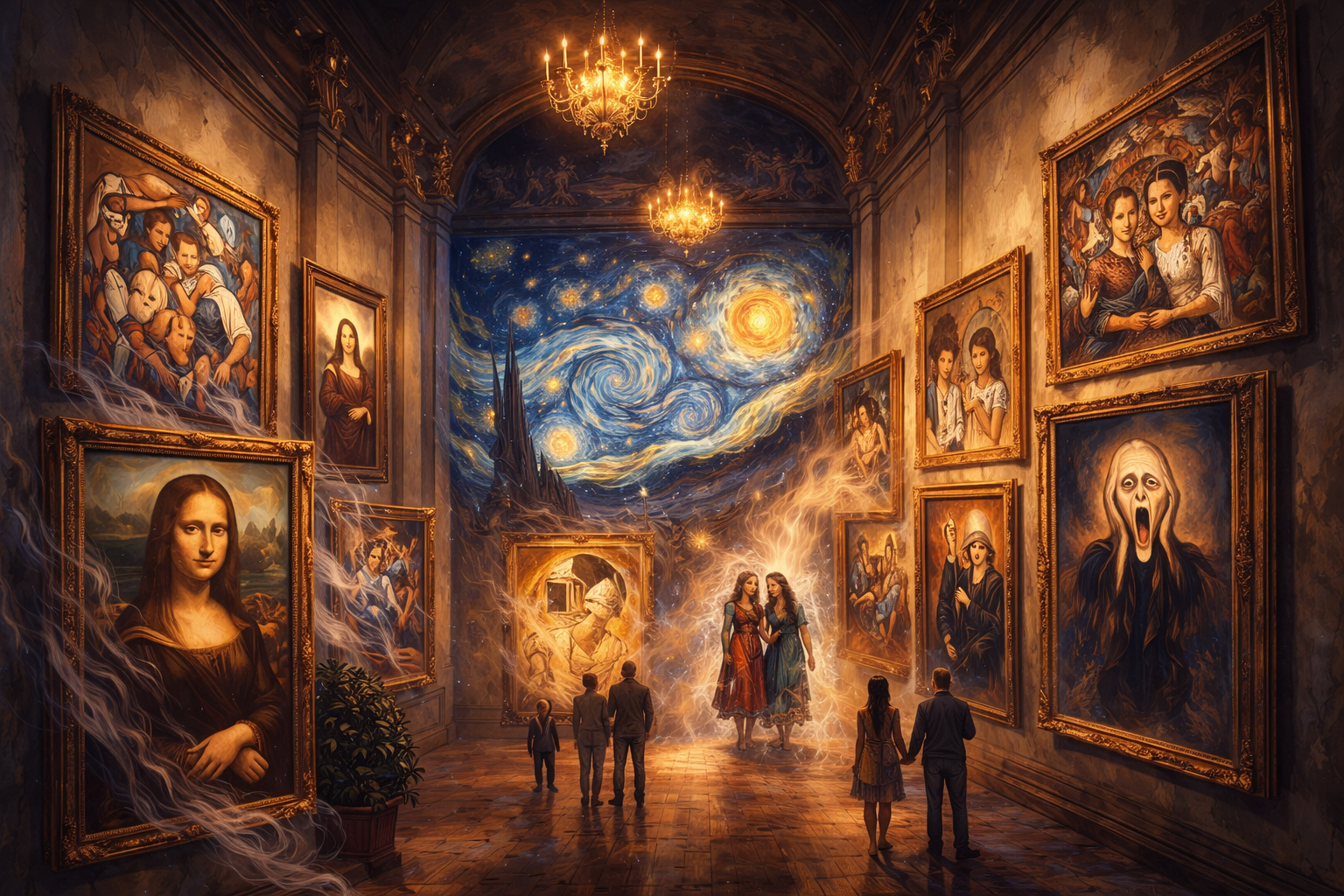
When art ceases to be contemplated and begins to breathe
That day, the exhibition had been an unquestionable success. It brought together the most celebrated masterpieces of the centuries, and countless visitors wandered through its halls. Some spoke of the difficulty of capturing human expression; others debated the challenge of representing the abstract; still others insisted that the hardest task of all was portraying nature itself.
The most revered paintings of all time hung upon those walls. When the final door closed, what unfolded inside went far beyond what the visitors’ eyes had dared to perceive. A faint hum lingered in the air, as though the gallery itself were breathing in the dark.
Behind the Mona Lisa, a shadow slowly rose, as if shaped from the same substance that inhabits every work of art. It gently brushed her hair and whispered:
“Mia Gioconda… today I noticed your smile was even more enigmatic. I feared your body might begin to move — that you might surrender to the passions of men. We have always been together; we are one. I do not know where you begin and where I end.”
Nearby, the stars began to whirl with greater intensity within The Starry Night.
Then the anguished voice of Vincent van Gogh broke the silence.
“I painted the sky as one bleeds ink. Each spark was a lament. And still they say I saw the universe distorted… No. I see it aflame.”
They turned toward Salvador Dalí.
“When I look at The Persistence of Memory, I am struck by how you seem to have foreseen the future. Today, it is not only clocks that melt in the heat — even minds are dissolving.”
Dalí smiled, twisting his ethereal mustache.
“Time has always been malleable. It is people who pretend it is solid.”
Near a towering column, fragments of faces rearranged themselves before Pablo Picasso.
“Reality never possessed a single angle,” he said. “I was merely honest enough to fragment it.”
In a corner bathed in intense gold, the gilded leaf shimmered within The Kiss.
Gustav Klimt spoke softly.
“Love is both ornament and abyss. It gleams on the surface, yet devours within.”
Suddenly, an eyebrow arched in defiance.
Frida Kahlo crossed the room, carrying with her the force of The Two Fridas.
“I painted myself because I was the subject I knew best. And even so, I was never whole. There are pains that exist only when we dare to look at ourselves directly.”
Beneath the window, light dissolved form within Impression, Sunrise.
Claude Monet watched brightness spill through color.
“Nothing is ever still. Light changes everything. Even us.”
Then a heavy silence settled over the hall.
There, in front of The Scream, the atmosphere seemed to thicken.
Edvard Munch kept his eyes fixed upon the floor.
“I did not paint a man screaming. It is the sound of the world passing through the soul.”
They turned, uneasy. Artists and artworks faced one another — and recognized themselves.
The hum in the air grew increasingly disquieting.
The walls seemed to draw inward.
There was no empty space left.
Then the Scream emerged.
The figure upon the bridge stretched its mouth beyond what seemed possible, and the sound did not come from it alone — it came from the entire gallery: from the walls, the floor, the ceiling. It was fear piercing through eras like invisible bars, like unseen hands tightening around throats.
The frames trembled.
Colors drained from the canvases.
The artists felt freedom pass through them, as though feeling had at last found the keys to its confinement.
It was no longer possible to distinguish creator from creation.
Brushstrokes pulsed like veins.
The canvases had hearts.
That night, art ceased to be representation.
It became reality.
And ever since, whenever a door closes, something begins to breathe in the dark.
https://digitalmehmet.com/author/rschumaher
Connect with me via my website, Medium, Instagram and LinkedIn
Discover more about my journey as a writer in my interview with Dr. Mehmet Yildiz.


Leave a Reply