

Censoring Circus
The Draconian Censor rules that Cracked Producer’s Knuckles and the Art of Tightrope Walk.
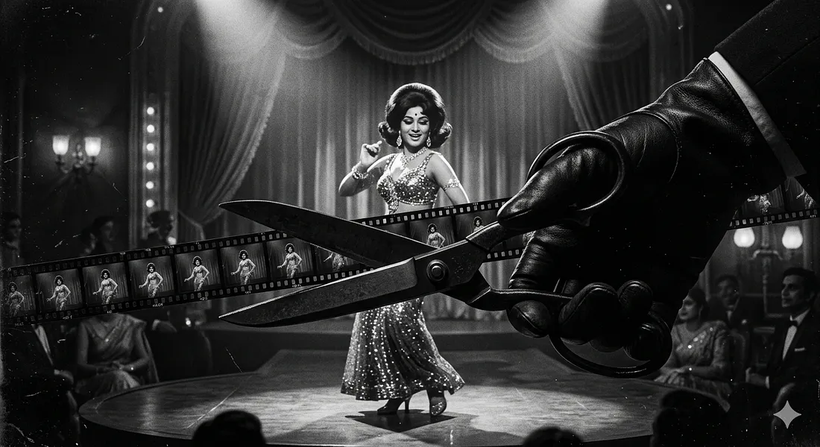
The ultimate tightrope walk: Old-school filmmakers had to artfully choreograph their stories around the literal and metaphorical scissors of a watchful Censor Board. (Image generated by Gemini)
Author’s Note:
Girisaṁ’s Coffee Shop, nestled under the cool shade of a sprawling tree, is a sanctuary for minds and souls to relax and unwind after a rigorous trek up the steep slopes of scholarly, educational, and technical stories. Here, there are no three-minute quick fixes for losing weight or gaining riches.
Enjoy a piping-hot cup of coffee paired with delicious snacks—where humor is the main ingredient, seasoned with a splash of high-seas maritime adventures, tales of Bhishma, and timeless mythology. No action is expected or required from you.
Pause to take in the panoramic view of the hills and cascading waterfalls before resuming your trek toward knowledge! Dr Mehmet Yildiz and Dr Michael Broadly would surely recommend a healthy dose of humor as the perfect complement to a nutritious diet and exercise regimen. Humor is the best medicine!
To be fair, though the censor boards of the black-and-white movie era were notoriously prudish, the AI of the present day is no better. With their Victorian codes of moral conduct and rigid guidelines, modern algorithms are just the digital ghosts of old-school censors.
Back then, there was no grey area — it was strictly black or white. You either bowed to the censor board’s rules or your film perished.
Take alcohol, for instance. In one vintage film, a husband encouraged his wife to take a sip of whisky. The ensuing hue and cry was so massive that the board slapped the movie with an “A” (Adults Only) certificate, a devastating blow in an era where the coveted “U” (Universal) certificate was the only ticket to a packed house.
The Mouth-to-Mouth Loophole
Kissing on screen was a catastrophe. Attempting it was essentially signing your own financial death warrant. No producer dared cross that line — until one brilliant mind found a novel loophole: a scene where the hero had to give mouth-to-mouth resuscitation to a drowning heroine.
When the board gasped, the producer argued, “Would you have him sacrifice a human life? The hero is not kissing her with amorous intention; he is saving her!”
The censor board grudgingly passed the scene, but with a strict condition: the hero had to marry the girl in the very next reel.
Language, too, was a poetic tightrope. Even the slimiest villains had to watch their vocabulary during assault scenes, relying instead on loud, harsh, theatrical laughter to convey their wicked intentions. He could not even say any foul word under his breath.
As an audience, we were relaxed. We knew the rules of the universe: the hero would rescue the girl, and the villain would either go to prison or reform or die. The villain only had a real fighting chance at survival if he happened to be married to the hero’s sister. The hero might bash his brother-in-law, but he would never kill him. By the final scene, the hero would request the police to release him because he had “reformed,” and the police — conveniently ignoring the man’s extensive criminal record — would oblige.
Life Mirroring Art (and Vice Versa)
They say movies mirror society, but the reverse is often true: people are deeply influenced by what they see on screen.
As a child, seeing lions devour zebras for the first time in the documentary African Safari ruined my appetite for days. It fundamentally shaped my food preferences. Years later, when I opted for a career in shipping, I realized the biggest challenge of the seafaring life was simply remaining a vegetarian.
Ships would store two months of food stock in massive refrigerated rooms. The meat and fish lockers were locked at -25°C while the dairy and vegetable rooms were at +5 ° C. Fresh vegetables were gone in less than two weeks, leaving only a very limited, frozen selection.
Today, I am horrified to see small children calmly eating their dinner while watching mindless violence on television. In one recent movie, a man is beheaded, and his headless body continues to dance for a few seconds before collapsing. Society has become entirely immune to gore.
The Virtue Tightrope
In the old days, the censors dictated that a woman’s chastity was more important than her life. If an unfortunate woman was wronged by the villain, the script invariably killed her off in an accident.
Even as a child, I couldn’t understand why the onscreen parents would drive their daughter away instead of thrashing the culprit. It was considered a “revolutionary” movie if the woman actually hunted down and maimed the villain herself.
To bypass the strict rules on eroticism, producers mastered the art of the tightrope walk. They would systematically squeeze exactly two cabaret dances into every film — usually set in a hotel or the villain’s secret den.
Young men would throng the theaters just to watch the voluptuous, richly endowed cabaret sisters who captivated the nation with little to no inhibitions. This was the board’s ultimate headache: When do we award an ‘A’ certificate? When do we order a re-shoot? When can we watch the film entirely?
Sneaking Past the Gatekeepers
The theater gatekeepers had the daunting task of policing the crowd. In an era with no ID cards, no driver’s licenses, and hardly any vehicles on the road, age was a guessing game.
As teenagers, my friends and I were frequently shooed away. Our stern, serious expressions and hurried walks never fooled the guards. Defeated by local cinema, we would sneak into English movies instead, where the management seemed to tell the gatekeepers to be a bit more lenient.
I still remember sneaking in to watch a Peter Sellers comedy where he accidentally wanders into a nudist party carrying nothing but a guitar. Even Western cinema back then was relatively restrained, though they certainly didn’t shy away from a kissing scene.
The Safe Distance
Because they couldn’t show reality, writers became absolute masters of double-meaning dialogue and suggestive lyrics. On the surface, the songs looked entirely innocent and decent; underneath, the second meaning was delightfully naughty, outrageous, and entirely “censor-cut” worthy.
It all came down to the specific members of the board tasked with policing the morals of society. A few fun-loving men were liberal, but the women on the censor board were famously tough nuts to crack.
In general, the censors were satisfied as long as the golden guideline was met: Truth Wins. Good had to triumph over evil. The heroines’ parents always hated the hero — it didn’t matter if he was a university gold medalist or the most handsome man in the province; Only because he had the temerity to fall in love with their daughter! He still had to fight the villains and the parents to win her hand.
Through it all, the board watched like hawks, practically measuring the physical distance between the actors during romantic duets to ensure they maintained a “safe distance.”
Yet, despite the censor board’s monumental efforts to police the screen, the mid-century population explosion continued unabated. Did those cabaret-dancing sisters excite the imagination of men more than the explicit media of today? Perhaps. Or perhaps a lack of contraceptives and knowledge was the truer culprit.
Still… it is certainly food for thought.
Enjoyed this story? Want to read the full story?
You can support my independent writing and get access to the full library, exclusive digital bundles, and art prints on Patreon:
- Join Tier 1 ($3.00/month): Get full access to this story plus all past and upcoming essays, mythological retellings, and e-book collections.
- This story is free on Patreon. Censoring Circus
Explore My Books on Amazon
- Trapped on an Unseaworthy Ship: Memoirs of a Chief Engineer
- Bhishma: The Legend (Volume 1)
- [Follow My Official Amazon Author Page] A.K.Girisam Amazon Author Page
- My books on Books2read
Thank you for supporting my writing journey! The next chapter arrives soon



Leave a Reply