

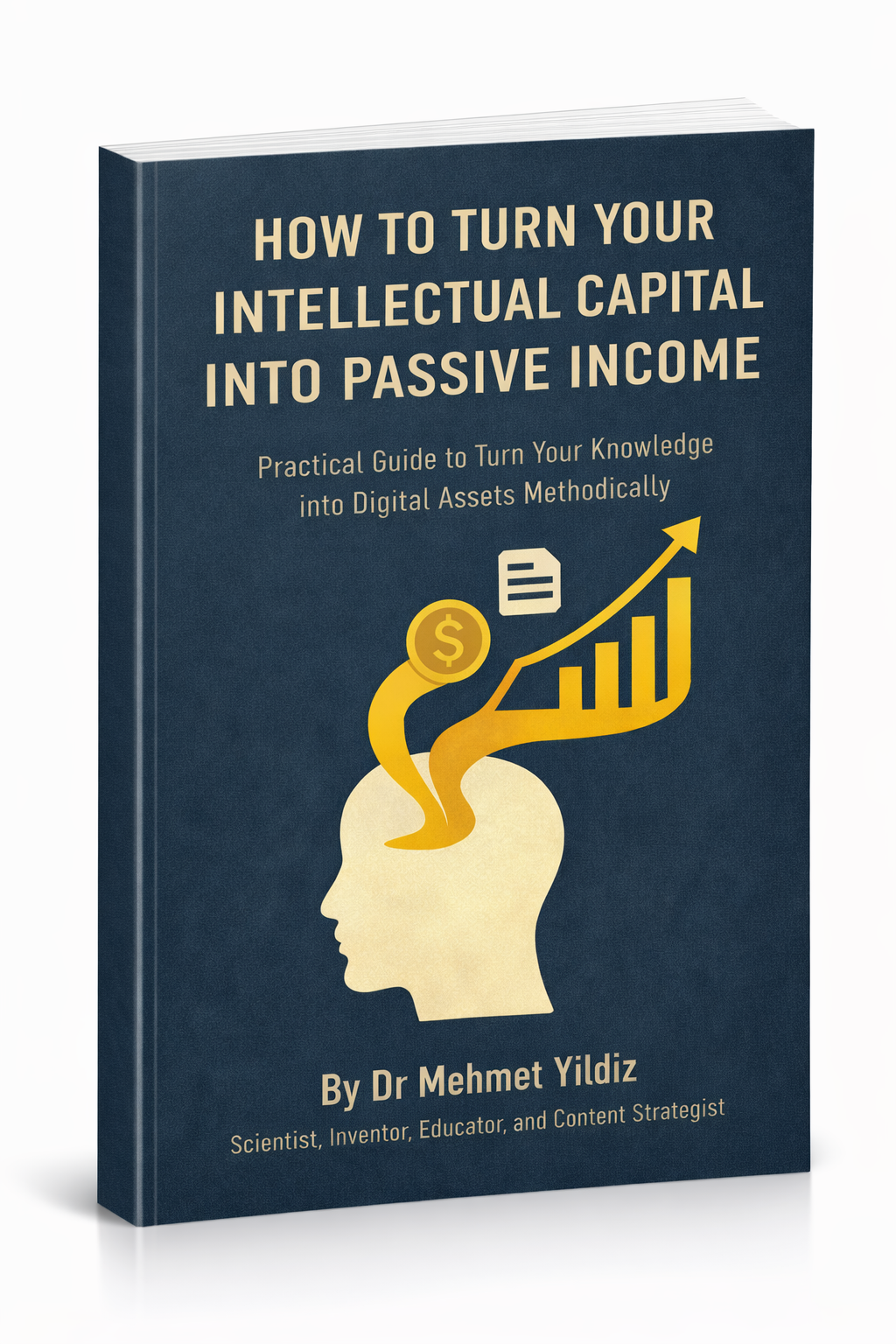
Integrating Two Frameworks to Create Synergy and Additional Clarity to Empower the Book “How to Turn Your Intellectual Capital into Passive Income: Practical Guide to Turn Your Knowledge and Experience into Digital Assets Methodically”
Curator’s Note: The book “How to Turn Your Intellectual Capital into Passive Income” utilizes two integrated frameworks: ICELAND™ and CAPITAL ENIGEN™. ICELAND™ focuses on the formation of intellectual capital, detailing processes like immersion, compression, and articulation, which transform tacit knowledge into structured assets. Conversely, CAPITAL ENIGEN™ serves as the activation architecture, encompassing steps to protect, govern, and monetize these intellectual assets. Together, they emphasize that intellectual capital must first be developed and stabilized before generating sustainable income. This dual framework clarifies responsibilities and enables professionals to manage their knowledge systematically, leading to predictable revenue without reliance on constant effort. This cornerstone essay was written by Dr. Mehmet Yildiz, who is the author of this book and 50+ more books in technology, science, healthcare, and content strategy.
Dear Subscribers,
You may wonder why this book uses two frameworks. When I began structuring this book, I faced a strategic choice.
I could present a single model explaining how intellectual capital becomes passive income. That approach would have been simpler. It would have required fewer diagrams and fewer moving parts. Yet it would not have been accurate.
Through decades of immersion in enterprise systems, research environments, invention cycles, consulting engagements, authorship, and disciplined documentation, I observed something that many discussions about passive income overlook. Intellectual capital formation and intellectual capital activation are not the same process. They operate under different logics. They require different disciplines. They mature at different speeds.
Attempting to compress both into one model creates conceptual confusion.
This is why this book introduces two distinct yet integrated frameworks: ICELAND™ and CAPITAL ENIGEN™.

ICELAND™ explains how intellectual capital forms. CAPITAL ENIGEN™ explains how intellectual capital functions economically. One describes cognitive architecture. The other describes economic architecture. Understanding this distinction is the key.
Many professionals I know work intensively for decades without realizing they are accumulating intellectual mass. They believe they are merely earning income. In reality, they are building structured judgment, pattern recognition, principled reasoning, and tacit expertise. Yet because this formation remains undocumented or unstructured, it never transitions into durable assets.
Others attempt to activate monetization mechanisms prematurely. They build digital products, courses, platforms, or subscription channels without first developing density. The result feels forced. Revenue becomes unstable because intellectual mass never reached compression.
The problem is not effort. The problem is sequencing. ICELAND™ exists to clarify formation.
It explains how immersion under real constraints produces tacit knowledge, how repetition compresses experience into judgment, how effort builds density, how leverage awareness signals readiness, how articulation transforms thought into structure, how Nexus strengthens coherence, and how Dividends prove durability.
ICELAND™ answers the question: How does intellectual capital become solid? But solidity alone does not produce structured yield. This leads to an aha moment.
Many highly capable professionals reach a point at which their thinking exerts influence, yet their economic model remains linear. Their frameworks guide decisions. Their documents circulate. Their ideas shape outcomes. Yet income still depends on daily presence.
This is where CAPITAL ENIGEN™ becomes necessary.
CAPITAL ENIGEN™ answers a different question: How does formed intellectual capital become governed, protected, and scalable intellectual property that produces durable economic yield?
- Capture prevents intellectual evaporation.
- Abstraction extracts transferable principles.
- Protection secures ownership.
- Institutionalization embeds knowledge into systems.
- Transfer enables replication.
- Amplification extends reach.
- Licensing monetizes structured permission.
- Encoding preserves fidelity.
- Navigation aligns assets with appropriate ecosystems.
- Governance protects integrity.
- Integration creates coherence across outputs.
- Normalization stabilizes yield.
- Earning becomes a structured outcome rather than a volatile hope.
These two architectures operate at different layers of reality.
ICELAND™ operates inside the mind and through disciplined documentation. CAPITAL ENIGEN™ operates inside legal systems, markets, institutions, and distribution channels. Separating them clarifies responsibility.
If intellectual capital is weak, the problem lies within ICELAND™. If monetization is unstable, the problem lies within CAPITAL ENIGEN™. If both function properly, compounding becomes predictable. This integration might create another aha moment in your understanding of the book’s key points.
Passive income is not passive at the beginning. It is engineered. It is structured. It is governed. It is documented. It is protected. It is normalized. Only after architecture stabilizes does effort detach from income velocity.
This is why I chose two frameworks rather than one. The glacier must form before the engine can move it. ICELAND™ forms the glacier, and CAPITAL ENIGEN™ releases its force.
Together, they create an integrated doctrine of intellectual property management aligned with my long-standing philosophy regarding tacit knowledge. Tacit knowledge remains powerful but invisible until it is articulated. Once articulated, it becomes transferable. Once transferred and protected, it becomes property. Once governed and integrated, it becomes infrastructure.
Infrastructure changes the professional identity.
When intellectual capital is treated as infrastructure rather than activity, anxiety reduces. Decision-making clarifies. Work becomes selective. Semi-retirement becomes strategic rather than uncertain. Contribution continues without dependency on constant exertion.
This integration offers readers several practical advantages.
First, diagnostic clarity. You can identify precisely where you stand. Are you immersed but unarticulated? Articulated but unprotected? Protected but unamplified? Amplified but unguided by governance? Instead of vague frustration, you gain a structural diagnosis.
Second, sequencing discipline. You will avoid premature scaling and delayed protection. You will know when to compress further and when to institutionalize.
Third, intellectual coherence. Your books, patents, courses, white papers, consulting models, and advisory structures will align around a unified architecture rather than existing as disconnected efforts.
Fourth comes the emotional steadiness. When you see your work as a layered infrastructure rather than an episodic activity, volatility becomes manageable.
The most awe-inspiring realization usually arrives quietly and slowly. For example, work you completed years ago continues shaping outcomes today. A structured framework influences thousands across decades. A patent enables entire product lines. A book becomes reference material in unfamiliar geographies. A white paper guides institutional decisions beyond your awareness.
This approach reflects a non-linear compounding. Yet non-linear compounding does not arise from luck. It arises from the formation and activation working together.
ICELAND™ without CAPITAL ENIGEN™ produces under-monetized brilliance. CAPITAL ENIGEN™ without ICELAND™ produces shallow products. Integrated, they produce a coherent intellectual infrastructure.
In the subsequent chapters of this, you will see how these frameworks operate independently and together. My intention is not merely to present concepts but to offer architectural thinking for your intellectual capital building. Architecture allows replication, replication enables compounding, and compounding produces stability.
The decision to treat your thinking as capital marks a turning point. The decision to engineer that capital systematically marks maturity. The glacier has already begun forming within your experience. The question is whether you will design the engine to guide its power.
Part I: ICELAND™ Framework: The Formation Architecture of Intellectual Capital
In this part, I introduce ICELAND™, a seven-layer executive architecture that explains how intellectual capital forms, stabilizes, and matures before it can generate durable economic value.
This model did not emerge solely from theory. It emerged from decades of immersion in enterprise systems, research environments, invention cycles, advisory work, authorship, teaching, and disciplined documentation. Over time, I observed a repeatable pattern across engineers, executives, scholars, consultants, and creators: serious work, when shaped intentionally, compounds into structured intellectual assets.
ICELAND™ does not describe monetization tactics.
It describes intellectual formation.
Most discussions about passive income begin at the wrong end of the equation. They focus on channels, tools, and platforms. Yet no engine produces motion without mass. Intellectual capital must first acquire density before it can generate yield.
ICELAND™ explains how that density forms.
The metaphor is deliberate. A glacier does not appear suddenly. It forms through accumulation, layering, and compression. Over time, it becomes powerful enough to gradually reshape landscapes.
Intellectual capital behaves the same way. It accumulates through responsibility, compresses through repetition, and gains power through structure.
ICELAND™ stands for:
- Immersion
- Compression
- Effort
- Leverage
- Articulation
- Nexus
- Dividends
Each layer transforms the nature of what you know. Each layer changes your relationship to work.
I — Immersion
Where Tacit Knowledge Begins
Immersion is sustained engagement in consequential work under real constraints. It is the phase where responsibility replaces theory.
You can imagine standing inside the system rather than observing it from the outside. A boardroom where decisions affect revenue. A laboratory where flawed assumptions invalidate results. A classroom where confusion forces clarity. A client engagement where vague thinking has a financial cost.
Immersion creates exposure. Exposure creates feedback. Feedback shapes judgment
In my early professional years, immersion consumed energy. I studied deeply, designed systems, solved complex problems, wrote technical explanations, and mentored younger professionals. At that time, income tracked presence. Work felt linear: effort produced output; output produced compensation.
Yet immersion was performing a deeper function. It was constructing intellectual mass. Without immersion, intellectual capital remains abstract. Reading cannot substitute for consequence. Theory deepens only when exposed to constraint. Immersion places knowledge under pressure, and pressure begins formation.
For executives, immersion means direct exposure to trade-offs. For scholars, it means confronting unanswered questions. For engineers, it means designing within limits. For educators, it means responding to real confusion.
Immersion forms the first layer of the glacier.
C — Compression
Where Experience Becomes Judgment
Compression is the process through which repeated experience condenses into pattern recognition and principled judgment.
You can visualize snow accumulating year after year. Gradually, the weight transforms it into dense ice. In professional life, repeated encounters with similar structures compress memory into intuition. Problems stop feeling chaotic. They begin to feel familiar.
Early learning requires conscious effort. Later understanding becomes implicit. You begin anticipating outcomes before all variables are visible. You detect structural risk before metrics confirm it.
Compression reduces noise. It sharpens discernment. It transforms scattered lessons into coherent models.
In business settings, compressed judgment allows leaders to see systemic fragility early. In research, it distinguishes meaningful anomaly from statistical fluctuation. In consulting, it produces recommendations grounded in principle rather than trend.
Compression also introduces humility. Experience reveals edge cases. It exposes uncertainty. It replaces rigid confidence with disciplined steadiness.
At this stage, intellectual capital gains density.
E — Effort
The Necessary but Temporary Engine
Effort is deliberate, sustained exertion that builds competence, credibility, and endurance.
You can picture a professional whose calendar carries the load. Meetings, deadlines, delivery cycles, explanations repeated across contexts. Progress depends on presence.
Effort builds capacity. It trains discipline. It establishes trust. Without sustained effort, intellectual mass remains thin.
In many professional work cultures, effort becomes identity. Busyness signals importance. Exhaustion signals dedication. For a time, this alignment holds.
However, effort is a formation phase, not a permanent strategy.
Through sustained immersion, I observed divergence among capable professionals. Some increased effort each year. Others redesigned their effort.
The difference lay in how they treated accumulated knowledge. Effort creates experience, and structure creates leverage. Without structure, effort binds income to time. With structure, effort becomes stored potential.
L — Leverage
The Inflection Point
Leverage is the recognition that accumulated judgment can reduce future effort for yourself and others. It marks the shift from repeated execution to architectural design.
Imagine solving the same class of problem again and again. At some point, you pause and ask: Why does this keep recurring? Instead of solving it repeatedly, you design a framework that prevents repetition.
Leverage awareness often emerges quietly. Work continues. Results remain strong. Yet repetition increases. Clients begin seeking perspective rather than labor. Colleagues request reasoning rather than execution.
This is the inflection point described in your earlier draft. Many interpret it as fatigue. In reality, it signals readiness for structural redesign. Leverage is the gateway from executor to architect.
A — Articulation
Turning Thought into Structure
Articulation is the disciplined conversion of tacit knowledge into explicit form through writing, modeling, diagramming, and structured explanation.
Picture an idea that feels obvious internally. The moment you write it down, ambiguity appears. Assumptions surface. The idea either collapses or strengthens through revision. Articulation exposes and refines.
Articulation externalizes cognition. It reduces cognitive load by replacing memory reconstruction with structured reference. It transforms experience into infrastructure.
For executives, articulation becomes decision frameworks; for researchers, methodological principles; for educators, structured curricula; and for innovators, schematics and patents. Articulation marks the conversion of tacit capital into transferable architecture.
N — Nexus
The Convergence of Minds
Nexus is the intersection point where articulated knowledge is tested, refined, and strengthened through intelligent interaction.
Picture a serious conversation rather than a broadcast. A peer challenges your model. A student asks a question that exposes a gap. A client pushes your framework into an unfamiliar context.
Throughout my career, dialogue sharpened ideas. Mentors questioned assumptions. Colleagues revealed blind spots. Students accelerated clarity
Nexus is cognitive convergence. It is not a distribution but serves as an intellectual stress test. Without Nexus, frameworks become brittle. With Nexus, they gain resilience.
Nexus strengthens coherence and prepares intellectual capital for structured dividends.
D — Dividends
The First Sustained Returns
Dividends within ICELAND™ are recurring benefits generated by structured intellectual capital before formal monetization. They are the sustained effects that continue even when your direct effort decreases.
Imagine a framework you created months ago still guiding a team today. For example, a white paper shaping decisions in your absence, a documented explanation eliminating repeated meetings, and a student applying your model successfully without further clarification.
Dividends appear first as:
Reduced repetition
Improved clarity
Increased autonomy
Selective engagement
Growing trust in your judgment
Over time, dividends also manifest as invitations, referrals, reuse of your intellectual materials, and opportunities arising from structured credibility.
Dividends signal that formation is complete. Intellectual capital now exists outside your immediate presence.
Executive Implications of ICELAND™
They are not yet fully monetized. They are proof of readiness.
Organizations that document reasoning, formalize decision frameworks, and institutionalize intellectual memory build resilience. Organizations dependent on key individuals remain fragile.
Individually, professionals who treat thinking as capital rather than an activity transition from time-bound income to structured yield.
From an inventor’s perspective, ICELAND™ is an engineering blueprint. Pressure produces compression. Compression produces structure. Structure enables leverage. Leverage generates dividends. The process resists shortcuts. It rewards consistency. It values depth over speed.
Key Points
The first realization: daily effort already contains seeds of leverage. The second: articulation accelerates freedom. The third: dividends appear before monetization. The fourth: structured intellectual architecture reshapes your professional identity.
ICELAND™ completes formation.
In Part II, we will introduce CAPITAL ENGINE™, the activation system that converts formed intellectual capital into protected, encoded, governed, and monetized intellectual property aligned with a coherent IP management strategy.
The glacier has formed. The engine is ready.
Part II: CAPITAL ENIGEN™ – The Activation Architecture of Intellectual Assets
In this section, I introduce CAPITAL ENGINE™, a twelve-node operational framework that converts formed intellectual capital into structured, protected, and monetizable intellectual property.
Where ICELAND™ describes cognitive formation, CAPITAL ENIGEN™ describes economic activation.
Many professionals successfully complete ICELAND™. They immerse, compress, articulate, design for reuse, and generate dividends. Yet they remain financially linear because they fail to formalize protection, governance, encoding, and yield stabilization.
CAPITAL ENIGEN™ addresses that gap. It stands for:
- Capture
- Abstract
- Protect
- Institutionalize
- Transfer
- Amplify
- License
- Encode
- Navigate
- Govern
- Integrate
- Normalize
- Earn
Each node represents a structural transformation. Each transformation moves intellectual capital closer to a durable, scalable economic function.
C — Capture
Preventing Intellectual Evaporation
Capture is the disciplined process of recording articulated knowledge in durable formats before it dissipates through memory decay or operational urgency.
Imagine completing a breakthrough insight during a consulting session or research engagement. Without capture, the insight fades into memory. With capture, it becomes a documented structure, such as notes, diagrams, draft chapters, internal white papers, and draft patents.
ICELAND™ articulation creates structure. Capture secures it.
Capture prevents intellectual evaporation. It converts refined thinking into tangible intellectual inventory. Without capture, formation remains vulnerable.
A — Abstract
Extracting the Core Principle
Abstraction distills captured knowledge into transferable principles independent of specific context.
Picture a consulting case solved successfully. Abstraction removes client-specific details and extracts the decision logic beneath the solution. The principle becomes reusable across industries.
Abstraction separates timeless reasoning from temporary conditions.
This step aligns closely with your tacit knowledge philosophy. Tacit insights often reside within specific episodes. Abstraction extracts the underlying architecture. Without abstraction, assets remain narrow. With abstraction, they become scalable.
P — Protect
Securing Ownership and Attribution
Protection formalizes legal and structural safeguards around intellectual assets to preserve ownership, attribution, and future optionality.
You may visualize examples such as books with registered ISBNs, patents with defined claims, copyright notices embedded in digital products, licensing agreements documented clearly, and trademarks assigned to frameworks.
Protection transforms intellectual capital into recognized intellectual property.
This is where your inventor perspective becomes central. Intellectual capital must be engineered and secured with foresight. Without protection, scale invites erosion.
Protection is not defensive paranoia. It is strategic stewardship.
I — Institutionalize
Embedding Knowledge into Systems
Institutionalization integrates intellectual assets into operational systems so they function independently of individual presence.
You may visualize a decision framework embedded in the company onboarding, a methodology adopted as internal policy, a teaching model standardized across programs, or a consulting template used consistently across engagements.
Institutionalization transforms individual expertise into organizational memory.
ICELAND™ created dividends at the personal level. Institutionalization multiplies those dividends across teams and institutions.
T — Transfer
Designing for Replication
Transfer is the deliberate design of intellectual assets so others can apply them without requiring your continuous supervision.
You can visualize it as a structured curriculum with clear progression, a licensing manual explaining implementation steps, or a white paper written with precision that enables replication.
Transfer requires clarity. It demands a disciplined explanation. It eliminates ambiguity. If ICELAND™ articulation created clarity, Transfer operationalizes it at scale.
A — Amplify
Extending Reach Without Diluting Substance
Amplification increases the visibility and accessibility of intellectual assets through aligned channels without compromising coherence.
You can imagine it as a central framework expressed as a keynote, book chapter, white paper, podcast discussion, academic article, or structured newsletter. The architecture remains stable. Expression adapts.
Amplification differs from exposure. Exposure seeks attention. Amplification seeks alignment. This node expands influence while preserving integrity.
L — License
Monetizing Structured Permission
Licensing grants defined rights for others to use your intellectual assets under agreed conditions, generating income without relinquishing ownership.
You can visualize it as a corporate training program adopting your model under contract, a university incorporating your framework into the curriculum with attribution, a software firm embedding your patented logic into product design.
Licensing can transform intellectual capital into structured permission economies. It reflects maturity. Ownership remains centralized. The application distributes outward.
E — Encode
Embedding Knowledge into Durable Formats
Encoding converts intellectual assets into stable, structured formats that preserve fidelity across time.
You can visualize it as books with defined chapters. Patent claims with precise language, recorded lectures archived for future learners, and digital platforms storing modular content.
Encoding protects nuance. It prevents distortion. It enables asynchronous influence.
Without encoding, amplification risks dilution. With encoding, scale retains clarity.
N — Navigate
Strategic Channel Alignment
Navigation identifies and aligns intellectual assets with appropriate ecosystems, platforms, institutions, and markets.
You can visualize it as selecting the right publishing channel, choosing appropriate licensing partners, aligning frameworks with industries that can apply them responsibly, or avoiding misaligned environments that distort purpose.
Navigation is strategic routing. ICELAND™ Nexus refined thinking through relationships. Navigation positions assets within economic ecosystems. They complement each other but operate at different layers.
G — Govern
Sustaining Integrity Over Time
Governance establishes oversight mechanisms that preserve quality, alignment, and coherence as intellectual assets scale.
You can visualize it as an editorial standard, licensing terms with performance conditions, periodic framework updates, or clear attribution guidelines.
Governance protects reputation and longevity. Without governance, scaling erodes credibility. With governance, growth strengthens authority.
I — Integrate
Creating Coherent Architecture
Integration ensures that all intellectual assets align within a unified conceptual system rather than remaining isolated outputs.
You can visualize it as books referencing shared frameworks, courses aligned with core principles, patents reinforcing broader models, and white papers extending foundational architecture.
Integration prevents fragmentation. In your work, multiple books, patents, designs, and other digital assets converge around coherent philosophical foundations. That coherence increases authority.
N — Normalize
Making Structured Yield Routine
Normalization occurs when intellectual asset performance becomes predictable, routine, and strategically managed rather than episodic.
You can visualize it as royalty streams monitored quarterly, licensing renewals scheduled systematically, advisory retainers renewed based on structured deliverables, or subscription models stabilized.
Income becomes managed infrastructure rather than an unpredictable outcome. Normalization can reduce volatility.
E — Earn
The Engine in Motion
Earning represents the sustained economic output generated by the fully activated intellectual capital engine.
You can visualize it as revenue flowing from books, patents, licensing, advisory retainers, subscriptions, derivative products, and educational programs — not because of daily effort alone, but because structured intellectual infrastructure now operates.
Earn is the visible output. The prior eleven nodes make it sustainable.
Integration: How ICELAND™ and CAPITAL ENIGEN™ Work Together
ICELAND™ forms an intellectual mass. CAPITAL ENIGEN™ converts that mass into structured motion. ICELAND™ is a cognitive architecture. CAPITAL ENIGEN™ is an economic architecture.
ICELAND™ produces Dividends as early signals of durability. CAPITAL ENIGEN™ stabilizes, governs, and multiplies those dividends into structured yield. One without the other creates an imbalance.
Formation without activation produces under-monetized expertise. Activation without formation produces shallow products.
Together, they form a coherent intellectual property management doctrine aligned with your tacit knowledge philosophy: tacit experience becomes explicit architecture, then governed intellectual property, then durable economic infrastructure.
Business Implications
For business executives and founders, CAPITAL ENIGEN™ clarifies that intellectual property must be engineered, not improvised.
For scholars and creators, it demonstrates that documentation alone is insufficient without protection and governance.
For inventors, it reinforces that innovation requires both formation and activation.
The integrated ICELAND™ – CAPITAL ENIGEN™ architecture transforms passive income from a tactic into engineered intellectual infrastructure.
The glacier forms. The engine activates. The yield stabilizes. And intellectual capital begins working independently of time-bound exertion.
Now that we have established the theoretical framework, we begin the practical aspects of this book in the upcoming chapters.
I will provide updates on this book via the official page on my site linked below:
Where can I order the book How to Turn Your Intellectual Capital into Passive Income: Practical Guide to Turn Your Knowledge and Experience into Digital Assets Methodically?
Currently, digital and print versions are available via Amazon and will be made available in multiple bookstores soon. I will also share the digital and audio on my discount bookstore at Digitalmehmet Content Ecosystem.


Leave a Reply