

Metabolic and Mental Health Insights
Insights Into the Biology and Psychology of Dealing With Loose Skin After Rapid Weight Loss with Practical Tips
Curator’s Note: This essay discusses the biological and psychological aspects of dealing with loose skin after significant weight loss. It emphasizes that while loose skin is often viewed as a cosmetic issue, it can profoundly affect self-image and confidence. The author shares personal insights, recognizing that biological adaptation, such as tissue remodeling, takes time and is often overlooked in recovery. The essay also highlights the importance of muscle preservation, cellular renewal, and the psychological journey required to reconcile body image with health achievements. Ultimately, it advocates for understanding loose skin not as a setback but as part of a broader adaptation process crucial for graceful aging and healthspan. This story was written by Dr Mehmet Yildiz, as extracted from his book chapters in this latest combo book The Cognitive Health & Longevity Collection: 5-Book Combo for Healthspan, Superlearning, Cellular Intelligence, Subconscious Mastery, & Graceful Aging as an education and inspiration resource
Dear readers, subscribers, and members of our community blogs,
In this essay, I summarize the biological and psychological dimensions of loose skin following substantial weight loss. Drawing on my personal experience, comprehensive scientific literature, and recorded observations from others who successfully improved their body composition, I discuss why loose skin develops, how the body adapts through tissue remodeling and cellular renewal, and why patience is the most overlooked factor in recovery. I reframe loose skin as a visible example of a broader principle in healthspan and graceful aging: meaningful biological adaptation takes time, but the human body possesses remarkable capacities for repair, renewal, and transformation when supported by healthy lifestyle practices.
Why Dealing with Loose Skin Matters More Than Most People Realize
Loose skin is usually dismissed as a cosmetic concern, and some people, especially those who don’t have it, see it as a petty matter. From a medical perspective, it is usually not considered a serious disease. Yet anyone who has experienced substantial weight loss understands that the issue can feel far more significant than the medical definition suggests.
From a psychological perspective, for some people, loose skin can affect confidence, self-image, and social comfort. Others feel frustrated because they worked hard to improve their health, yet still see reminders of their former body when they look in the mirror. The emotional impact can be surprisingly powerful. In some cases, people who successfully reverse abdominal obesity, as I did, continue to struggle psychologically because their appearance does not align with their expectations.
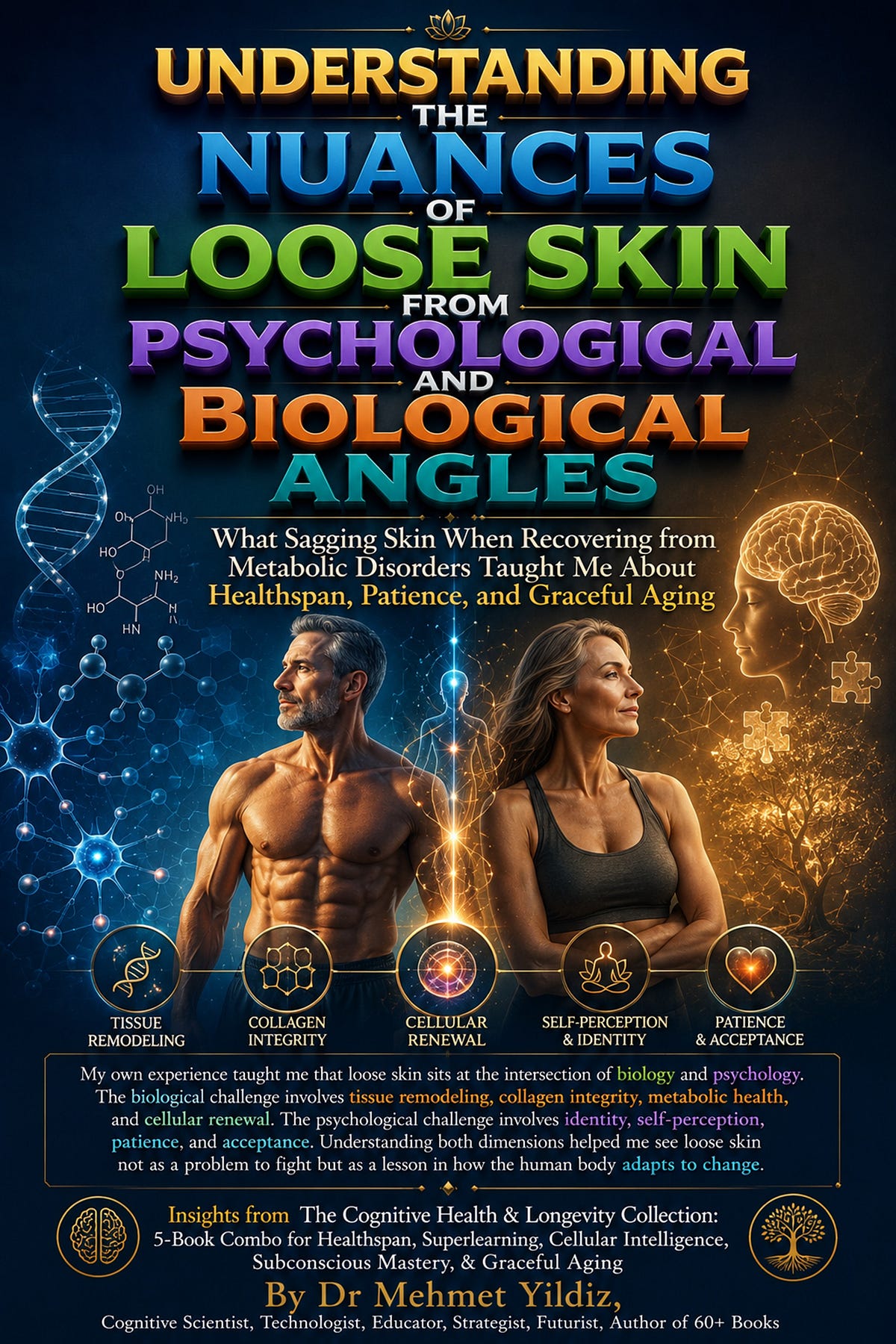
My own experience taught me that loose skin sits at the intersection of biology and psychology. The biological challenge involves tissue remodeling, collagen integrity, metabolic health, and cellular renewal. The psychological challenge involves identity, self-perception, patience, and acceptance. Understanding both dimensions helped me see loose skin not as a problem to fight but as a lesson in how the human body adapts to change.
Over time, I realized that this experience reflected a broader principle relevant to healthspan and graceful aging. The body is remarkably adaptive, but adaptation often unfolds more slowly than we would like. Whether the goal is improving metabolic health, building muscle, sharpening cognition, or maintaining vitality during aging, biology tends to reward consistency more than speed.
Purpose of This Chapter in My New Health & Wellness Collection
Several years ago, I wrote an educational manuscript for a client in the healthcare sector about my journey to reverse metabolic dysfunction and address some of the unexpected challenges that accompanied substantial weight loss.
One chapter focused on particularly loose skin, a surprisingly common issue that many people encounter after improving their metabolic health and reducing excess body fat.
At the time, I viewed the topic primarily as a practical concern. However, the deeper I explored the scientific literature and reflected on my own experience, the more I realized that loose skin represents something much more interesting than a cosmetic issue. It offers valuable insights into how the human body adapts to change, how tissues remodel themselves, and why biological recovery often unfolds more slowly than behavioral change.
Over the years, I also shared several articles on this topic. Many readers reached out to tell me that the discussion helped them view their situation differently. Rather than seeing loose skin as a personal failure or an unavoidable consequence of weight loss, they began to understand it as part of a broader biological adaptation process.
For this updated chapter in my Healthspan Mastery and Graceful Aging books, part of The Cognitive Health & Longevity Collection, I revisit the topic of dealing with loose skin from biological and psychological angles through a wider lens.
Beyond appearance, loose skin provides an opportunity to explore metabolism, tissue remodeling, cellular renewal, muscle preservation, hormonal health, body image, and one of the most important lessons in healthy aging: meaningful adaptation takes time.
I distilled my long research manuscript into 9 short sections in a single chapter to make it easier to digest, focusing on the key points, refraining from scientific and technical details, and making it a practical and educational resource.

Part 1: Your Skin Is Not Just Packaging
The Largest Organ Most People Usually Ignore
We think of skin as a covering, which makes sense. In reality, it is one of the most active and largest organs in the human body. It regulates temperature, participates in immune defense, protects against environmental threats, provides sensory information, and continuously renews itself throughout life.
The skin consists of three primary layers:
The epidermis forms the outer protective barrier. Beneath it lies the dermis, which contains blood vessels, nerves, collagen, and elastin. The deepest layer, known as the hypodermis, contains fat tissue and connective structures that help anchor the skin to underlying muscles and organs.
The dermis plays a particularly important role in skin elasticity. Collagen provides structural strength, while elastin allows tissues to stretch and recoil.
Together, they help the skin adapt to changes in body size and movement. However, these proteins are not permanent. They are continuously being broken down and rebuilt throughout life.
One of the most fascinating aspects of skin biology is that the skin you have today is not exactly the same skin you had years ago. Skin cells constantly die and are replaced. For example:
Proteins are renewed, blood vessels adapt, and connective tissues reorganize. The skin functions as a living record of lifestyle, environment, metabolic health, and aging.
Part 2: When Fat Loss Happens Faster Than Remodeling
The Body Does Not Always Follow the Scale
One of the biggest misconceptions about weight loss is that all tissues adapt at the same speed. Fat stores can shrink relatively quickly when energy balance changes and metabolic health improves. Connective tissues, collagen networks, and structural components require considerably more time.
A useful analogy is renovating a house. Removing old furniture can happen in a single day. Rebuilding the walls, replacing support structures, and redesigning the interior may take months or years.
Similarly, losing fat changes body composition rapidly, but remodeling the tissues that previously supported that fat can take much longer.
Age, genetics, smoking history, hormonal health, sun exposure, nutrition, inflammation, and the duration of obesity all influence this process.
Younger skin generally possesses greater adaptive capacity because collagen production and tissue repair tend to be more efficient. However, adaptation remains possible throughout life.
This realization changed my perspective completely. Instead of searching for shortcuts, I became interested in understanding what conditions help the body optimize its natural ability to adapt. That shift in thinking ultimately proved more valuable than any specific technique.
Part 3: The Hidden Scaffold Holding Us Together
A Fascinating Structure Called the Extracellular Matrix
Most discussions about loose skin focus on collagen. While collagen is important, a broader structure deserves attention. It is called the extracellular matrix.
The extracellular matrix serves as a biological scaffold that surrounds cells throughout the body. It contains collagen, elastin, glycoproteins, minerals, signaling molecules, and other structural components that help tissues maintain integrity and function.
This network is constantly being remodeled. Old proteins are removed, and new proteins are synthesized. Cells communicate through this matrix. Nutrients, hormones, and growth factors influence its behavior.
The quality of this scaffold affects not only skin appearance but also the health of blood vessels, joints, muscles, and organs.
One challenge of aging is that extracellular matrix remodeling gradually becomes less efficient. For example, collagen synthesis slows, elastin becomes less resilient, and tissue repair may take longer.
This knowledge helps explain why adaptation occurs more slowly later in life. Supporting healthy remodeling, therefore, becomes an important aspect of both healthspan and graceful aging.
Part 4: Why Muscle Matters More Than Most People Realize
The Missing Piece in Many Transformation Stories
Many weight-loss journeys focus almost exclusively on reducing fat, which is important but not the whole story. While lowering excess body fat can improve health, preserving and building muscle may be even more important in the long run.
Muscle is far more than a mechanical structure that helps us move. It functions as a metabolic organ that influences glucose regulation, insulin sensitivity, energy expenditure, inflammation, and physical resilience. Active muscles also release signaling molecules known as myokines that communicate with the brain and other organs.
As I continued improving my body composition, I noticed that increasing lean muscle mass produced more visible improvements than losing additional fat.
For example, gaining lean muscles improved my posture, strength, movement quality, and overall appearance. It also provided a supportive structure beneath the skin, helping me eliminate loose skin.
From a healthspan perspective, muscle preservation is one of the strongest predictors of independence and quality of life during aging. Our goal should not simply be to lose weight but should be to maintain a metabolically active, functional body capable of supporting vitality for decades.
Part 5: The Biological Story of Cellular Renewal
The Body Is Constantly Renovating Itself
One of the most exciting developments in biology involves understanding how cells renew themselves. Far from being static structures, cells continuously repair damage, recycle components, and remove dysfunctional material.
Researchers have devoted substantial attention to processes such as autophagy and mitophagy, which I leveraged in eliminating my loose skin after reversing my abdominal obesity.
Autophagy and mitophagy act as cellular and mitochondrial housekeeping mechanisms. Through these biological processes, cells and mitochondria identify damaged components and recycle them. Related processes, including mitophagy and lipophagy, help maintain mitochondrial quality and lipid metabolism.
While it would be inaccurate to claim that autophagy directly eliminates loose skin, these renewal systems contribute to the body’s overall maintenance and adaptation capacity.
Biological and lifestyle factors such as resistance training, restorative sleep, metabolic flexibility through a fat-adapted body, adequate nutrition from whole foods, periods of fasting and feeding, thermogenesis (cold and heat exposure), and other factors appear to support many of these pathways.
The important lesson for me was that the body possesses remarkable self-renewal capabilities. Adaptation does not occur as a result of a single intervention. It happens from countless repair processes occurring every day beneath our awareness.
As loose skin goes beyond biology and has a psychological aspect, I also used the power of my subconscious mind to reverse my abdominal obesity and eliminate the loose skin afterward.
Part 6: When the Mind Needs Time to Catch Up
The Psychology of Looking Different
One aspect of our biological transformation receives far less attention than it deserves. The body changes faster than the mind. Let me explain what I mean by this philosophical perspective based on my observations.
Many people living with obesity and overweight spend years or decades identifying with a larger body. Even after substantial improvements in health and body composition, their internal self-image may remain unchanged. They continue evaluating themselves through old beliefs, insecurities, or social comparisons.
Loose skin can amplify this challenge by serving as a visible reminder of the past. While health markers improve and metabolic function recovers, attention may remain focused on perceived imperfections. This creates a psychological gap between objective progress and subjective experience.
One of the most important lessons I learned was that health and appearance are not the same thing. Improving health may improve appearance, but genuine well-being requires something deeper, such as self-respect, patience, and appreciation for how far the body has already come.
As we age, this lesson becomes even more valuable. Every stage of life introduces changes in appearance. People who age gracefully tend to appreciate function, vitality, purpose, and capability rather than chasing an impossible standard of physical perfection.
Part 7: We Heal Better Together
The Often Overlooked Power of Community
When I first experimented with various approaches to improving my health, I largely worked on my own. Looking back, I realize how much faster I could have progressed with the support of knowledgeable peers.
Years later, when I joined sensibel biohacking communities, I observed that those who learned together achieved better outcomes. They shared experiences, exchanged ideas, encouraged one another, and remained accountable during difficult periods in challenging life circumstances.
This observation aligns with growing evidence showing that social connections rewire the brain and influence health and wellness outcomes. For example:
Supportive relationships can affect stress hormones, emotional resilience, adherence to healthy habits, and psychological well-being. Human beings evolved as social creatures, and our biology in this modern world still reflects that reality.
Therefore, I don’t see healthspan as a solo project. Whether our goal is to improve metabolic health, preserve cognition, build muscles, or adapt to aging, supportive communities can accelerate progress while making the journey more enjoyable and effective.
Part 8: What Eliminating Loose Skin Taught Me About Graceful Aging
Adaptation Is the Real Story
Looking back, having loose skin after substantial fat loss was never the most important part of my health and wellness journey. It was simply the visible manifestation of a much larger biological process.
The real lesson for me involved biological and psychological adaptation. I learned that the body continuously updates itself. For example:
Our cells are replaced, proteins are renewed, neural circuits reorganize, hormonal signals shift, mitochondria adapt, muscles respond to training, and connective tissues remodel. These processes occur throughout life.
Sometimes we underestimate what the body can accomplish because we evaluate progress over days or weeks. Human biology reveals its most meaningful changes over months and years. The same principle applies to cognition, fitness, emotional resilience, and healthy aging.
One of the most important lessons of healthspan is not to stop aging, which is impossible in our current capability. The goal is to support adaptation.
Graceful aging goes beyond preserving a younger version of ourselves, which I find unfeasible. My focus on graceful aging is on maintaining vitality, function, independence, purpose, and well-being as we continue to evolve throughout our lifespan.
Part 9: Key Takeaways for Dealing with Loose Skin
Loose skin after substantial weight loss offers a visible example of how biological adaptation is tightly coupled with behavioral change.
Skin health depends on far more than appearance, as it reflects the integrity of collagen, elastin, connective tissue, metabolic health, hormonal balance, and cellular renewal systems.
Based on my five decades of experience and research, preserving and building lean muscle mass naturally (through healthy lifestyle choices) is one of the most important strategies for improving body composition, metabolic health, physical function, and healthy aging.
The most effective ways for me to eliminate loose skins naturally were OMAD (one meal a day), periodic fasting up to 10 days 4 times annually that initiated autophagy and mitophagy, consuming whole foods in a ketogenic eating regimen, performing resistance training, especially calisthenics with some weight-bearing exercises, daily 3 cold showers and occasional ice baths, and weekly dry saunas.
Psychological adaptation requires as much attention as physical transformation. Self-image changes more slowly than physiology.
The body possesses extraordinary capacities for repair, renewal, and adaptation when given a chance. Given sufficient time, support, and consistency, it can achieve far more than we initially imagine.
Healthspan and graceful aging ultimately depend on working with our biology and pscyhology rather than fighting them. The body may not always move at the speed we desire, but it is constantly striving to adapt, heal, and maintain balance with its extraordinary intelligence.
In April 2022, I wrote a story titled “Three Tips to Eliminate Loose Skin: Reducing wobbly skin had been much more challenging than receiving my doctorate, but I eventually succeeded over a decade ago,” which helped some of my readers at the time. I believe my approach may give you fresh and unique perspectives.
I also wrote another personal story in 2022 upon request from my loyal readers titled Here’s How I Got Healthier and Smoother Skin via 5 Lifestyle and Holistic Health Approaches: Eliminating allergies and autoimmune conditions made the most significant impact.
As our skin health is also related to hormones and neurotransmitters, you might check out this recent chapter to enhance your understanding:
The Vital Impact of Hormones and Neurotransmitters on the Nervous System
Here’s Why These Cellular, Biochemical, and Systemic Interactions Matter for Healthspan, Cognition, and Graceful Aging.medium.com
I wrote many stories about weight loss and muscle gain, which might guide you and give you fresh perspectives from my personal experiences, observations, and research. I added them to the list linked below:
List: Weight Loss / Muscle Gain | Curated by Dr Mehmet Yildiz | Medium
Weight Loss / Muscle Gain · 73 stories on Mediumdr-mehmet-yildiz.medium.com
Thank you for reading my perspectives. I wish you a healthy and happy life.
[End of story]
Here are some recent sample chapters from this collection, which might give you new perspectives on healthspan and graceful aging.
Why Survival Mode Shrinks the Brain’s Network and Thriving Mode Expands It
What Wounds and Destroys Mitochondria and What Heals, Renews, and Strengthens Them
Updates on My Creative Work with Relevant Links
I am pleased that my new health and wellness books, What the Brain Needs, Why We Fail, and How We Can Fix It, Ketosis + BDNF: The Healing Molecules That Saved My Life, Cellular Intelligence, Feel Better, Live Smarter, Thrive Anywhere, How I Accelerated My Learning Effortlessly for a Happier Life, Healthspan Mastery, The Science & Wisdom of Graceful Aging, and the Subconsious book, were published and are now available in many bookstores, as part of my Health, Wellness, and Cognitive Performance Series.
You can check out my FEATURED series of 60+ books on Amazon markets:
Some of my books are published at Apple Stores, Smashwords, Vivlio, Kobo, Barnes & Noble, BooksaMillion, Fable, Bookshop.org, or my discount bookstore.
If you are a writer, you are welcome to join my publications by sending a request via this link. I support 42K writers who contribute to my publications on this platform. Check out the recent update for the writers of my publications.
You can contact me via my website. If you are a new writer, check out my writing list to find some helpful stories for your education. You can also join my author platform as a guest blogger.
I interviewed several new professionals and thought leaders. You can find them linked to the end of the latest one.
I invite you to subscribe to my publications on Substack, where I offer experience-based and original content on health, content strategy, book authoring, and technology topics you can’t find online to inform and inspire my readers.
Healthspan Mastery (NEW)
Get an email whenever Dr. Mehmet Yildiz publishes. He is a top writer and editor on Medium.
dr-mehmet-yildiz.medium.com
Check out Free Blog Posts by Digitalmehmet Contributors. Here is the link to my FREE personal blogs. Now you can read our blog posts via a Flipboard Magazine for convenience.
I invite you to explore some of my books on my discount bookstore including: Train Your Brain for a Healthier and Happier Life, Cortisol Clarity, Substack Mastery Version 2, The Zen of Book Authoring, Monetize Your Passion with WooCommerce, Agile Business Architecture for Digital Transformation V2, Agile Business Architecture for Digital Transformation (Audiobook), A Powerful Toolkit for Substack Newsletter Mastery, Smart and Ethical SEO, Modern Affiliate Marketing for Writers, 4 Pillars of Enterprise Architecture, and Smart Email Marketing Content Integration, The Mysterious Leadership Mind of Robert F. Kennedy Jr.,


Leave a Reply