

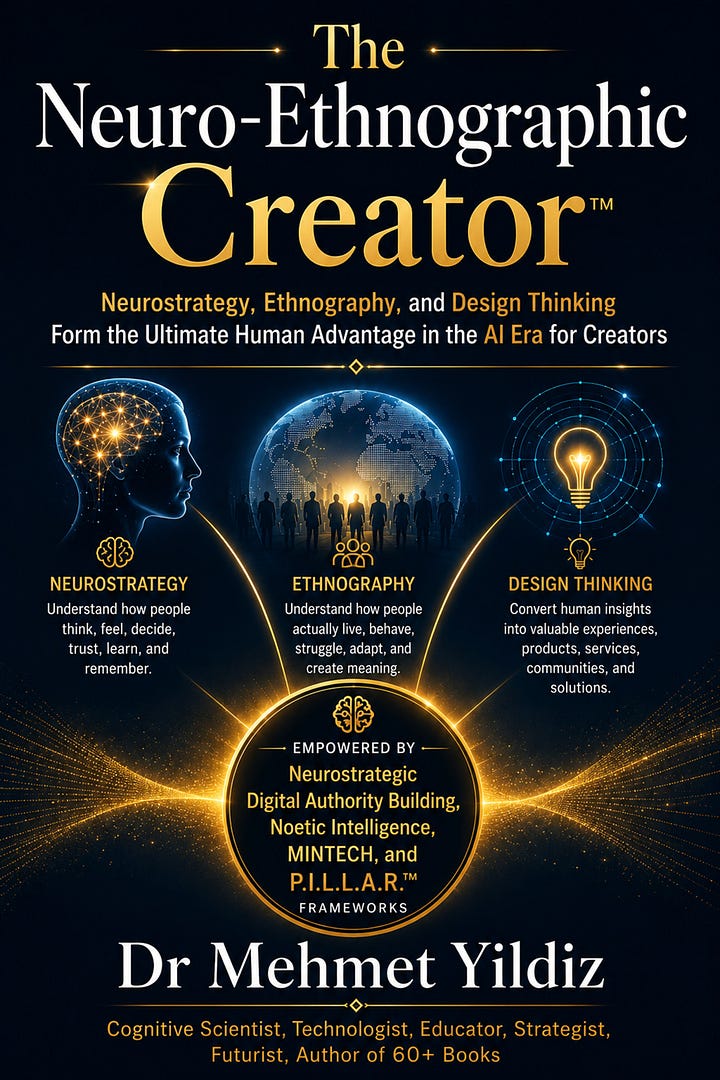
The Neuro-Ethnographic Creator™ Includes Neurostrategy, Ethnography, and Design Thinking to Form the Ultimate Human Advantage in the AI Era
Curator’s Note: The Neuro-Ethnographic Creator™ merges neurostrategy, ethnography, and design thinking to leverage human understanding in the era of AI. As artificial intelligence transforms information generation, qualitative human insights become invaluable. The framework emphasizes understanding how people think, behave, and need solutions. Neurostrategy informs creators about cognitive processes, ethnography uncovers real-world behaviors, and design thinking facilitates practical solutions. Together, these disciplines foster meaningful engagement rather than mere content production. This approach prioritizes human cognition and understanding, asserting that a creator’s competitive advantage lies not in competing with AI, but in complementing it through a deeper human connection. The full framework will launch on January 6, 2027. The Neuro-Ethnographic Creator™ is now in pre-order and will be available on 6 January 2027. This book was written by Dr Mehmet Yildiz an author of 60+ books.
Why Human Understanding May Become the Most Valuable Skill in the Age of Artificial Intelligence
We are witnessing one of the most significant technological transitions in human history. For centuries, individuals and organizations have gained an advantage through access to information.
Those who possessed specialized knowledge, scarce expertise, or privileged access to data enjoyed a meaningful edge over their peers. The internet changed that equation by making information more accessible. Artificial intelligence is now changing it again by making information generation abundant.
Today, intelligent systems can write blog posts, create images, generate software code, summarize research papers, analyze large datasets, produce marketing campaigns, and answer complex questions within seconds. Tasks that once required hours, days, weeks, or even years of human effort can now be completed almost instantly.
This development has generated both excitement and anxiety for society. Many creators, researchers, consultants, educators, entrepreneurs, and professionals are asking the same question.
If artificial intelligence can produce content at scale, what remains uniquely human? More importantly, what capabilities will continue to create value when machines can perform an increasing number of cognitive tasks simultaneously?
I firmly believe the answer is not in producing more content but in understanding people more deeply. Artificial intelligence can generate words, recognize patterns, and automate processes. However, meaningful human value happens from something more fundamental. It happens from understanding how people think, how they live, and how solutions can improve their lives.
This realization led me to develop a framework I call The Neuro-Ethnographic Creator™. The framework integrates three disciplines that have impacted much of my professional and academic journey: neurostrategy, ethnography, and design thinking.
Individually, each discipline offers powerful insights into human behavior and innovation. When combined, they form a practical system for creating value in an increasingly AI-enabled world. For example:
Neurostrategy examines how people think, feel, decide, learn, trust, and remember. It draws upon insights from neuroscience, psychology, behavioral science, and cognitive research to explain why individuals respond to certain ideas, messages, experiences, and opportunities. While many creators focus primarily on what they want to communicate, neurostrategy encourages us to understand how the human mind receives, interprets, and acts on information.
Ethnography adds a different perspective. Instead of studying people in controlled environments, ethnography seeks to understand them in their natural settings. Ethnography encourages observation before judgment and curiosity before conclusions. Ethnographic inquiry reveals a simple yet profound truth: people do not always behave as they claim. The gap between stated intentions and actual behavior frequently contains the most valuable insights. Hidden frustrations, unmet needs, emerging aspirations, and overlooked opportunities become visible only through careful observation.
Design thinking provides the bridge between understanding and action. Insights alone create little value unless they lead to meaningful solutions. Design thinking offers a structured approach for transforming observations into practical outcomes. It helps creators, innovators, entrepreneurs, and professionals experiment, refine, and improve ideas before scaling them. Rather than seeking perfect answers from the outset, design thinking encourages iterative learning through continuous improvement.
When these three disciplines are combined, they become synergistic and create something larger than the sum of their individual parts. Neurostrategy helps us understand the mind. Ethnography helps us understand the human context. Design thinking helps us create solutions that matter. In combination, they form what I call “The Creator Trinity™.”
At the center of this Trinity is a capability that may become increasingly valuable in the coming decades: human understanding. This is where I believe many current discussions about artificial intelligence miss an important point. Much of the public conversation focuses on what machines can do. Far less attention is given to what humans should become.
The future may not help those who simply learn how to use AI tools. Those tools will eventually become available to almost everyone. Instead, sustainable advantage may come from developing a deeper understanding of human cognition, human behavior, and human needs.
A creator who understands attention can communicate more effectively. A creator who understands human behavior can identify problems worth solving. A creator who understands design thinking can translate insights into outcomes that improve lives. Artificial intelligence can amplify these capabilities, but it cannot fully replace them.
The Neuro-Ethnographic Creator™ therefore represents more than a content creation framework. It is a mindset, a discipline, and a practical approach to value creation. It encourages us to move beyond information production and toward human-centered understanding. It reminds us that before we create products, services, businesses, communities, books, courses, articles, or technologies, we must first understand the people we seek to serve.
This perspective may become important as AI-generated content continues to expand. When human-generated quality information becomes abundant, insight becomes valuable. When meaningful content becomes plentiful, meaning becomes valuable. When automation becomes accessible, human understanding becomes valuable.
The creators who thrive in this new environment may not be those who produce the most content. There may be those who develop the deepest understanding of the people behind the data, the audiences behind the metrics, and the human experiences behind the algorithms. The future of creation may therefore not depend on competing with artificial intelligence but on complementing it with human intelligence.
Machines can help us process information, but humans must still determine why that information matters. Machines can generate content. However, humans must still determine what deserves to be created. Machines can identify patterns, but humans must still determine which patterns are meaningful.
The Neuro-Ethnographic Creator™ is built upon this distinction. This framework offers a practical approach for those who wish to remain relevant, valuable, and impactful in an era of rapidly advancing science and technology. More importantly, this framework provides a pathway to creating work that serves people rather than just demanding attention.
In our frenetic world, increasingly influenced by advances in artificial intelligence, understanding humanity may become the ultimate competitive advantage. Therefore, I created the Neuro-Ethnographic Creator™ framework and decided to turn my research manuscript into a publicly accessible book. It will be available on 6 January 2027.
I wrote many stories about Neurostrategy, Ethnographic Research, and Design Thinking. I linked samples below to give you an idea of these emerging fields for content developers, especially for the next generation of creators.
What Is Neurostrategy and Why Understanding It Is Vital for Creators, Freelancers, Professionals…
Insights from My Research and Experience in Neurostrategic Digital Authority Building Initiatives and Recorded…medium.com
How Writers Can Attract More Readers by Using Design Thinking Principles
Used in both professional and personal pursuits, Design Thinking is a valuable tool to integrate into our writing…medium.com
How Writers Can Use Ethnographic Research to Create Original and Valuable Content
Used in both professional and personal pursuits, ethnography is a valuable tool to integrate into writing practice for…medium.com
This framework is part of my futuristic studies, especially for preparing for the 2050s, which I documented in another book titled Technology Horizons 2050 and Beyond. I shared several sample chapters on this platform. As the most recent one, I invite you to check out this story for our collective future and share your thoughts if possible:
The Hidden Foundations of Our Future: Energy, Ecology, and Human Cooperation for the 2050s
What Must Happen Before Our Scientific, Technological, and Engineering Future Can Become Realitymedium.com
Thank you for reading my perspectives. I wish you a healthy and happy life.
[End of story]
Updates on My Creative Work with Relevant Links
I am pleased that my new health and wellness books, What the Brain Needs, Why We Fail, and How We Can Fix It, Ketosis + BDNF: The Healing Molecules That Saved My Life, Cellular Intelligence, Feel Better, Live Smarter, Thrive Anywhere, How I Accelerated My Learning Effortlessly for a Happier Life, Healthspan Mastery, The Science & Wisdom of Graceful Aging, and the Subconsious book, were published and are now available in many bookstores, as part of my Health, Wellness, and Cognitive Performance Series.
You can check out my FEATURED series of 60+ books on Amazon markets:
Some of my books are published at Apple Stores, Smashwords, Vivlio, Kobo, Barnes & Noble, BooksaMillion, Fable, Bookshop.org, or my discount bookstore.
If you are a writer, you are welcome to join my publications by sending a request via this link. I support 42K writers who contribute to my publications on this platform. Check out the recent update for the writers of my publications.
You can contact me via my website. If you are a new writer, check out my writing list to find some helpful stories for your education. You can also join my author platform as a guest blogger.
I interviewed several new professionals and thought leaders. You can find them linked to the end of the latest one.
I invite you to subscribe to my publications on Substack, where I offer experience-based and original content on health, content strategy, book authoring, and technology topics you can’t find online to inform and inspire my readers.
Healthspan Mastery (NEW)
Get an email whenever Dr. Mehmet Yildiz publishes. He is a top writer and editor on Medium.
dr-mehmet-yildiz.medium.com
Check out Free Blog Posts by Digitalmehmet Contributors. Here is the link to my FREE personal blogs. Now you can read our blog posts via a Flipboard Magazine for convenience.
I invite you to explore some of my books on my discount bookstore including: Train Your Brain for a Healthier and Happier Life, Cortisol Clarity, Substack Mastery Version 2, The Zen of Book Authoring, Monetize Your Passion with WooCommerce, Agile Business Architecture for Digital Transformation V2, Agile Business Architecture for Digital Transformation (Audiobook), A Powerful Toolkit for Substack Newsletter Mastery, Smart and Ethical SEO, Modern Affiliate Marketing for Writers, 4 Pillars of Enterprise Architecture, and Smart Email Marketing Content Integration, The Mysterious Leadership Mind of Robert F. Kennedy Jr.,


Leave a Reply