

The Hidden Foundations of Our Future: Energy, Ecology, and Human Cooperation for the 2050s. What Must Happen Before Our Scientific, Technological, and Engineering Future Can Become Reality
Curator’s Note: We curated this important chapter written by Dr. Mehmet Yildiz as it discusses the fundamental foundations necessary for a prosperous technological future by the 2050s, as outlined in the book “Technology Horizons 2050 and Beyond.” Key themes include energy availability, sustainable water and food systems, ecological resilience, social stability, and international cooperation, emphasizing that these elements are often overlooked in favor of technology itself. The author argues that future advancements in artificial intelligence, biotechnology, and other fields depend on these interconnected infrastructures. The book aims to provide a roadmap for approaching complex systems problems, advocating for collective intelligence to address challenges in a rapidly changing world while remaining optimistic about humanity’s potential for innovation.
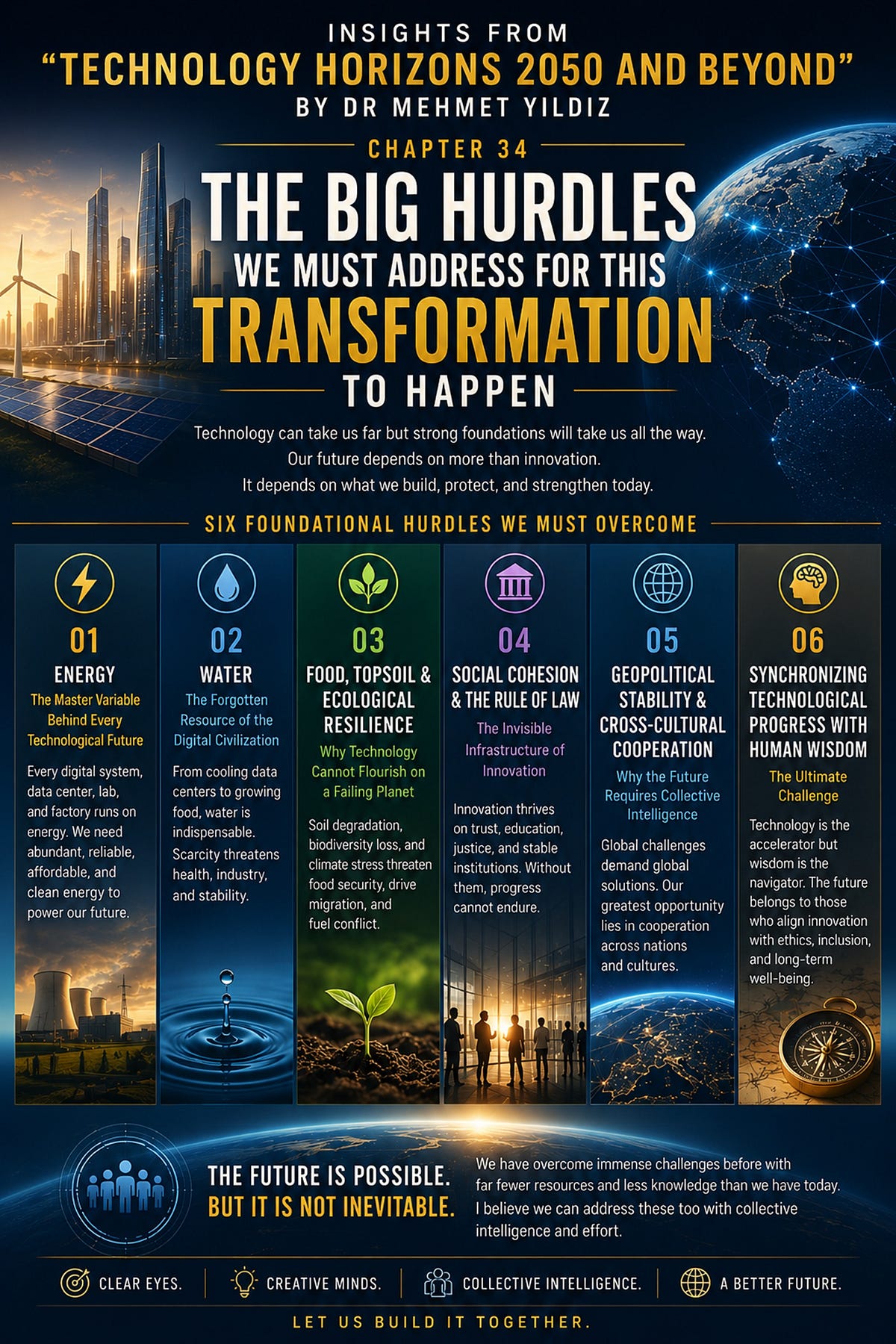
Image Credit: I designed this poster to create awareness of our global challenges for its use during the launch of my recent book, Technology Horizons 2050 and Beyond — ISBNs: 9798231583355, 9798182000840, 9798182003711, 9798235571105
Importance of This Story by the Author: Early readers thought this was the most important chapter of this book because if we can’t maintain these foundations, this optimistic vision will not manifest. Considering the rapid, frenetic changes in tech, we might not even see the 2050s on Earth, which would indicate an existential crisis for humanity. Let’s explore the ideas and discuss potential solutions for our collective future!
Summary of the Big Elephants in the Room from Technology Horizons 2050 and Beyond

Throughout the alpha and beta reading periods of this manuscript titled Technology Horizons 2050 and Beyond, hundreds of scholarly contributors, subject-matter experts, thought leaders, environmental activists, and discerning readers raised what they described as the “big elephants in the room.”
These discerning readers appreciated the scientific, technological, and engineering possibilities presented throughout 30+ chapters, but they also challenged me in a friendly and caring way to examine the underlying assumptions that make such a future possible in 2050 and beyond.
Their observations were profound and fully aligned with my research. Every transformative development I discussed in this book, from artificial general intelligence and quantum computing to regenerative medicine, planetary climate management, space manufacturing, and interplanetary settlements, depends on multiple foundational conditions that are usually treated as background assumptions rather than central variables in the scientific literature and popular media.
These foundations, which I cover in this chapter, are not algorithms, processors, tools, methods, or scientific breakthroughs. They include abundant and reliable energy, sustainable water and food systems, ecological resilience, social stability, functioning institutions, and sufficient cooperation among nations and cultures.
This invaluable feedback from early access readers reminded me that every technological civilization ultimately rests on physical, ecological, and societal infrastructures that are easy to overlook when our imagination is captivated by fascinating inventions and innovations.
We have been typically discussing artificial intelligence as software, regenerative medicine as biology, quantum computing as mathematics, and space exploration as engineering. Yet none of these fields can exist independently of electricity generation, freshwater availability, agricultural productivity, educational systems, functioning supply chains, legal frameworks, and reasonably cooperative societies.
The future will not emerge solely from science, technology, and engineering efforts and investments. It will result from the interaction among these disciplines, including the coordination of natural resources, economics, governance, politics, culture, and collective human behavior.
This realization does not weaken technological optimism. Far from it, it will strengthen it by forcing us to examine the entire system rather than only its most visible components. In many ways, the technologies described throughout this book represent the branches of a tree. The roots are less glamorous, but without healthy roots, the most beautiful branches cannot survive.
Because these challenges are deeply interconnected, I discuss them through six broad and interrelated themes, making them easier to comprehend, remember, and view as parts of a larger living system rather than as isolated problems.
Part 1 — Energy: The Master Variable Behind Every Scientific, Technological, and Engineering Enabled Future
Throughout this book, I have written about artificial general intelligence, quantum computing, immersive realities, autonomous mobility, regenerative medicine, planetary-scale climate engineering, and off-Earth manufacturing. What all these technologies share is an extraordinary appetite for energy, just as the human brain does.
There is a tendency to speak about artificial intelligence as though it exists inside an abstract “cloud.” In reality, there is no such cloud system. It is a concept we created in the last decade. For example, all physical machines operate in vast data centers that contain millions of processors, networking devices, and storage systems and continuously consume electricity.
Training advanced AI models already requires immense computational resources. Future AGI systems, digital twins of cities, climate simulations, molecular modeling platforms, and immersive virtual environments will require computational capacities several orders of magnitude larger than those available today.
The challenge goes beyond producing electricity. The challenge is generating sufficient net energy in forms that are reliable, affordable, scalable, and environmentally sustainable.
History offers useful lessons. The Industrial Revolution was fundamentally an energy revolution enabled by coal. The twentieth century was impacted by oil, natural gas, and electrification.
Likewise, many technological futures envisioned in this book will ultimately depend on humanity’s success in creating abundant low-carbon energy through advanced renewables, grid-scale storage, intelligent supergrids, next-generation nuclear technologies, and commercially viable fusion power.
The issue becomes even more important when we consider energy return on investment. Modern civilization requires not just energy, but surplus energy. Hospitals, universities, research laboratories, semiconductor foundries, and advanced manufacturing systems all depend upon large amounts of excess productive capacity.
If energy systems become very expensive, unreliable, scarce, or resource-intensive, society may have less capacity to invest in long-term scientific research and innovation. Energy will therefore be the master variable upon which every other technological transformation depends.
Part 2— Water: The Forgotten Resource of the Digital Civilization
Water does not appear much in discussions about artificial intelligence, biotechnology, or quantum computing. Yet water may become one of the defining strategic resources of the twenty-first century.
Data centers require substantial quantities of water for cooling. Semiconductor manufacturing uses extraordinary volumes of ultra-pure water. Pharmaceutical production, biotechnology laboratories, hydrogen generation, and advanced manufacturing processes all depend heavily on reliable freshwater supplies.
At the same time, many regions of the world already face significant water stress. Aquifers are declining. Snowpack patterns are changing. Rainfall is becoming less predictable in some regions. Population growth and urbanization continue to increase demand, while climate variability places additional pressure on already-stressed water systems.
The challenge extends far beyond computing. Agriculture accounts for the majority of global freshwater withdrawals. Water scarcity directly affects food production, public health, industrial productivity, energy generation, and political stability. As history shows, prolonged drought can reduce agricultural yields, raise food prices, trigger migration, and intensify geopolitical tensions.
One can easily imagine a future in which humanity possesses advanced artificial intelligence and sophisticated quantum systems, yet struggles to maintain agricultural productivity due to water shortages.
This situation would represent a profound paradox. The technologies of the 2050s will therefore depend as much on breakthroughs in desalination, wastewater recycling, atmospheric water harvesting, precision irrigation, drought-resistant crops, and intelligent water management systems as on advances in machine learning and computational science. Water may prove to be one of the great limiting factors of technological civilization.
Part 3— Food, Topsoil, and Ecological Resilience: Why Technology Cannot Flourish on a Failing Planet
Another elephant in the room concerns ecological resilience. Modern civilization depends upon fertile soils, pollinators, biodiversity, stable climate systems, fisheries, forests, and functioning ecosystems. These services are so fundamental that we sometimes forget they exist until they begin to deteriorate.
Throughout history, environmental degradation has contributed to the decline of civilizations. Deforestation, soil depletion, salinization, water shortages, and changing climatic conditions have repeatedly weakened societies and increased vulnerability to economic and political disruption.
The twenty-first century faces similar risks. For example, topsoil erosion, biodiversity loss, declining freshwater availability, and climate instability may threaten food production in some regions. The United Nations and numerous scientific bodies have repeatedly warned about declining soil health, loss of pollinator populations, and the increasing fragility of agricultural systems.
Food insecurity has historically contributed to migration, political instability, and conflict. Human beings may tolerate many inconveniences, but societies become remarkably fragile when food systems fail.
Large population movements will strain institutions and intensify geopolitical tensions. Governments may need to divert resources from education, scientific research, and innovation toward crisis management and emergency response.
The future described throughout this book assumes that societies remain sufficiently stable to educate scientists, finance research, construct infrastructure, and cooperate internationally.
If ecological stresses become severe enough to threaten basic human needs, societies will understandably redirect attention toward immediate survival rather than long-term innovation, as the human body does. Our technological future, therefore, depends upon our ecological future. The two are inseparable.
Part 4— Social Cohesion and the Rule of Law: The Invisible Infrastructure of Innovation
From my observations, the least discussed requirement for technological progress is social cohesion. I learned that innovation flourishes where there is trust, reasonably stable governance, educational opportunity, legal predictability, protection of intellectual property, and sufficient social cooperation to sustain long-term projects.
The visions I presented throughout this book assume that scientists, engineers, and technologists continue to collaborate across borders, that supply chains remain functional, that educational institutions remain productive, and that investment environments remain sufficiently stable to support decades of research and development.
History reminds us that these conditions cannot be taken for granted. Resource scarcity, economic inequality, misinformation, political polarization, mass migration, and social fragmentation can place enormous strain on institutions. Artificial intelligence itself may intensify these pressures by accelerating labor displacement, widening information asymmetries, and concentrating economic power.
Scientific, technological, and engineering progress cannot be separated from human behavior. My recent noetic intelligence framework reminds us that collective intelligence emerges from relationships, trust, communication, and cooperation among large numbers of interacting agents. Intelligence itself may degrade when societies become excessively fragmented, distrustful, or polarized.
A world characterized by institutional breakdown and declining trust may struggle to realize even its most promising scientific opportunities. The rule of law is therefore not simply a legal concept but a combinatorial innovation infrastructure. Without trust in contracts, scientific integrity, educational institutions, and regulatory systems, technological progress becomes difficult to sustain.
Part 5— Geopolitical Stability and Cross-Cultural Cooperation: Why the Future Requires Collective Intelligence
Many of the technologies discussed in this book are global by nature. For example, climate engineering, planetary defense, pandemic preparedness, artificial general intelligence governance, quantum security, and interplanetary exploration cannot be managed effectively by individual nations acting in isolation.
They require cooperation at unprecedented scales. Yet we live in an era of increasing geopolitical competition. Nations compete for critical minerals, semiconductor leadership, artificial intelligence capabilities, energy security, and strategic influence.
Importantly, economic nationalism and technological fragmentation may complicate international collaboration precisely when cooperation is becoming more essential.
The future will depend upon our ability to build what I call collective noetic intelligence: the capacity of diverse individuals, institutions, cultures, and intelligent systems to learn, reason, and act together despite differences in values, priorities, and interests.
History offers encouraging examples. International scientific collaborations eradicated smallpox, built the International Space Station, decoded the human genome, and accelerated vaccine development during global health emergencies.
The challenges ahead are even larger. No single country can stabilize the climate, defend the planet from asteroids, govern advanced artificial intelligence, or manage space resources alone.
The future demands collective intelligence operating at planetary scales. This requirement will become one of humanity’s greatest social and cognitive challenges.
Part 6— The Ultimate Challenge: Synchronizing Technological Progress with Human Wisdom
Despite these concerns, I do not see these challenges as grounds for abandoning technological, scientific, and engineering optimism. Rather, I view them as reminders that humanity’s future is fundamentally a systems problem.
Artificial intelligence may optimize energy grids. Fusion energy may support desalination and carbon removal. Advanced biotechnology may improve crop resilience. Swarm intelligence may enhance disaster response and resource allocation. Quantum computing may accelerate materials discovery for sustainable infrastructure. Noetic intelligence may improve collective decision-making across institutions and nations.
In many ways, humanity’s greatest challenge is not inventing individual technologies. It is learning how to orchestrate them together while preserving ecological integrity, social stability, and human dignity.
One of the lessons I have learned over five decades of studying science, technology, and complex systems is that civilizations do not struggle because they run out of ideas. They struggle when the energetic, ecological, and institutional foundations that support those ideas begin to weaken.
The technologies I described throughout this book remain possible. But they are not inevitable. The future will not be built only in laboratories, research institutes, startups, and data centers. It will also be built in rivers, farms, forests, power stations, classrooms, courts of law, and relationships among people across the globe.
The most advanced artificial intelligence will be of limited value in a world without water. Quantum computers will not solve problems if societies cannot cooperate. Fusion reactors alone will not guarantee human flourishing if inequality and conflict continue to deepen.
From the perspective of noetic intelligence, all these systems are deeply interconnected. Energy influences water security. Water influences agriculture. Agriculture influences migration and political stability. Political stability influences scientific collaboration and innovation. Innovation, in turn, affects our ability to solve problems in energy, water, and ecology.
Similar to the human body, the future therefore resembles a living cognitive ecosystem rather than a collection of isolated technologies. Our success may ultimately depend on whether we can achieve sufficient wisdom to manage energy, water, ecosystems, institutions, and collective human behavior at the same pace as our scientific capabilities.
From my perspective, this may be the greatest scientific, technological, and engineering challenge of the twenty-first century and the defining test of our collective noetic intelligence for the 2050s and beyond.
Despite these formidable hurdles, I remain cautiously and realistically optimistic. Our long history suggests that humanity’s greatest advances emerged not from despair, but from the determination to confront difficult realities while believing that solutions remain possible.
I choose optimism because we have overcome formidable challenges before with far fewer resources, less scientific knowledge, and much more limited technological capabilities than we possess today. I believe we can address these challenges as well through collective intelligence, sustained effort, and the remarkable human capacity for cooperation and innovation.

[End of the Chapter]
I introduced this futuristic book in a story last year. The book Technology Horizons 2050 and Beyond has been published in paperback, hardcover, and large-print versions on multiple platforms. The digital and audio versions will be available on 30 June 2026.

Early access to audio via Google Play is now available. It is 9 hours 56 minutes listening time.
In this book, you will explore 30+ interconnected domains that will impact the future. The central thesis of this book is simple yet profound: the future is a systems problem. The most significant changes of the coming decades will arise not from individual technologies but from their convergence.
Advances in biotechnology will influence artificial intelligence. Quantum computing will reshape materials science and climate modeling. Neurotechnology and immersive realities will redefine education, creativity, and identity. New forms of energy and the space industry may alter economics and geopolitics in ways previous generations could scarcely have imagined.
Each chapter follows a three-stage foresight model:
2030 Outlook — technologies moving from laboratories into practical deployment
2040 Transition — large-scale adoption and societal adaptation
2050 Vision — long-term implications for industries, institutions, and human experience
This framework transforms the book from a collection of predictions into a practical roadmap for thinking about change.
This work explores the concepts through my previous work on the psychology and philosophy of emerging technologies. It answers questions such as:
What happens to identity when organs become replaceable, and biology becomes designable? What happens to work when intelligence becomes collaborative? What happens to culture when physical and virtual realities merge? And what does it mean to remain human in an age of increasingly intelligent machines and modifiable biology?
This book is not speculative science fiction. It is grounded in current research, scientific literature, industry developments, and strategic foresight methodologies. The result is a credible and thought-provoking guide for thought leaders, entrepreneurs, inventors, artists, educators, scientists, policymakers, investors, and curious minds seeking to understand where humanity may be heading.
If you are building the next breakthrough company, designing policy for emerging technologies, investing in frontier science, developing your own inventions, or simply exploring the deeper meaning of human evolution in an age of machines, this book offers both a strategic framework and an invitation to think differently.
The future will not wait for us to be ready. Its earliest signals are already visible in laboratories, code repositories, hospitals, research centers, creative studios, and classrooms around the world.
The coming decades may become the most extraordinary period in human history. This book is an invitation to see it before it arrives, to understand its possibilities and risks, and even to help shape it because the future is not something we inherit. It is something we actively create.
Here are some sample chapters:
The Dawn of Organoid Intelligence: Towards Brain-Like Machines in the 2030s
The Power of Swarm Intelligence for Collective Human-AI Systems by the 2050s
A Glimpse Into the Future of Science, Technology, and Engineering from My Perspective
The Psychology of Emerging Technology Will Guide Us in This Journey to the 2050s and Beyond
I will share more chapters in the Technology Horizons 2050 and Beyond — Official Page
I also introduced another futuristic book for creators, which will be published in January 2027. It is titled “The Neuro-Ethnographic Creator: Neurostrategy, Ethnography, and Design Thinking Form the Ultimate Human Advantage in the AI Era for Creators”
Here is the link to the introduction:
The Neuro-Ethnographic Creator™
Neurostrategy, Ethnography, and Design Thinking Form the Ultimate Human Advantage in the AI Eramedium.com
Thank you for reading my perspectives. I wish you a healthy and happy life.
[End of story]
Updates on My Creative Work with Relevant Links
I am pleased that my new health and wellness books, What the Brain Needs, Why We Fail, and How We Can Fix It, Ketosis + BDNF: The Healing Molecules That Saved My Life, Cellular Intelligence, Feel Better, Live Smarter, Thrive Anywhere, How I Accelerated My Learning Effortlessly for a Happier Life, Healthspan Mastery, The Science & Wisdom of Graceful Aging, and the Subconsious book, were published and are now available in many bookstores, as part of my Health, Wellness, and Cognitive Performance Series.
You can check out my FEATURED series of 60+ books on Amazon markets:
Some of my books are published at Apple Stores, Smashwords, Vivlio, Kobo, Barnes & Noble, BooksaMillion, Fable, Bookshop.org, or my discount bookstore.
If you are a writer, you are welcome to join my publications by sending a request via this link. I support 42K writers who contribute to my publications on this platform. Check out the recent update for the writers of my publications.
You can contact me via my website. If you are a new writer, check out my writing list to find some helpful stories for your education. You can also join my author platform as a guest blogger.
I interviewed several new professionals and thought leaders. You can find them linked to the end of the latest one.
I invite you to subscribe to my publications on Substack, where I offer experience-based and original content on health, content strategy, book authoring, and technology topics you can’t find online to inform and inspire my readers.
Healthspan Mastery (NEW)
Get an email whenever Dr. Mehmet Yildiz publishes. He is a top writer and editor on Medium.
dr-mehmet-yildiz.medium.com
Check out Free Blog Posts by Digitalmehmet Contributors. Here is the link to my FREE personal blogs. Now you can read our blog posts via a Flipboard Magazine for convenience.
I invite you to explore some of my books on my discount bookstore including: Train Your Brain for a Healthier and Happier Life, Cortisol Clarity, Substack Mastery Version 2, The Zen of Book Authoring, Monetize Your Passion with WooCommerce, Agile Business Architecture for Digital Transformation V2, Agile Business Architecture for Digital Transformation (Audiobook), A Powerful Toolkit for Substack Newsletter Mastery, Smart and Ethical SEO, Modern Affiliate Marketing for Writers, 4 Pillars of Enterprise Architecture, and Smart Email Marketing Content Integration, The Mysterious Leadership Mind of Robert F. Kennedy Jr.,


Leave a Reply