

Business Leadership in the AI Era: The Missing Business Perspective and Approach in the Advanced Computational Intelligence Era
Here’s Why I Wrote This Book as a Business Case Study of NVIDIA and How You Can Benefit from It
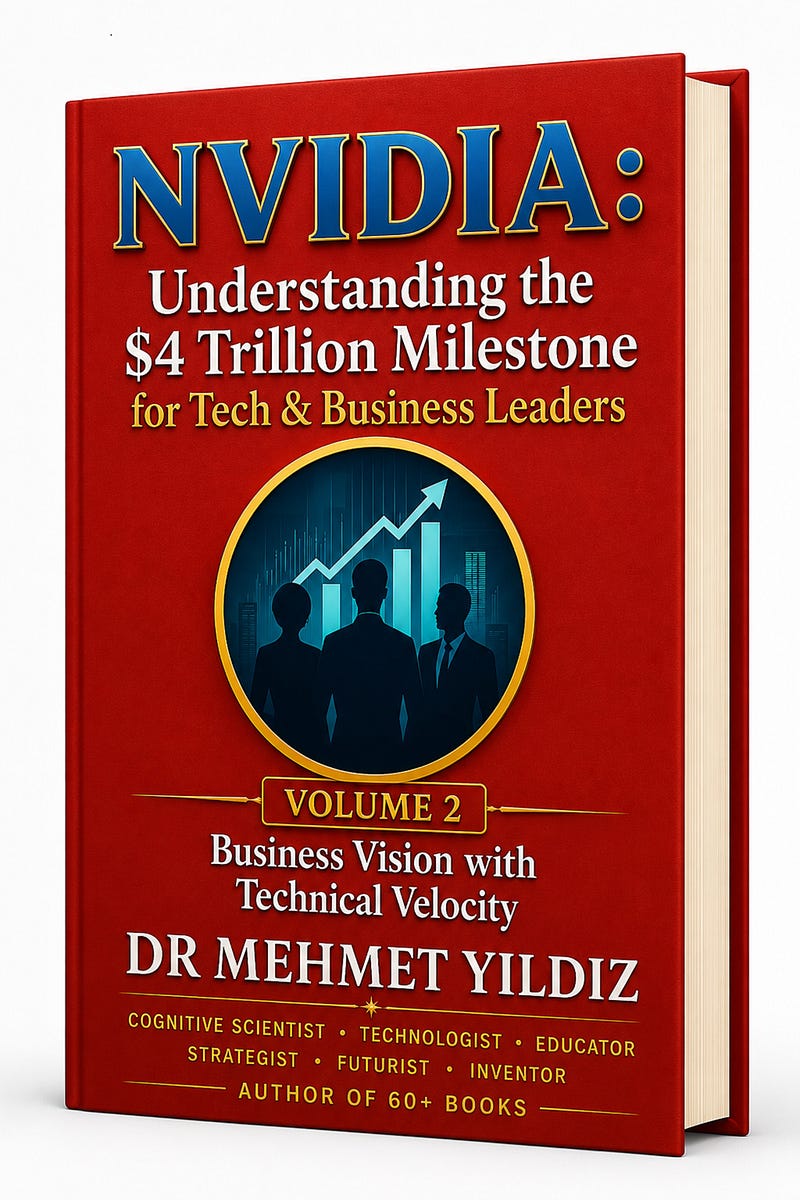
Curator’s Note: This book, “NVIDIA: Understanding the $4 Trillion Milestone for Tech & Business Leaders,” written by Dr Mehmet Yildiz, serves as a sequel to the initial volume focused on NVIDIA’s architectural journey in the AI landscape. It addresses the broader implications of NVIDIA’s ascent beyond financial success, emphasizing the strategic resource of computational intelligence. The book aims to offer business leaders insights into navigating a rapidly evolving economy influenced by intelligent systems. It combines practical lessons with an examination of architecture, leadership, and strategic decision-making, inviting readers to rethink how organizations can leverage technology and adapt for sustained relevance in future market landscapes.
NVIDIA: Understanding the $4 Trillion Milestone for Tech & Business Leaders
Recently, I introduced NVIDIA to readers who might not have heard of the company in an educational story for beginners. Today, I will explain the reasons behind writing this second volume, which is published this week and will be distributed globally in multiple formats next week.
When I completed the first volume titled Eminent Architects of the AI Era, I presented a comprehensive architectural perspective on one of the most influential technology companies of our time.
The book examined NVIDIA through the lenses of enterprise architecture, systems thinking, cognitive science, and business leadership. My goal went beyond explaining how a remarkable company achieved extraordinary success to understanding the deeper architectural principles that enabled it to evolve from a specialized graphics processor manufacturer into a cornerstone of the global artificial intelligence ecosystem.
The response from readers around the world was encouraging and thought-provoking. Enterprise architects, engineers, researchers, executives, entrepreneurs, investors, educators, policymakers, and graduate students shared a common observation.
While the first volume explained how NVIDIA evolved architecturally, it also raised a much larger question:
What does this extraordinary journey mean for business leaders, founders, investors, policymakers, and organizations that must now operate in an economy impacted by intelligent systems?
That question became the foundation of this second volume.
The timing could hardly be more significant. During the preparation of this book in 2025, NVIDIA exceeded a market valuation of four trillion dollars and, by 2026, approached the five-trillion-dollar mark, becoming one of the most valuable companies in modern history.
Predictably, headlines focused on financial milestones, stock performance, investor enthusiasm, and artificial intelligence. Those developments certainly deserve attention, yet they represent only the visible surface of a much deeper transformation that I wanted to bring to light and articulate clearly to a broad audience.
Throughout my professional career since the 1980s, I have learned that extraordinary outcomes are not explained solely by visible events. Behind every sustainable business organization and institution lies an empowering architecture that casual observers seldom notice.
I learned that behind every technological revolution exists a network of leadership decisions, technical trade-offs, ecosystem relationships, organizational capabilities, governance models, and strategic investments that accumulate gradually over many years. By the time financial markets recognize the outcome, the underlying architecture has been evolving gradually for decades.
From my perspective, NVIDIA’s multi-trillion-dollar valuation is one such signal. It is not just a financial milestone, nor simply another Silicon Valley success story. It reflects a structural transition in the global economy.
This remarkable success signals that computational intelligence is becoming a strategic resource comparable to electricity, gas, telecommunications, and the internet during previous technological revolutions. More importantly, it suggests that the architecture supporting intelligence itself may become one of the defining competitive advantages of the twenty-first century, as I also documented in my futuristic book Technology Horizons 2050 and Beyond.
This new volume of the NVIDIA series explores that transition through practical business lessons, architectural thinking, and executive reflections designed to help business and technology leaders prepare for the intelligence economy rather than just observe it.
Although NVIDIA remains the central case study in this volume, this is not intended to be another corporate biography or chronological company history. Nor is it a sponsored publication. Numerous excellent books, documentaries, interviews, and articles already explain NVIDIA’s products, financial performance, and leadership journey. Rather than repeating those accounts, I aimed to answer a different set of questions such as:
Why did global markets assign unprecedented value to this particular company at this particular moment in history?
Why did accelerated computing emerge as a strategic foundation for modern economies?
How did architecture, leadership, ecosystem design, software strategy, and long-term thinking reinforce one another to create sustainable competitive advantage?
Most importantly, what can founders, CEOs, investors, enterprise architects, educators, and policymakers learn from this remarkable journey as they prepare for the next generation of intelligent organizations?
One editorial decision influenced the structure of this book from the very beginning. Rather than presenting NVIDIA as just another successful technology company, I treat each chapter as an executive case study that concludes by translating its central ideas into broader strategic lessons for business leaders, founders, investors, educators, enterprise architects, and policymakers.
These concluding business reflections intentionally move beyond the facts of NVIDIA’s remarkable journey. They explore questions that every executive eventually encounters, such as:
How should organizations prepare for the computational intelligence economy?
What distinguishes architectural value from temporary market enthusiasm?
Why do some ecosystems compound while others gradually weaken? How should investors recognize invisible assets that rarely appear on financial statements?
What qualities will distinguish successful CEOs as artificial intelligence, robotics, biotechnology, quantum computing, and other emerging technologies begin converging over the coming decades?
My objective, therefore, is not simply to explain what NVIDIA accomplished. My goal is to help readers understand why those accomplishments matter and how similar business architectural principles can be applied across industries, organizations, governments, and economies. I believe these reflections will encourage readers to think beyond today’s technologies and develop the strategic perspective required for tomorrow’s opportunities.
These questions, which I attempted to answer in clear language, extend well beyond a single organization. They invite us to examine the changing relationship between technology, business, leadership, economics, education, national competitiveness, organizational resilience, and human decision-making.
My perspectives in this volume have been formed by more than four decades of work at the intersection of enterprise architecture, cognitive science, healthcare technology, digital transformation, and executive leadership. During that time, I had the privilege of contributing to large-scale initiatives at global organizations, including IBM, Siemens, Microsoft, and NATO, while continuing my independent research into cognition, systems thinking, organizational behavior, and emerging technologies.
Those experiences taught me that successful organizations do not excel because of isolated innovations or individual inventions. They succeed because they continuously align technology, architecture, leadership, people, governance, business processes, organizational culture, and long-term purpose into coherent systems that adapt without losing their identity.
These systemic and methodical perspectives guide every chapter in this business volume. While the first volume examined NVIDIA primarily through an architectural lens, this second volume broadens the discussion toward business strategy, executive leadership, platform economics, investor insights for long-term investing, ecosystem design, sovereign artificial intelligence, education, innovation, organizational resilience, and the emerging relationship between accelerated computing and global competitiveness.
Enterprise and business architecture remain central throughout, as architecture and business are inseparable. One provides the invisible structure; the other expresses that structure through execution, markets, innovation, and organizational performance.
As a reader, you do not need an engineering or technical background to benefit from this book. Whenever technical concepts become important, I explain them in accessible language while preserving their strategic significance. My objective is to simplify complexity without oversimplifying reality, organizing ideas into a form that supports thoughtful decision-making.
Whether you lead a multinational corporation, build a startup, advise governments, educate future innovators, invest in emerging technologies, or simply wish to understand the forces impacting and rebuilding our world, I believe this book provides both practical guidance and a broader strategic perspective to the leaders of our future.
As I highlighted in this volume, the rapid evolution of artificial intelligence has generated extraordinary excitement, legitimate concerns, and considerable speculation. In such environments, it is easy to become distracted by daily announcements, quarterly earnings reports, product launches, and market volatility. These events certainly matter, but they do not explain the deeper forces shaping technological history.
Throughout this book, I deliberately step back from the headlines to examine the sustainable business architectural patterns connecting innovation, leadership, ecosystem design, ethical governance, and long-term value creation for society.
As the first volume explored the architectural DNA of NVIDIA, this second volume examines the broader implications of that architecture for business, leadership, investing, organizational design, and society itself.
Ultimately, this volume goes beyond predicting which company will dominate the next decade to understanding the qualities that enable organizations to remain relevant as technology, markets, and human expectations continue to evolve.
If you are interested in this topic, I invite you to read these chapters in two ways. First, as a business architectural case study explaining one of the most remarkable business transformations of our generation. Second, as a series of executive reflections exploring how coherent leadership, resilient architectures, disciplined investment, trusted ecosystems, continuous learning, and responsible governance may help define the organizations that change the intelligence economy of tomorrow.
I hope the ideas presented throughout these chapters encourage you not just to understand NVIDIA differently, but to think differently about leadership, investing, organizational design, and the future of business itself. From my perspective, that is the book’s larger purpose as confirmed by its alpha and beta readers in the last 12 months.

After its announcement in 2025, the second volume of this book, titled “NVIDIA: Understanding the $4 Trillion Milestone for Tech & Business Leaders,” will be available on 15 July 2026, ISBNs: 9798231334452, 9798185702499, 9798185703885. Volume 1, titled “Eminent Architects of the AI Era: What NVIDIA Teaches Us About Vision, Power, and Thinking Beyond the Box,” was published in March 2026 — ISBNs: 9798231169238, 9798255048243, 9798231334452, 9798255049158
The paperback and hardcover formats of the book were published by Amazon yesterday, and the digital version will be available on 15 July 2026.

I am pleased that Google Play also made the audio version available in early access, which is around 5 hours of listening time.

I offered several sample chapters of my NVIDIA books on this platform in story formats:
Why I Find NVIDIA So Special as a Strategist and Superlearner
NVIDIA: Understanding the Company Behind the Computational Intelligence Revolution
Eminent Architects of the AI Era: The Parallel Rise of NVIDIA and OpenAI
How NVIDIA Is Helping Robots Get Closer Toward Embodied Reasoning with “Cosmos Reason” Architecture
From GPUs to Personal Intelligence: Why NVIDIA Is Reinventing the Personal Computer
Why Everyone Knows Facebook but Many Have Never Heard About NVIDIA
Is Trump’s AI Strategy Brilliant or Dumb? Or Are We Asking the Wrong Question?
Thank you for reading my perspectives. I wish you a healthy and happy life.
[End of the Chapter]
Review of the Chapter by Dr Shiv Goel, MD, FACP
This is a superb primer for non-technical readers on why NVIDIA is more than “the AI stock of the moment” and is better understood as an architectural backbone of the intelligence economy.I especially appreciate how you anchor the story in NVIDIA’s early bet on graphics as a new computational discipline and then thread that forward to its evolution into a full-stack computing company spanning GPUs, CUDA, networking, and integrated systems. The contrast between CPUs as “executives” and GPUs as a “well-organized workforce” is a clean mental model that works for both business leaders and clinicians like me who are used to thinking in systems rather than components.Framing NVIDIA’s trajectory as a case study in long-term architectural patience, ecosystem thinking, and software-led leverage feels more insightful than the usual product- or valuation-centric narratives. The way you tie CUDA to decades of downstream innovation in healthcare, scientific research, autonomous vehicles, and national AI infrastructure makes the technical history feel immediately relevant to policy makers, educators, and investors.As someone who writes primarily about health, longevity, and computational tools in medicine, I also found it helpful that you explicitly connect accelerated computing to AI-assisted medical research, drug discovery, and complex biological modeling. It opens a clear bridge between NVIDIA’s “behind-the-scenes” architecture and the everyday realities of clinicians, researchers, and health-system leaders who are trying to understand why AI capacity has suddenly become a strategic resource.I’m looking forward to how the later chapters expand this architectural lens — especially around intelligent infrastructure for healthcare and personal computing — because this introduction does a great job of setting expectations that the book is about understanding the future NVIDIA is helping to reveal, not simply memorizing its product catalog or stock milestones.

Dr Shiv Goel, MD, FACP
Founder of Prime Vitality
https://primevitalityhealth.com/
Updates on My Creative Work with Relevant Links
I am pleased that my new health and wellness books, What the Brain Needs, Why We Fail, and How We Can Fix It, Ketosis + BDNF: The Healing Molecules That Saved My Life, Cellular Intelligence, Feel Better, Live Smarter, Thrive Anywhere, How I Accelerated My Learning Effortlessly for a Happier Life, Healthspan Mastery, The Science & Wisdom of Graceful Aging, and the Subconsious book, were published and are now available in many bookstores, as part of my Health, Wellness, and Cognitive Performance Series.
You can check out my FEATURED series of 60+ books on Amazon markets:
Some of my books are published at Apple Stores, Smashwords, Vivlio, Kobo, Barnes & Noble, BooksaMillion, Fable, Bookshop.org, or my discount bookstore.
If you are a writer, you are welcome to join my publications by sending a request via this link. I support 43K writers who contribute to my publications on this platform. Check out the recent update for the writers of my publications.
You can contact me via my website. If you are a new writer, check out my writing list to find some helpful stories for your education. You can also join my author platform as a guest blogger.
I interviewed several new professionals and thought leaders. You can find them linked at the end of the latest one.
I invite you to subscribe to my publications on Substack, where I offer experience-based and original content on health, content strategy, book authoring, and technology topics you can’t find online to inform and inspire my readers.
Healthspan Mastery (NEW)
Get an email whenever Dr. Mehmet Yildiz publishes. He is a top writer and editor on Medium.
dr-mehmet-yildiz.medium.com
Check out Free Blog Posts by Digitalmehmet Contributors. Here is the link to my FREE personal blogs. Now you can read our blog posts via a Flipboard Magazine for convenience.
I invite you to explore some of my books on my discount bookstore including: Train Your Brain for a Healthier and Happier Life, Cortisol Clarity, Substack Mastery Version 2, The Zen of Book Authoring, Monetize Your Passion with WooCommerce, Agile Business Architecture for Digital Transformation V2, Agile Business Architecture for Digital Transformation (Audiobook), A Powerful Toolkit for Substack Newsletter Mastery, Smart and Ethical SEO, Modern Affiliate Marketing for Writers, 4 Pillars of Enterprise Architecture, and Smart Email Marketing Content Integration, The Mysterious Leadership Mind of Robert F. Kennedy Jr.,


Leave a Reply