

Why the Next Phase of Enterprise AI Requires More Than Models, Agents, and Automation and What It Means for Enterprise Architecture and Organizational Cognition
Curator’s Note: The essay analyzes Plug and Play’s 2026 Enterprise AI Strategy Pulse Survey, highlighting a significant shift in enterprise AI. Organizations have moved from mere experimentation to production, with 74% deploying AI systems. However, many struggle to measure the value generated, revealing a critical gap between deployment and effective measurement. The report emphasizes that integrating AI into a coherent enterprise architecture is essential for sustainable success. Leaders must focus on aligning AI capabilities with business outcomes and ensure that both human and machine intelligences work effectively together. Ultimately, the future of enterprise AI is in creating a cognitive architecture that enhances decision-making and collaboration. This story was written by Dr Mehmet Yildiz, Cognitive Scientist, Technologist, Educator, Neurostrategist, Futurist, Author of 60+ Books,
Dear Subscribers,
In this story, I will discuss the key findings of Plug and Play’s 2026 Enterprise AI Strategy Pulse Survey and interpret what they may mean for the next phase of enterprise AI. Rather than simply restating the survey results, I aim to place them within the broader context of enterprise architecture, organizational cognition, agentic AI, governance, and human–AI collaboration.
Drawing on my background in enterprise architecture, technology, and cognitive science, I explore why the transition from AI experimentation to production raises a deeper question for leaders: how can organizations integrate people, knowledge, processes, and intelligent systems into a coherent architecture that creates measurable business and cognitive value?
For several years, the dominant question in boardrooms was straightforward: How can we use artificial intelligence?
Organizations experimented with machine learning, generative AI, copilots, chatbots, retrieval systems, and capable AI agents. Some initiatives improved productivity. Others accelerated software development, customer service, research, marketing, and knowledge work. Many remained pilots.
In 2026, however, the more consequential question is changing. How do we turn widespread AI deployment into measurable, sustainable enterprise value?
Plug and Play’s 2026 Enterprise AI Strategy Pulse Survey, authored by Amit Patel, Lakshmi Devi K P V and Ipsha Pandey, offers a timely window into this transition. Based on responses from 41 enterprise leaders from Fortune 500 and Forbes Global 2000 organizations, the survey suggests that enterprise AI has crossed an important threshold. AI is no longer confined to laboratories and innovation teams. According to Plug and Play, 74% of respondents already have AI systems in production.
Yet another finding deserves equal attention: roughly half do not consistently track whether those systems are delivering value. That apparent contradiction tells a much bigger story. We have become remarkably good at deploying AI. The harder task now is building enterprises capable of integrating, governing, evaluating, and learning from it.
From my perspective as a cognitive scientist and former enterprise architect, this marks an important shift. The next phase of enterprise AI will depend less on accumulating individual AI tools and more on creating coherent architectures in which people, processes, data, knowledge, intelligent systems, and governance work together. In other words, the AI challenge is becoming an architecture challenge.
What the Plug and Play Survey Is Really Telling Us
The significance of the Plug and Play findings becomes clearer when we look beyond adoption statistics.
A company can deploy an AI system without changing the architecture of the enterprise around it. A marketing team can acquire an AI content assistant. A software team can introduce coding copilots. Customer service can deploy conversational agents. Finance can experiment with forecasting models. Human resources can use AI-supported analytics.
Each initiative may succeed independently. But an enterprise is not merely a collection of independent functions.
It is a complex adaptive system in which information moves across organizational boundaries, decisions create downstream consequences, people depend on shared knowledge, and technologies interact with processes built over many years.
This distinction matters because AI becomes fundamentally different when it moves from assisting isolated tasks to participating in interconnected workflows.
A chatbot answering an employee’s question is one thing. An intelligent system that interprets organizational knowledge, consults multiple data sources, recommends a decision, initiates actions, coordinates with other agents, monitors results, and learns from feedback is something else entirely.
The latter requires architecture. And that, in my view, is one of the deeper implications of the Plug and Play survey.
The Measurement Gap Is Also an Architectural Signal
The finding that deserves particular executive attention is the gap between deployment and measurement.
If nearly three-quarters of surveyed organizations have AI in production while around half do not consistently measure its value, we should not interpret this simply as a missing dashboard or KPI problem. It may reveal something deeper.
Measuring the value of a standalone technology is relatively straightforward when its purpose is narrowly defined. If a system reduces transaction processing time from ten minutes to three, the benefit can be measured. If automation eliminates a repetitive manual step, its productivity contribution may be calculated.
AI complicates this equation because its effects spread across processes. An AI system might save an employee thirty minutes while producing an error that costs another team two hours. An agent might accelerate a workflow while introducing governance risks. A knowledge assistant might reduce search time while simultaneously improving decision quality in ways that conventional productivity metrics fail to capture.
Therefore, the question cannot remain: How much AI have we deployed? It must become: What capability has the enterprise gained, what value does that capability create, and how do we know?
This is where enterprise architecture becomes highly relevant again.
From AI Tools to Enterprise Capability
During my years working in enterprise architecture, I repeatedly observed a familiar pattern whenever an important technology emerged.
Organizations understandably became excited about the technology itself. Different business units acquired products. Vendors introduced platforms. Proofs of concept multiplied. New technical teams appeared. Investment accelerated. Eventually, however, the enterprise encountered integration problems.
Systems needed access to shared data. Security policies had to be coordinated. Business processes crossed organizational boundaries. Technology decisions created dependencies. Governance became necessary. Architecture that seemed bureaucratic during experimentation suddenly became essential when systems reached scale.
AI appears to be following a similar trajectory, but at considerably greater speed. We can think of this development as a progression: AI Tools → AI Systems → AI Ecosystems → Cognitive Enterprise Architecture
At the first stage, AI helps individuals perform tasks. At the second, AI becomes embedded in applications and workflows. At the third stage, multiple models, agents, databases, knowledge systems, APIs, and human teams begin interacting.
The fourth stage is more profound. Intelligent capabilities become part of the operating architecture through which the organization perceives information, remembers knowledge, evaluates alternatives, makes decisions, acts, receives feedback, and adapts.
At that point, AI is no longer merely another technology deployed inside the enterprise. It begins participating in how the enterprise thinks.
From Automation to Agency
This transition is becoming more important with the emergence of agentic AI.
Traditional automation generally follows predefined instructions. Generative AI introduced a more flexible capability: systems could produce, summarize, analyze, and interact with information in natural language.
AI agents extend that capability further. An agent may receive a goal, determine intermediate steps, use external tools, retrieve information, interact with systems, evaluate results, and continue acting toward an objective.
The architectural implications are significant. When software begins to initiate actions rather than merely respond to commands, questions of identity, authorization, memory, context, accountability, monitoring, escalation, and human oversight become much more important.
Who authorized the agent?
What information can it access?
What does it remember?
Which actions may it execute independently?
When must it request human judgment?
How do other systems know whether to trust it?
Who becomes accountable when several agents contribute to a consequential decision?
These are not just model-performance questions. They are questions of enterprise architecture, governance, and organizational design.
The Missing Layer: Organizational Cognition
There is another dimension that I believe deserves greater attention. Enterprise AI discussions frequently focus on what machines can do. Cognitive science encourages us to ask a different question: What kind of cognitive system are we creating when humans and intelligent machines begin working together?
Organizations already possess forms of distributed cognition. No single employee contains all the knowledge of a multinational enterprise. Knowledge is distributed across people, databases, documents, processes, institutional memory, relationships, technologies, and cultural practices.
An organization senses changes in its environment. It interprets information. It remembers previous experiences. It allocates attention. It evaluates alternatives. It makes decisions. It acts. It learns from outcomes.
These functions bear important similarities to cognitive processes. AI is now entering many of them. This does not mean that an enterprise literally becomes a biological mind, nor does it imply that contemporary AI possesses human consciousness. Such claims would go far beyond the available evidence.
The more useful proposition is architectural. We are beginning to construct hybrid cognitive systems in which biological and artificial capabilities contribute differently to shared organizational goals. That distinction may become one of the defining management questions of the coming decade.
A Neural Artificial Cognition Perspective
This question also connects with the Neural Artificial Cognition (NAC™) framework I have been developing through the intersection of cognitive science, neurobiology, psychology, computing, and intelligent systems.
The central issue is broader than making machines more intelligent. Intelligence alone does not explain cognition.
Biological cognition involves interacting capacities such as perception, attention, memory, learning, prediction, reasoning, contextual interpretation, adaptation, metacognition, and action. These capacities operate within feedback loops rather than as isolated functions.
Enterprise AI is beginning to display an analogous architectural challenge.
We can build highly capable models. We can connect them to tools. We can provide memory. We can create agents. We can connect those agents to enterprise knowledge and allow them to act.
But connecting capabilities does not automatically produce coherent cognition. The components need relationships, feedback, context, constraints, evaluation mechanisms, and governance.
This is why I see a useful progression: Automation → Assistance → Agency → Artificial Cognition → Collective Enterprise Cognition
Many enterprises today appear to be moving from assistance toward agency. The more interesting frontier is beyond that transition.
What happens when multiple artificial agents, human specialists, organizational knowledge systems, business processes, and decision structures begin operating as an interconnected cognitive network? That is where AI strategy starts meeting cognitive architecture.
Humans Must Remain Part of the Architecture
There is a danger in interpreting the rise of enterprise AI solely as a substitution story. If AI can perform a task, organizations may naturally wonder whether the human performing it is still required.
Sometimes automation will indeed eliminate particular forms of work. History gives us ample precedent. But cognition is more complicated than task execution.
Humans contribute contextual understanding, lived experience, ethical judgment, social intelligence, intuition, empathy, imagination, accountability, and the ability to interpret ambiguous situations through cultural and historical knowledge.
Machines offer distinct strengths: computational scale, rapid retrieval, pattern detection, persistent monitoring, simulation, consistency, and the ability to process quantities of information far beyond the unaided human capacity.
The strategic opportunity therefore extends beyond asking: Which human tasks can AI replace? A more productive architectural question is: Which cognitive responsibilities should remain human, which can be delegated to machines, and which become more valuable when humans and artificial systems perform them together?
That question changes the conversation from workforce substitution to cognitive design.
Six Layers That Enterprise Leaders Need to Connect
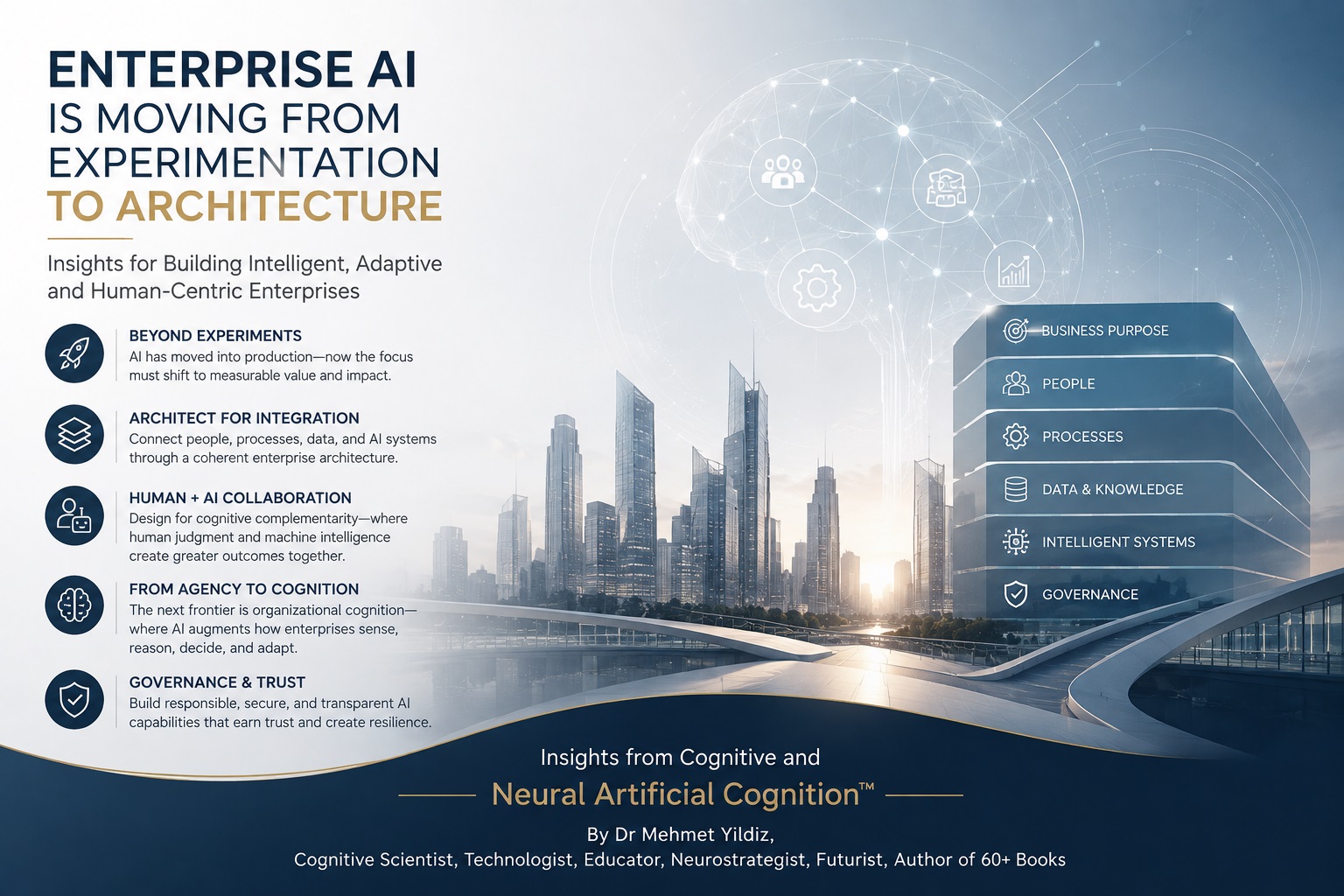
From an architectural perspective, I believe enterprise AI strategies need alignment across six interconnected layers: Business Purpose → People → Processes → Data and Knowledge → Intelligent Systems → Governance
Business purpose defines why the capability exists. People contribute judgment, expertise, accountability, creativity, and organizational context. Processes connect individual actions into repeatable value creation. Data and knowledge provide memory and context. Intelligent systems provide computational and agentic capabilities. Governance establishes boundaries, assigns responsibility, builds trust, defines measurement, and provides oversight. Weakness in one layer can undermine the others.
A sophisticated AI model operating on poor organizational knowledge will produce limited value. An autonomous agent operating without appropriate governance may create unacceptable risk. Excellent technology embedded in a badly designed process may simply automate inefficiency.
This is why buying better models alone cannot solve the enterprise AI problem. Architecture connects capability to purpose.
Moving from Deployment Metrics to Cognitive Value
The Plug and Play survey’s measurement finding may therefore point toward another necessary change. Executives will need better ways of measuring what I would call cognitive value.
Traditional ROI remains essential. Revenue, cost reduction, productivity, cycle time, quality, customer outcomes, and risk must still be measured.
But organizations may also need to understand how AI affects their capacity to think and act.
Does the organization detect important signals earlier?
Can employees retrieve institutional knowledge faster?
Are decisions better informed?
Can teams evaluate more alternatives before committing resources?
Does the enterprise learn from previous decisions?
Are weak signals reaching decision-makers?
Can intelligent agents coordinate activities without obscuring accountability?
Does human judgment improve because people receive better information, or deteriorate because they become overly dependent on automated recommendations?
These questions take us beyond counting AI deployments. They ask whether AI is improving the cognitive performance of the enterprise.
What Enterprise Leaders Should Consider Next
The Plug and Play survey arrives at an important moment. The experimental phase of enterprise AI has taught organizations what these technologies can do. The next phase must determine how those capabilities belong within the enterprise.
For boards and executives, this means connecting AI investment to measurable business outcomes rather than treating deployment itself as progress.
For CIOs and CTOs, it means thinking beyond individual models toward interoperability, data architecture, identity, security, observability, knowledge systems, and agent orchestration.
For enterprise architects, it creates an opportunity to rethink architecture around intelligent and autonomous components rather than conventional applications alone.
For AI leaders and data scientists, it means recognizing that model performance is only one component of enterprise success.
And for business leaders, it means understanding that AI strategy can no longer remain exclusively inside the technology function. It touches organizational design, workforce capability, knowledge management, governance, strategy, and culture.
There is encouraging evidence that this broader shift is already underway. Other recent enterprise research similarly points toward organizations moving beyond individual productivity applications and toward process redesign, strategic integration, and new business models.
From an AI-Enabled Enterprise to a Cognitive Enterprise
From my perspective, the most important contribution of Plug and Play’s 2026 Pulse Survey is that it captures enterprise AI at an inflection point.
The first era was about possibility. The second was about experimentation. The third has been about deployment. The emerging era will be about integration, measurement, architecture, and cognition.
Organizations will continue adopting better models. Agents will become more capable. Infrastructure will mature. Costs will change. New vendors will appear. Some technologies attracting enormous attention today will disappear. But beneath those changes lies a more enduring architectural challenge.
Enterprises must determine how human intelligence, artificial intelligence, organizational knowledge, processes, governance, and autonomous systems can function coherently together.
That is why I believe the defining enterprise AI question is changing. It may no longer be: “Does our organization use AI?” Soon, almost every significant enterprise will. The more consequential question may become: “How intelligently can our people, machines, knowledge, and organizational systems think and act together?”
The organizations that learn to answer that question will be doing considerably more than deploying artificial intelligence. They will be designing the cognitive architecture of the enterprise itself.
Summary of Report:
The report points to a widening gap between deployment and measurement, along with an ownership structure that’s shifting away from IT and into individual business units.
Here are the key highlights of the report from Plug and Play:
- 74% of respondents have at least one AI solution in production
- Among companies with AI in a single function, 74% say ROI is too early to measure or isn’t tracked at all
- 92% say data privacy, explainability, and compliance are the top factors in vendor selection, ahead of performance (74%) and flexibility (53%)
- Only 21% of AI ownership sits with a CAIO, AI lead, or center of excellence; 37% sits with functional or line-of-business heads.
- Data foundation issues remain the top blocker to scale, cited by 71% of respondents, and stay high across every stage of adoption.
Plug and Play executives are available to discuss why enterprises with AI already in production still can’t answer basic ROI questions, and what needs to change for deployment to translate into measurable results in the second half of 2026.
Thanks to our curators turning this post to a summary and interactive podcast.
About the Company
Plug and Play is a global innovation platform and venture capital firm headquartered in Sunnyvale, California, connecting technology startups with corporations, investors, and industry partners across an international innovation ecosystem. The company supports startups from early-stage development through growth by providing access to accelerator programs, mentorship, corporate partnerships, pilot opportunities, investment, and commercial networks. At the enterprise level, Plug and Play helps major organizations identify and engage emerging technologies that can address strategic and operational challenges. At the same time, its venture capital activities span multiple stages and technology sectors. Its ecosystem covers areas including artificial intelligence, fintech and insurtech, supply chain and logistics, mobility, healthcare, agriculture, retail, and other emerging technologies, giving the organization a distinctive vantage point from which to observe how innovation moves from experimentation into real-world enterprise adoption.


Leave a Reply