

Here’s Why I Believe IBM’s New Modular Cryogenic Architecture Could Change How We Scale Quantum Computers for the Future of Fault-Tolerant Quantum Computing and an Educational Introduction to Key Concepts
Curator’s Note: IBM’s recent demonstration of a modular cryogenic architecture at its Poughkeepsie facility marks a significant advancement in quantum computing. Instead of relying on a single large superconducting cryostat, IBM introduced modular cryogenic cells that can be interconnected. This approach not only enables more efficient cooling but also addresses the engineering complexities of scaling quantum systems, such as wiring density and thermal stability. The architecture aims to support future fault-tolerant quantum computers like Quantum Starling, targeted for 2029. This shift emphasizes the importance of designing quantum systems as interconnected modules rather than just increasing individual qubit counts, potentially transforming quantum computing’s landscape. This essay was written by Dr Mehmet Yildiz, a cognitive scientist, inventor, futurist, and technologist, who worked at IBM as an executive enterprise architect for over 2 decades.
Dear Subscribers,
Today, I decided to write this educational essay because yesterday (August 19, 2026), IBM demonstrated an intriguing response to this problem. Rather than simply building an ever-larger quantum refrigerator, its engineers successfully connected and operated two modular cryogenic cells at IBM’s quantum facility in Poughkeepsie, New York. The achievement does not represent a new type of quantum computer by itself. It represents something potentially just as consequential: a new architectural approach to building much larger quantum systems.
Imagine building a computer that cannot function unless its processor is kept less than 0.015 degrees above absolute zero. Now imagine trying to scale that machine to thousands of interconnected components while every additional cable, connection, and electronic device can introduce heat or noise that threatens the computation itself.
This is one of the less visible engineering challenges behind the race toward useful quantum computing. You might have heard about qubit counts, new quantum processors, quantum advantage, and error correction. However, you might hear much less about the extraordinary physical infrastructure required to keep quantum processors cold, isolated, connected, controlled, and stable enough to perform useful computation.
IBM reports that the connected system reached temperatures below 15 millikelvin, or less than 0.015 kelvin above absolute zero. For perspective, the cosmic microwave background that fills the universe has a temperature of about 2.7 kelvin. Quantum engineers are therefore creating controlled environments on Earth that are dramatically colder than the natural background temperature of deep space.
The announcement deserves attention because quantum computing is gradually becoming a systems-engineering challenge rather than simply a competition to pack more qubits onto individual chips.
Superconducting quantum processors require refrigeration, vacuum systems, shielding, wiring, microwave electronics, readout infrastructure, classical control systems, and protection against thermal and electromagnetic disturbances. Every additional processor and connection, therefore, creates engineering consequences that extend far beyond the qubit itself.
IBM’s latest demonstration approaches this problem architecturally. Rather than continuing to enlarge a single traditional cylindrical cryostat, IBM has developed cryogenic cells that can be placed and connected side by side.
Each provides a controlled ultra-cold environment while creating a pathway for processors in neighboring cells eventually to communicate through short interconnections. IBM sees this modular infrastructure as one of the foundations for its planned fault-tolerant Quantum Starling system, targeted for 2029.
First, What Does Cryogenic Mean in Quantum Computing?
Cryogenics is the science and engineering of producing and maintaining extremely low temperatures. In superconducting quantum computing, however, cryogenics is much more than refrigeration in the everyday meaning of the word.
The quantum processor must operate in an environment where thermal energy is sufficiently suppressed for extremely fragile quantum states to survive long enough to be controlled and measured.
IBM’s superconducting processors operate at temperatures measured in millikelvin, meaning thousandths of a kelvin above absolute zero. At these extraordinary temperatures, certain electrical circuits become superconducting, enabling them to exhibit the properties required to function as quantum bits, or qubits.
The need for such extreme conditions comes partly from the fragility of quantum information. Qubits can lose their useful quantum state through interactions with their surroundings, a process known as decoherence.
In simple terms, decoherence occurs when unwanted interactions with heat, electromagnetic radiation, materials, or other environmental influences disturb the delicate quantum state carrying information.
Cooling therefore becomes part of the computer architecture itself rather than simply an environmental service surrounding the computer.
How Do We Make Something That Cold?
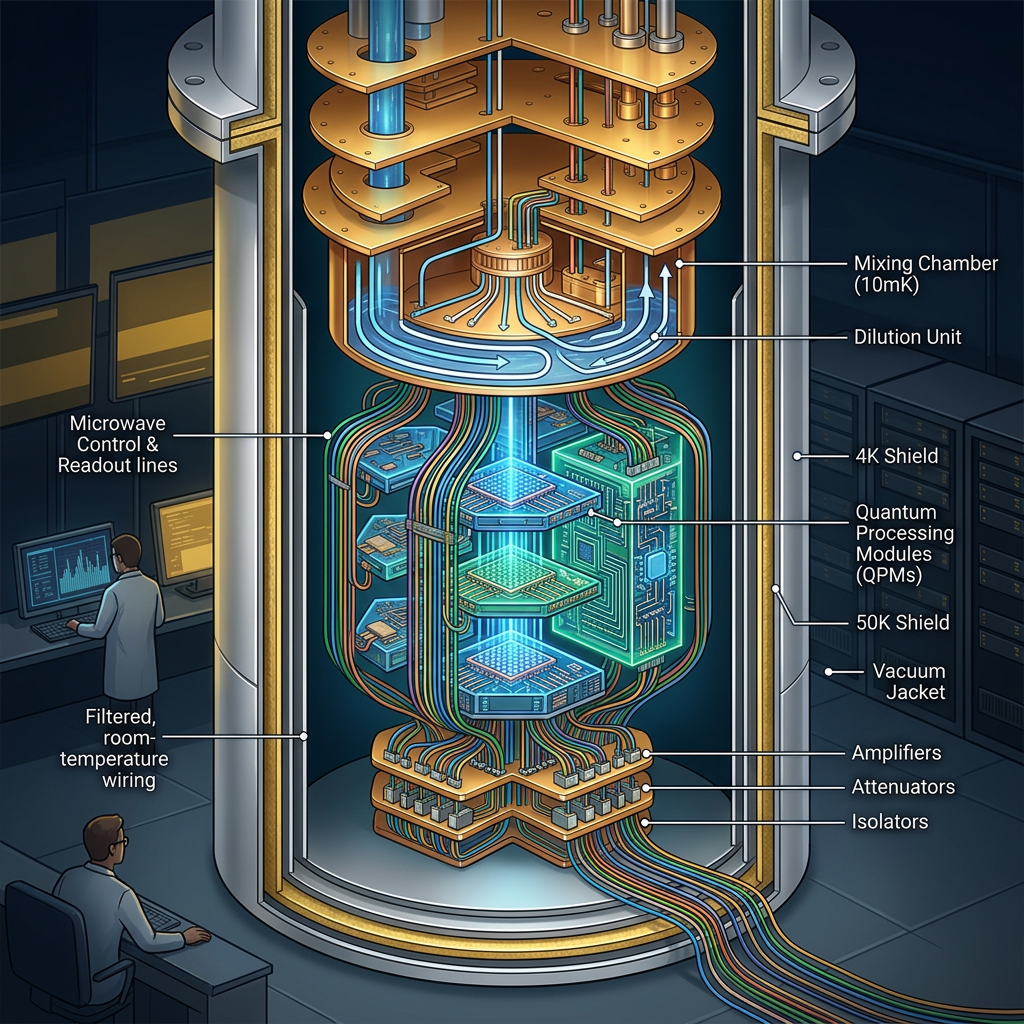
The machine responsible for creating this extraordinary environment is called a dilution refrigerator. Unlike a household refrigerator, it uses the properties of helium isotopes, principally helium-3 and helium-4, together with multiple cooling stages to bring the quantum processor progressively closer to absolute zero.
Modern systems can use mechanical cryocoolers for the initial cooling stages before the dilution process produces temperatures measured in millikelvin. IBM previously explored the challenges of scaling this infrastructure through its experimental Project Goldeneye cryogenic system, which reached approximately 25 millikelvin.
If we could look inside a superconducting quantum computer, we would therefore see something very different from a conventional server. Control signals originating in room-temperature electronics must travel through progressively colder stages before reaching the processor. Measurement signals then have to be returned from the quantum hardware to classical electronics, where they can be interpreted.
That creates an intuitive engineering problem. Imagine trying to feed thousands of delicate control and measurement lines into an extraordinarily sensitive freezer while preventing those same connections from carrying unwanted heat and noise inside.
Every cable, amplifier, connector, filter, and control circuit has physical consequences. Engineers therefore have to manage wiring density, thermal conduction, electromagnetic interference, signal integrity, available space, and the heat generated by supporting electronics while simultaneously maintaining an environment only fractions of a degree above absolute zero.
This creates a fundamental engineering tension. We want to connect and control more qubits, yet every additional connection can potentially introduce wiring, heat, noise, and physical complexity. Recent research continues to identify cryogenic wiring, control electronics, readout infrastructure, and thermal loads as significant constraints on scaling superconducting quantum computers.
Why Can’t We Simply Build a Bigger Quantum Refrigerator?
Traditional superconducting quantum computers generally place their processors inside self-contained cylindrical cryostats. This architecture has served the industry remarkably well. IBM progressed from its five-qubit cloud-accessible machine in 2016 through generations of increasingly capable processors and cryogenic systems.
But physical scale eventually creates its own constraints. More qubits require additional control and readout infrastructure. More wiring introduces potential thermal loads. Larger processors and systems require additional physical space. Connecting processors over increasing distances introduces additional engineering challenges, including signal loss, noise, synchronization, and unwanted interactions.
IBM identifies spatial constraints, heat generation, and qubit crosstalk among the issues that make indefinite single-chip scaling increasingly difficult.
There is, therefore, an architectural question underlying the quantum-computing race. Instead of asking only “How many qubits can we place on the next processor?”, we need to ask “How can multiple processors operate together as one reliable computational system?” That question leads directly to modularity.
IBM’s Answer: Build the Cryogenic Infrastructure as Modules
IBM’s new design challenges the assumption that scaling requires one large cylindrical cryostat. Instead, the company has developed box-shaped cryogenic cells constructed from solid aluminum panels and framing. Each cell creates a complete cryogenic environment capable of housing quantum hardware, while adjacent cells can be physically connected.
The geometry matters as conventional cylindrical cryostats can require relatively long physical connections between processors. Box-shaped cells can sit closely beside one another, shortening potential interconnect paths.
Quantum cables can pass through openings between neighboring cells while interconnected layers of thermal shielding create what IBM describes as a protected cryogenic tunnel between the systems.
We can think of the difference somewhat like moving from one enormous machine toward a modular data-center architecture. Instead of requiring every future expansion to fit within a single enclosure, additional computational capacity can be organized into interconnected units.
Each IBM cell also provides substantially more room for future hardware. IBM reports approximately 0.53 square meters of available wiring area and 2.75 cubic meters of vacuum-chamber volume per cell. The company expects future versions of individual cells to support thousands of qubits.
That last point requires an important qualification. This is an architectural capacity goal, not evidence that IBM has already demonstrated thousands of operational qubits inside these modules.
What IBM Actually Demonstrated
This distinction between demonstrated capability and future intention matters. IBM reports that two prototype cryogenic cells have now been successfully coupled and operated together at its Poughkeepsie quantum facility. The combined modules cooled to 4 kelvin in less than five days and subsequently reached temperatures below 15 millikelvin.
The first operational pair is physically substantial. Together, the modules are more than eight feet tall and eight feet wide. IBM also reports that each module provides up to 12 times as much wiring space as the most commonly used current quantum systems.
That additional capacity matters because scaling a quantum computer requires far more than finding room for additional processors. Engineers need space and thermal capacity for control, measurement, communication, and potentially processor-to-processor connections without overwhelming the cryogenic environment.
IBM also reports that the thermal interaction between connected cells can be kept sufficiently small to maintain manageable cooling time and temperature stability as the cells are joined. If this characteristic continues as the architecture expands, it could become an important engineering advantage of the modular approach.
IBM has therefore demonstrated the cryogenic architecture, not the completed fault-tolerant quantum computer that this architecture is intended eventually to support.
From Bigger Chips to Connected Quantum Systems
This announcement illustrates a broader transition occurring across advanced computing: scaling individual components is increasingly being supplemented by connecting multiple components into larger coordinated systems.
Conventional computing followed a comparable architectural progression. Improvements in individual processors remained important, but enormous computing capacity eventually came from connecting processors, servers, storage systems, networks, and accelerators. Modern supercomputers and cloud platforms derive their capabilities from this coordinated architecture rather than from one gigantic processor.
Quantum computing appears to be encountering its own version of this architectural transition. IBM states that future quantum computers will depend on multiple processors working together. Some workloads could be distributed among processors, while more tightly connected processors could operate as components of a larger quantum computational system.
Independent research supports the broader importance of modular approaches. A 2026 Nature Photonics study demonstrated coherent signal transfer between superconducting circuits housed in separate dilution refrigerators via a one-kilometer optical fiber link. The researchers identified refrigerator size and cooling capacity as constraints on further scaling superconducting processors.
Their solution differs technically from IBM’s adjacent-cell architecture, but both developments point toward the same larger challenge: future quantum computers may require effective ways to connect multiple cryogenic computational environments.
The L-Coupler Becomes an Important Part of the Story
IBM’s modular cryogenic architecture is also designed to accommodate its L-coupler technology. These long-range quantum interconnects are intended to connect quantum processing units within dilution refrigerators over distances approaching one meter.
IBM says researchers will be able to use the new cryogenic cells to test these interconnections as part of its modular fault-tolerant architecture. This is where the announcement becomes much more than a story about refrigeration.
Cooling, processor design, interconnection, error correction, classical control, measurement, and software increasingly need to function as parts of one coordinated system. A scalable quantum computer is therefore better understood as an integrated computational architecture than as an isolated quantum chip.
IBM’s roadmap reflects this systems perspective. The company plans to use modular processors and quantum communication technologies as stepping stones toward larger fault-tolerant systems, with Quantum Starling targeted for 2029.
IBM describes Starling as a planned large-scale fault-tolerant quantum computer designed to operate with 200 logical qubits and execute circuits containing 100 million quantum gates. These figures remain future targets rather than capabilities demonstrated by the current cryogenic experiment.
What Is a Logical Qubit, and Why Does It Matter?
This distinction becomes easier to understand when we separate physical qubits from logical qubits.
Physical qubits are the actual quantum devices inside a processor. They are extremely sensitive to errors. A logical qubit is a more reliable computational unit created by encoding quantum information across multiple physical qubits so that errors can be detected and corrected.
The process used to achieve this is known as quantum error correction. In simplified terms, instead of trusting one fragile physical qubit to preserve information perfectly, the system distributes information across multiple qubits and continually checks for errors without directly destroying the quantum information being protected.
This is one reason why raw physical qubit counts can be misleading when evaluating future quantum computers. A machine may require many physical qubits to create a much smaller number of dependable logical qubits.
Fault tolerance therefore changes the entire engineering equation. A useful fault-tolerant machine must maintain enough high-quality physical qubits, interconnections, measurement systems, classical decoding capacity, control electronics, and cryogenic stability to support reliable logical computation over extended operations.
A theoretical error-correction architecture means little if the physical machine cannot house, cool, connect, control, and measure the hardware required to implement it.
Cryogenics Is Becoming Part of Computer Architecture
From an architectural perspective, I find this one of the most interesting implications of IBM’s announcement.
In conventional computing, we often think of cooling as supporting infrastructure. We design processors and servers and then engineer cooling systems around their thermal characteristics.
Superconducting quantum computing makes that separation much harder. The cryogenic environment influences what can physically be connected, where electronics can reside, how much wiring can enter the system, how much heat can be tolerated, how processors communicate, and how easily hardware can be replaced or expanded.
Cryogenics therefore becomes part of the computational architecture itself. Current academic research reinforces this point. Studies of superconducting fault-tolerant systems increasingly examine cryogenic control electronics, wiring density, thermal conduction, amplifier dissipation, readout infrastructure, and power delivery as system-level scaling constraints.
Progress toward useful quantum computing may consequently depend on several interacting disciplines at once: quantum physics, materials science, electrical engineering, refrigeration, microwave engineering, computer architecture, packaging, error correction, classical computing, and software engineering.
Modularity Could Also Change How Quantum Computers Are Maintained
The most visible benefit of modularity is scalability, but another architectural implication deserves greater attention: serviceability and evolution.
Imagine a conventional data center in which every new processor required rebuilding the entire facility. Modern computing infrastructure avoids that problem through modular designs, standardized interfaces, replaceable components, and systems that can expand incrementally.
Quantum computing is obviously different, particularly because its components operate under extreme cryogenic conditions. Nevertheless, the architectural principle is familiar.
A modular cryogenic system could potentially allow engineers to develop, test, service, or upgrade parts of the infrastructure with greater independence than would be possible inside an increasingly large monolithic cryostat. Individual cells could accommodate evolving generations of processors, wiring, interconnects, and cryogenic electronics while the broader architecture provides continuity.
This does not mean IBM has already demonstrated seamless cell-by-cell maintenance of a production quantum computer. It means its architecture creates a physical framework in which modular development and servicing become more plausible.
That distinction matters because industrial computing systems must eventually do more than demonstrate laboratory performance. They need to be maintainable, diagnosable, upgradeable, and capable of evolving across hardware generations.
What This Announcement Does Not Mean
We should nevertheless interpret IBM’s demonstration carefully. IBM has not demonstrated its planned Quantum Starling computer. It has not demonstrated thousands of fault-tolerant logical qubits. Nor has this experiment by itself solved quantum error correction or the many remaining challenges of large-scale quantum computing.
What IBM has demonstrated is a physical cryogenic architecture capable of connecting two ultra-cold modules while maintaining an environment suitable for superconducting quantum hardware.
That makes this an infrastructure milestone rather than a completed computational milestone. But infrastructure milestones matter. The history of computing shows that advances in processors become useful at scale only when the surrounding architecture can support them.
My Perspective: The Important Unit Is Becoming the Quantum System
For years, public discussion of quantum computing has been dominated by qubit counts. That measure made sense during the early development of the field, but it increasingly tells us only part of the story.
The more consequential question now is how to make qubits reliable computational systems.
IBM’s modular cryogenic demonstration illustrates this transition particularly well. Future machines may combine multiple quantum processors, cryogenic modules, quantum interconnects, classical controllers, real-time decoders, error-correction layers, and software into one coordinated architecture.
In my view, the important unit of progress is therefore gradually moving from the quantum chip toward the quantum system.
IBM’s new cryogenic cells should not simply be viewed as larger or differently shaped refrigerators. They represent an experiment in how we might physically architect quantum computers at a scale where a single processor, a single chip, and eventually perhaps a single cryogenic enclosure are no longer enough.
The next era of quantum computing may therefore be determined as much by architecture, integration, and systems engineering as by the qubits themselves.
As architecture, integration, and engineering are critical points for our emerging technologies, I documented my experiences, perspectives, and predictions in a new book titled “Cognitive Systems Architecture and Engineering in the AI Era: From Neural and Cognitive Foundations to Agentic and Artificial Cognition in 12 Steps”. This book is now available on multiple platforms in digital, paperback, hardcover, and audio formats, including Amazon Kindle, Paperback, Hardcover, Google Play Digital, and Barnes & Noble.
Although IBM Had “Its Worst Day in 115 Years,” I Still Believe in Its Future
References and Further Reading
IBM Quantum — “IBM’s New Modular Architecture for Cryogenic Systems,” August 19, 2026. Primary source describing the modular architecture, coupled-cell demonstration, cryogenic design, dimensions, wiring capacity, and relationship to IBM’s quantum roadmap.
IBM Quantum — Roadmap Toward Large-Scale Fault-Tolerant Quantum Computing. Background on IBM Quantum Starling and IBM’s planned fault-tolerant architecture.
IBM Quantum — Project Goldeneye. Technical background on dilution refrigeration, helium-3/helium-4 cooling, millikelvin operation, and IBM’s earlier large-scale cryogenic experiments.
IBM Quantum — Quantum Hardware and Cryostat. Background explaining IBM’s cryostat components, temperature stages, microwave wiring, amplifiers, and superconducting quantum hardware.
Nature Electronics — Research on Cryogenic Quantum-Control Electronics, 2026. Recent research examining wiring and control-electronics challenges associated with scaling superconducting quantum processors.
Nature Photonics — Photonic Connection Between Superconducting Circuits in Separate Dilution Refrigerators, 2026. Research demonstrating the broader scientific movement toward modular and interconnected superconducting quantum architectures.
Thank you for reading my perspectives. I wish you a healthy and happy life.
[End of the Essay]
You can check out my FEATURED series of 60+ books on Amazon markets:
If you are a writer, you are welcome to join my publications by sending a request via this link. I support 43K writers who contribute to my publications on this platform. Check out the recent update for the writers of my publications.
You can contact me via my website. If you are a new writer, check out my writing list to find some helpful stories for your education. You can also join my author platform as a guest blogger.
I interviewed several new professionals and thought leaders. You can find them linked at the end of the latest one.
I invite you to subscribe to my publications on Substack, where I offer experience-based and original content on health, content strategy, book authoring, and technology topics you can’t find online to inform and inspire my readers.
Healthspan Mastery (NEW)
Get an email whenever Dr. Mehmet Yildiz publishes. He is a top writer and editor on Medium.
dr-mehmet-yildiz.medium.com
Check out Free Blog Posts by Digitalmehmet Contributors. Here is the link to my FREE personal blogs. Now you can read our blog posts via a Flipboard Magazine for convenience.
I invite you to explore some of my books on my discount bookstore including:Train Your Brain for a Healthier and Happier Life, Cortisol Clarity, Ketosis + BDNF: The Healing Molecules That Saved My Life, The Science & Wisdom of Graceful Aging, The LIFE Matrix Keeps the Score, How I Accelerated My Learning Effortlessly for a Happier Life, Neurocomputing and Neural Architectures, Substack Mastery Version 2, The Zen of Book Authoring, Monetize Your Passion with WooCommerce, Agile Business Architecture for Digital Transformation V2, Agile Business Architecture for Digital Transformation (Audiobook), A Powerful Toolkit for Substack Newsletter Mastery, Smart and Ethical SEO, Modern Affiliate Marketing for Writers, 4 Pillars of Enterprise Architecture, and Smart Email Marketing Content Integration, The Mysterious Leadership Mind of Robert F.Kennedy Jr., Cognitive Computing Reimagined.
Reference: Chapter of Generosity™ at Digitalmehmet Content Ecosystem
Cognitive Computing Reimagined
Prefacio: Por Qué Escribí Este Libro y Cómo Puede Beneficiarle
Reclaiming Cognition from Computation: A Scholarly Appraisal of the Interdisciplinary Neural Artificial Cognition™ (NAC) Framework


Leave a Reply