

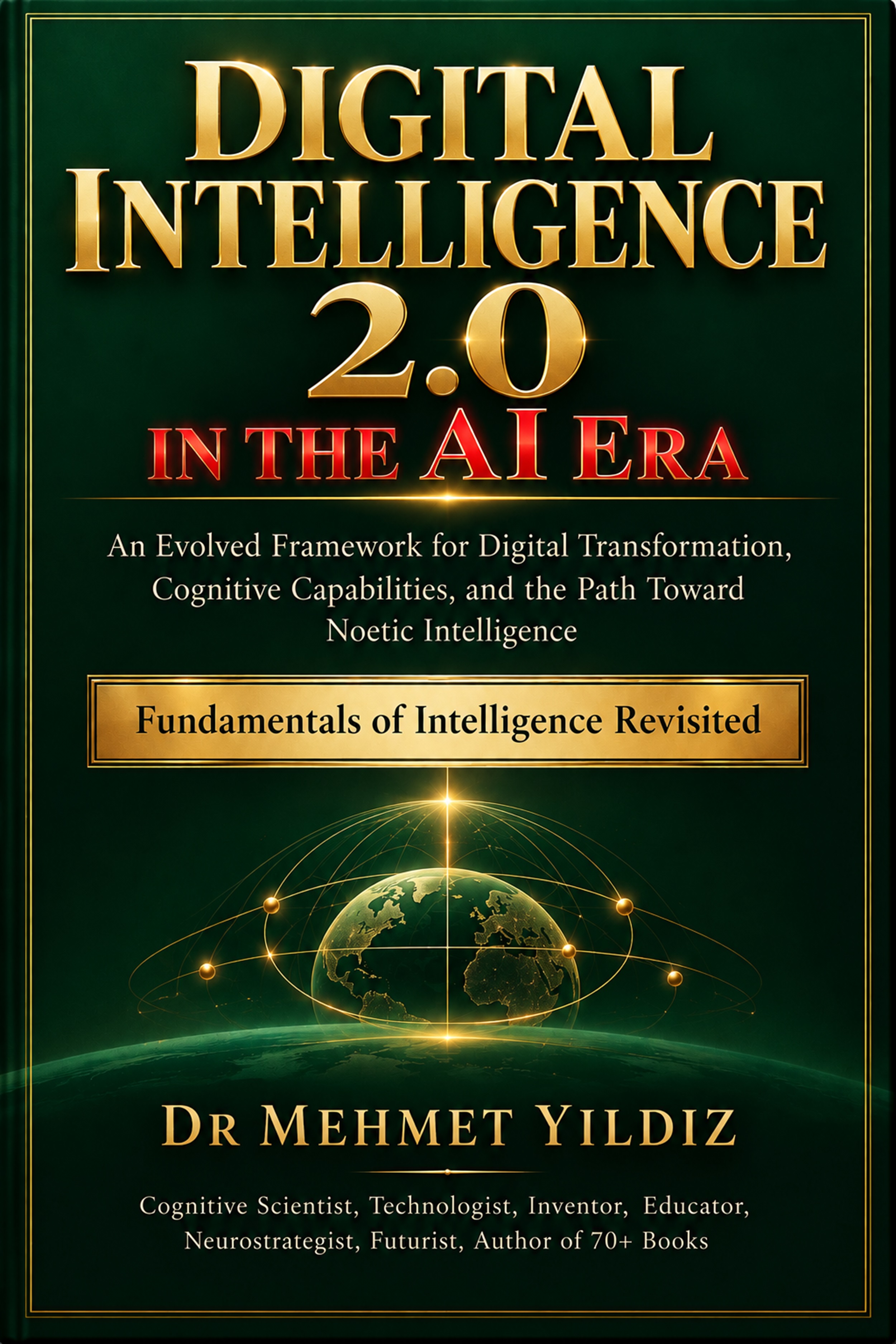
An Evolved Framework for Digital Transformation, Cognitive Capabilities, and the Path Toward Noetic Intelligence
Curator’s Note: In “DIGITAL INTELLIGENCE 2.0 in the AI Era,” Dr. Mehmet Yildiz revisits the concepts of digital intelligence, exploring how organizations can achieve true digital and cognitive capabilities in 2026. Despite advancements in technology, Yildiz argues that digital savvy does not equate to intelligence, as many enterprises face ongoing challenges like poor data quality and complexity. This work emphasizes the need to rethink enterprise architecture, prioritizing decision-making and human judgment over mere technology expansion. With insights into the role of AI and noetic intelligence, the book targets a diverse audience, advocating for a more strategic approach to harnessing digital tools for meaningful impact. Bibliographic References: DIGITAL INTELLIGENCE 2.0 in the AI Era: An Evolved Framework for Digital Transformation, Cognitive Capabilities, and the Path Toward Noetic Intelligence by Dr. Mehmet Yildiz. ISBNs: 9798175255738, 9798175257602, 9780466649425 (Audio). ASINs: B0HK7NBF8N, B0HKC1LGT4, B0HKC5SDMR, B0HK7R74TC. EAN: 2940184906263. GKEYs: 4jEOEgAAQBAJ, AQAAAECG2HSY4M — Official Page. The author also shared the Preface of the book on Medium and a brief intro on Telegram for a broader audience.
Fundamentals of Intelligence Revisited in 2026
Dear subscribers and visitors, welcome! Thank you for checking this intro.
When I wrote the first version of Digital Intelligence in 2019, I was trying to address a problem I had observed for many years in large business and academic organizations. Enterprises were becoming more digital, but having more technology did not necessarily make them more intelligent. Seven years later, that distinction matters even more.
In 2026, we have extraordinary access to cloud platforms, massive amounts of data, analytics, automation, intelligent assistants, AI agents, generative AI, mobile computing, connected devices, and rapidly evolving digital ecosystems. Yet I still see familiar problems: fragmented architectures, poor-quality data, rising technology costs, legacy systems, duplicated capabilities, security risks, overwhelmed employees, skills gaps, competing priorities, and AI initiatives struggling to demonstrate sustainable business value.
This perspective led me back to the question at the heart of my original work: What actually makes an organization digitally intelligent? My answer is still not “more technology.” In fact, one of this book’s central arguments is that an organization can be highly digital without being digitally intelligent.
So I didn’t want to take my 2019 book, add a few chapters about generative AI, replace some old technology names, and call it a new edition. Too much has changed for that approach. I went back to the underlying framework and reconsidered it through what we have learned about enterprise architecture, complexity, economics, innovation, simplification, agility, collaboration, technology, data, mobility, workforce capability, and now artificial intelligence.
This book looks at the pain points I see executives and professionals dealing with every day.
How do we reduce complexity without weakening capability?
How do we distinguish useful AI from expensive experimentation or hype?
How do we prevent faster technology from creating faster waste?
How can we turn enormous amounts of data into trustworthy context for decisions?
What should we automate, what should we simplify, and what should remain under human judgment?
How do we work with AI agents when they can act, not just answer questions?
How do we boost productivity without overwhelming the people we’re trying to help?
These are not exclusively technology questions. They are business questions. That is why I wrote this book for a broad audience. A CEO may read it through the lens of strategy and organizational capability. A CFO may see the economics of complexity, AI investment, productivity, and value. A CIO or CTO may concentrate on architecture, platforms, cloud, agents, integration, security, and technical debt. A CDO may see data differently when we move from accumulating information toward context, semantics, provenance, trust, and decision intelligence. A CHRO may recognize an emerging workforce in which people, AI assistants, and agents contribute different capabilities to the same work.
Architects, product leaders, program managers, consultants, entrepreneurs, researchers, educators, and students may find different entry points into the same problem. One conclusion became particularly clear to me while rewriting this book: AI makes architectural thinking more important, not less.
When creation becomes easier, selection becomes harder. If we can generate software faster, we need better judgment about what deserves to be built. If AI can produce endless information, human attention becomes more valuable. If agents can perform actions, authority and accountability matter more. If AI makes employees faster, we still need to ask whether the entire organization is becoming more productive or simply producing more work.
This thinking also brought together two major strands of my professional life that I have studied for decades: enterprise architecture and cognitive science. I started seeing the modern enterprise less as a collection of technologies and more as a distributed cognitive system. People, data, applications, models, agents, processes, devices, and institutions can contribute different capabilities to how an organization perceives conditions, remembers experience, reasons about problems, makes decisions, acts, learns, and adapts.
Therefore, I included Noetic Intelligence as the next step in my thinking, intelligence content, and research portfolio. I do not use this term to suggest that today’s AI systems possess human consciousness or sentience. I use it to explore what may become possible when human and artificial capabilities participate coherently in larger systems of perception, memory, reasoning, decision, action, learning, and reflection while we preserve human purpose, judgment, responsibility, and meaning.
I have tried to keep this book practical because these ideas developed that way throughout my career. I am less interested in predicting a spectacular AI future than in helping us make better decisions with the capabilities already arriving in our organizations.
After revisiting seven years of technological change, I came back to a surprisingly simple conclusion. Our challenge for 2026 and beyond is no longer just becoming more digital. We have already done much of that.
Our harder challenge is becoming more intelligent about the digital and artificial intelligence we already possess, while preparing ourselves mindfully for what comes next.
From a cognitive aspect, DIGITAL INTELLIGENCE 2.0 in the AI Era is also closely related to my recent book, Cognitive Computing Reimagined: Neural Artificial Cognition™ Through Neurobiology, Cognitive Psychology, and Intelligent Systems (Technology Excellence and Leadership Series). I introduced it in a story lately:
Why Did I Need to Redefine Cognitive Computing in the AI Era?
An Introduction to Neural Artificial Cognition™ (NAC) via My Recent Book “Cognitive Computing Reimagined: Neural…medium.com
This comprehensive book, DIGITAL INTELLIGENCE 2.0, is now available as digital, paperback, hardcover, and audio formats. I will share some chapters and sections soon. Bibliographic and Access Details:
DIGITAL INTELLIGENCE 2.0 in the AI Era: An Evolved Framework for Digital Transformation, Cognitive Capabilities, and the Path Toward Noetic Intelligence by Dr. Mehmet Yildiz. ISBNs: 9798175255738, 9798175257602, 9780466649425 (Audio). ASINs: B0HK7NBF8N, B0HKC1LGT4, B0HKC5SDMR, B0HK7R74TC. EAN: 2940184906263. GKEYs: 4jEOEgAAQBAJ, AQAAAECG2HSY4M — Official Page.
I shared the chapters of the 2019 version on this platform in 2021. As the principles still apply, you may check them out if you are interested in this topic: Chapter 1, Chapter 2, Chapter 3, Chapter 4, Chapter 5, Chapter 6a, Chapter 6b, Chapter 7a, Chapter 7b, Chapter 8, Chapter 9, Chapter 10, Chapter 11, Chapter 12, Chapter 13, Chapter 14, Chapter 15, Chapter 16, Chapter 17, Chapter 18, Chapter 19, Chapter 20, Chapter 21, Chapter 22.
Thank you for reading my perspectives. I wish you a healthy and happy life.
[End of the Chapter]
You can check out my FEATURED series of 70+ books on Amazon marketplaces:
I also added my catalog of digital and audiobooks from Google to a collection that can be accessed easily:
Digital and Audiobooks by Dr Mehmet Yildiz on Google Play — The Digitalmehmet Content Ecosystem
50+ Digital and Audiobooks links by Dr Mehmet Yildiz on Google Play and Google Books for easy access. Other platform…digitalmehmet.com
If you are a writer, you are welcome to join my publications by sending a request via this link. I support 43K writers who contribute to my publications on this platform. Check out the recent update for the writers of my publications.
You can contact me via my website. If you are a new writer, check out my writing list to find some helpful stories for your education. You can also join my author platform as a guest blogger.
I interviewed several new professionals and thought leaders. You can find them linked at the end of the latest one.
I invite you to subscribe to my publications on Substack, where I offer experience-based and original content on health, content strategy, book authoring, and technology topics you can’t find online to inform and inspire my readers.
Healthspan Mastery (NEW)
Get an email whenever Dr. Mehmet Yildiz publishes. He is a top writer and editor on Medium.
dr-mehmet-yildiz.medium.com
Check out Free Blog Posts by Digitalmehmet Contributors. Here is the link to my FREE personal blogs. Now you can read our blog posts via a Flipboard Magazine for convenience.
I invite you to explore some of my books on my discount bookstore including:Train Your Brain for a Healthier and Happier Life, Cortisol Clarity, Ketosis + BDNF: The Healing Molecules That Saved My Life, The Science & Wisdom of Graceful Aging, The LIFE Matrix Keeps the Score, How I Accelerated My Learning Effortlessly for a Happier Life, Neurocomputing and Neural Architectures, Substack Mastery Version 2, The Zen of Book Authoring, Monetize Your Passion with WooCommerce, Agile Business Architecture for Digital Transformation V2, Agile Business Architecture for Digital Transformation (Audiobook), A Powerful Toolkit for Substack Newsletter Mastery, Smart and Ethical SEO, Modern Affiliate Marketing for Writers, 4 Pillars of Enterprise Architecture, and Smart Email Marketing Content Integration, The Mysterious Leadership Mind of Robert F.Kennedy Jr., Cognitive Computing Reimagined.
Share links to your newsletters here
Share links to your stories here


Leave a Reply