

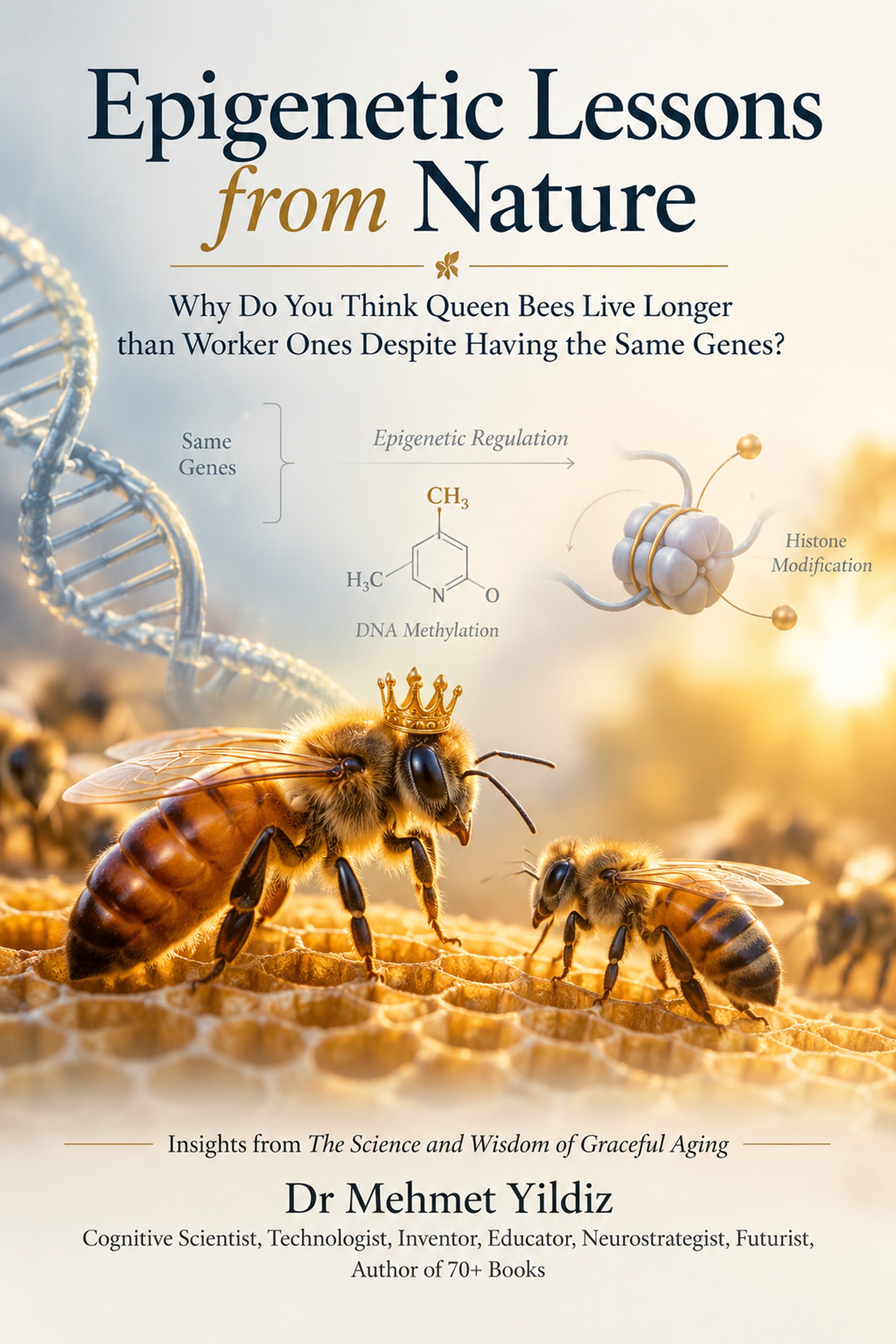
What Queen Bees Can Teach Us About Genes and Longevity
Purpose of the post: This post is a concise and accessible summary of my scholarly essay recently published on my Medium publication ILLUMINATION Scholar, where I explored what the remarkable differences between queen and worker bees can teach us about epigenetics, gene regulation, nutrition, environment, and longevity. The original essay examines the science in greater depth, including DNA methylation, developmental regulation, and key findings from published research. Readers interested in the scientific details and references can read the full scholarly essay on Medium. Here is the link to the essay:
One of the most fascinating lessons about epigenetics can be found inside an ordinary beehive. Consider two female honeybees beginning life with essentially the same genetic blueprint. One becomes a worker and may live only several weeks during the active summer season. The other becomes a queen, can produce enormous numbers of offspring, and may live for years. How can such dramatically different lives emerge from essentially the same genes?
The answer begins during development. Queen-destined larvae receive a different nutritional experience, most famously through their sustained feeding with royal jelly. This nutritional environment triggers a cascade of biological changes that affect development, reproduction, metabolism, hormones, behavior, and eventually longevity. The queen develops functional ovaries and specializes in reproduction, while workers develop for the many tasks required to maintain the colony.
This remarkable difference gives us an accessible way to understand epigenetics. Our genes contain biological instructions, but possessing a gene does not mean that it will always be used in the same way, at the same time, or to the same degree. Cells have sophisticated regulatory systems that influence how they express genetic information. Epigenetic mechanisms are part of this regulatory architecture.
One of these mechanisms is DNA methylation, in which small chemical groups can be added to DNA without changing its underlying genetic sequence. Scientists studying honeybees discovered that interfering with enzymes involved in DNA methylation could influence whether developing larvae acquired worker-like or queen-like characteristics. These experiments helped establish honeybees as an important model for understanding how nutrition, development, and gene regulation can interact.
However, subsequent research also taught us an important lesson about science itself. Methylation alone cannot explain queen development. Scientists have identified roles for other regulatory processes involving chromatin, hormones, metabolism, nutrient sensing, and gene expression. Even the once-popular idea that one particular component of royal jelly might be the master “queen-making” substance turned out to be much more complicated.
In other words, there does not appear to be a simple queen switch. The longevity difference is equally fascinating. A queen lives a relatively protected existence inside the hive, continuously fed and cared for by attendants. A worker follows a very different life trajectory. Workers maintain the colony, nurse larvae, guard the hive, and eventually many become foragers. Foraging exposes them to enormous energy demands, weather, predators, pathogens, pesticides, accidents, and other environmental hazards.
Yet the worker story contains another surprise. Winter workers can live for months rather than the several weeks typical of summer workers. Their genes have not suddenly changed. Their physiology, environment, social roles, and metabolic needs have changed. This gives us another illustration of why lifespan cannot be understood from genes alone.
The queen presents an additional biological puzzle because she combines extraordinary reproductive activity with remarkable longevity. In many species, reproduction carries substantial physiological costs. Honeybee queens demonstrate that evolution can organize metabolism, reproductive biology, hormonal signaling, and cellular maintenance in ways that allow intense reproduction and long life to coexist.
Naturally, we should be careful when translating these observations to humans. We are not honeybees, and eating royal jelly will not turn on a human version of a queen’s longevity program. That is not the lesson I take from this fascinating natural experiment. The deeper lesson is that our genes do not operate in isolation.
Human genes also function within biological environments influenced by nutrition, metabolism, physical activity, sleep, hormones, environmental exposures, aging, and many other factors. Epigenetic mechanisms provide one way through which some of these influences interact with gene regulation. This does not mean that we can simply “rewrite our genes” through lifestyle, as some popular accounts of epigenetics suggest. Genetics still matters enormously, and many epigenetic changes may be consequences of biological processes rather than their causes.
Epigenetics gives us a more nuanced view of biological inheritance. DNA provides possibilities and constraints, while development and life continually interact with the systems regulating how that information is used.
Perhaps this is why I find the beehive such a beautiful classroom for biology. The queen and the worker begin with essentially the same genetic alphabet, yet nutrition, development, physiology, behavior, environment, and molecular regulation contribute to remarkably different lives.
The alphabet may be similar, but biology can write very different stories with it.
Thank you for reading my perspectives. I wish you a healthy and happy life.
[End of the Blog Post]
You can check out my FEATURED series of 70+ books on Amazon marketplaces:
Health, Wellness, and Cognitive Performance Series
Technology Excellence and Leadership Series
Writing Mastery, Excellence, and Eminence Series
Leadership Concepts and Case Studies Series
Socials Connections: LinkedIn | X (Twitter) | Facebook | Instagram | Quora


Leave a Reply