

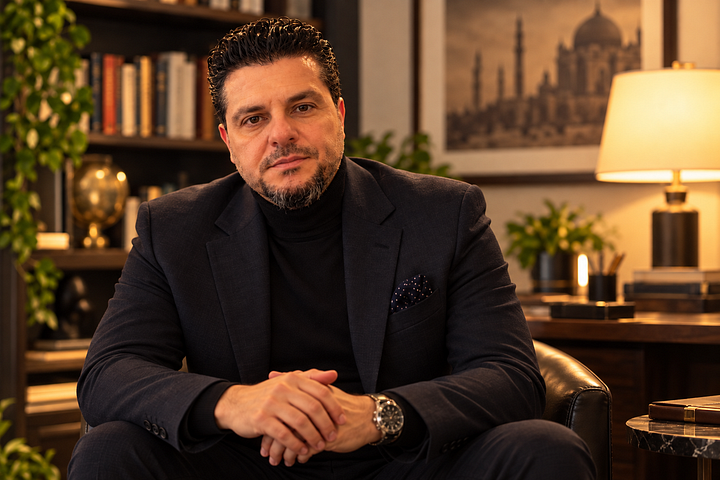
Dr. Bekim Belica is a researcher, public servant, educator, book author, and father of five children.
Curator’s Note: Dr. Bekim Belica, a multifaceted scholar and educator, engages in a conversation where he shares his diverse professional journey encompassing public service, research, and teaching. A father of five, he emphasizes the importance of character development and the deeper purpose behind education, asserting that knowledge should lead to responsible actions. Dr. Belica addresses health as the capacity for engagement in life rather than mere absence of illness. His writing, spanning various platforms, aims to cultivate intellectual honesty and self-reflection while asking crucial questions about personal growth and character. He aspires to fuse his public persona with his private self while continuing to contribute to academic and public discourse. This interview was conducted by Dr. Mehmet, owner and chief editor of ILLUMINATION Integrated publications on Medium, Substack, Patreon, and Digitalmehmet
Purpose of the Story
Dear Subscribers and Visitors,
I have been interviewing authentic writers and leaders in their fields and sharing the scripts on multiple platforms. In today’s episode, I invited Dr. Bekim Belica to introduce himself in his own words with my prompts. I wanted to spotlight his profile, as he is a scholar, educator, public servant, and thought leader in leadership and education. Dr. Belica also contributes to my publications, especially ILLUMINATOIN and Curated Newsletters on Medium, and is a valuable member of our community of writers and readers across multiple platforms. I invite you to explore his stories and follow his profile to benefit from his thought leadership. You can also connect with him on LinkedIn and my Slack workspace for writers and readers, which is free and moderated for members.

Hi Dr. Belica, welcome. Let’s start with a bit about your background.
Hi Dr. Yildiz, thanks for the kind invitation. The easiest answer would be to share my résumé. But I would rather tell you what the résumé leaves out in this conversation. In this story, I’ll share a few highlights of my background briefly and discuss my perspectives, which might relate to your audience from the writing and reading communities.
I work as an educator, professor, writer, researcher, public servant in the US, and, perhaps most importantly, a father of five. My professional life has moved through a combination of leadership, management, organizational behavior, public service, and education.
My intellectual interests have taken me somewhat farther afield into philosophy, ethics, theology, character formation, and the question that seems to sit beneath all of them:
What kind of human being are we becoming while we are busy accomplishing things?
That question has become important to me as I have gotten older. For much of life, we are taught to accumulate: credentials, promotions, titles, publications, possessions, recognition. Eventually, however, another question intrudes. What has all this accumulation done to the person doing the accumulating?
My life has not developed in neat academic compartments. I have spent years working in demanding professional environments while teaching students and raising five children. I have experienced success, disappointment, responsibility, exhaustion, intellectual change, and periods in which convictions I once considered settled became unsettled.
I think that mixture has shaped my writing more than any credential has. I am less interested now in appearing certain than I am in becoming truthful.
Why did you choose your profession?
I am not sure I chose one profession. That may be the more accurate answer. My professional life has occupied several worlds, including public service, management, leadership, and higher education. Teaching, however, gave me what the others could not: the opportunity to participate in another person’s intellectual development.
A professor can explain a theory, grade an assignment, and move on. But the real work of education begins when a student starts questioning an assumption they carried into the classroom. That moment interests me.
I do not believe education should merely produce employees who perform tasks better. Education should make people harder to manipulate, better able to examine evidence, more aware of their assumptions, and more responsible for the judgments they make.
If a student finishes one of my courses remembering every management theory but has never examined how he treats people when he has power over them, I am not convinced that I have completely succeeded as an educator. Knowledge matters, but character determines what we do with it.
What do health and well-being mean to you?
At this stage of my life, health has become less theoretical. When we are younger, we sometimes treat our bodies as though they’ve signed a permanent contract with us. We sleep too little, work too much, postpone exercise, absorb stress, and assume our bodies will keep cooperating.
Eventually, it sends amendments to the contract. For me, well-being is therefore not simply the absence of illness. It is the ability to remain present in your own life. I keep asking questions like:
Can you participate fully in the lives of the people who depend on you? Can you think clearly? Can you sleep? Can you sit silently without immediately reaching for distraction? Can you maintain enough physical and emotional energy to be useful to someone besides yourself?
By answering these questions in my life, I have become much less interested in the appearance of health and much more interested in the capacity health gives us to live responsibly.
What are your hobbies, or what excites or entertains you?
Reading, writing, thinking, teaching, and increasingly, learning things that remind me that I am still a beginner. That last category is important. There is something healthy about being competent in one area and then entering another where you know almost nothing. It punctures the ego.
I enjoy philosophy, theology, leadership studies, ethics, history, and questions about human behavior. I am fascinated by the distance between what people say they value and what their repeated behavior reveals that they value.
I also enjoy ordinary family life more than my academic interests might suggest. I am raising five children, so some evenings the great philosophical question is not Aristotle’s conception of virtue. It is what I am going to cook for dinner and whether five people with five different opinions will eat it. That keeps scholarship in perspective.
What are the top three books that affected your life?
The Qur’an has occupied an important and complicated place in my intellectual and spiritual life. I do not say that sentimentally. Faith, doubt, belief, moral responsibility, suffering, and the existence of God are not abstract subjects to me. A text can affect your life not only by giving you answers but by refusing to let you escape the questions.
Al-Ghazali’s writings have also deeply influenced my thinking, particularly his insistence that knowledge without transformation can become another possession of the ego. That idea is uncomfortable for anyone who makes a life around education. We can become very knowledgeable about virtue without becoming particularly virtuous.
Thomas Aquinas has affected me for a different reason. His treatment of reason, virtue, habit, moral formation, and the ordering of human action helped me see that character is not simply something we possess. Character is something we repeatedly construct.
If I were permitted a fourth category rather than a fourth book, I would include writers who have forced me to confront reputation and the self: Augustine, Marcus Aurelius, Thomas à Kempis, Kierkegaard, and others. They disagree profoundly about important things, but they converge on one disturbing insight: A human being can win the approval of the crowd and still lose authority over himself.
Now Let’s talk about your writing. Why do you write on Medium?
I write here because Medium occupies an unusual space between scholarship and conversation.
Academic writing has enormous value, but academic conventions can sometimes create distance between an idea and the person who needs it. At the other extreme, social media can reduce complicated questions to slogans designed to survive for six seconds.
Medium allows something between those worlds. I can write about leadership without pretending leadership is a collection of motivational quotations. I can write about character without pretending I have perfected mine. I can examine faith without disguising doubt. I can write about institutions without reducing difficult problems to slogans.
More importantly, Medium allows me to think publicly. I don’t want every essay to happen as if I’ve already solved the problem I am writing about. Sometimes writing is the laboratory in which I discover what I actually believe.
Do you write on other platforms like Substack? If so, how do you find them?
Yes. My writing lives in several different worlds, and I have come to appreciate what each one demands of me.
Academia is an important part of my scholarly life. It gives a home to the more academic and research-oriented side of my work and lets me engage readers looking for sustained arguments rather than abbreviated commentary. That matters to me because I never want the accessibility of my public writing to come at the expense of intellectual rigor. Research requires patience with evidence, sources, competing interpretations, and conclusions that may be less tidy than we would prefer.
I also write for MuslimMatters, where I have the opportunity to engage questions of faith, ethics, character, and contemporary life within a Muslim intellectual conversation. That work occupies a different but equally important space for me. I do not believe faith should be protected from difficult questions. Some of the questions that interest me most arise precisely where belief encounters doubt, suffering, reason, moral responsibility, and the difficulty of actually living what one claims to believe.
My books occupy another space altogether. A book lets me stay with a question long enough for it to resist my first answer. The Formation of Character gave me that opportunity through moral and spiritual development, while Arrogance: The Destruction of NonProfit Governance let me examine what can happen when ego, authority, and institutional responsibility collide.
I therefore do not see Academia, MuslimMatters, Medium, ILLUMINATION, and my books as competing outlets. They ask different things of me as a writer. Academia asks me to substantiate. MuslimMatters asks me to engage faith seriously. Medium asks me to converse. ILLUMINATION gives that conversation a community. Books ask me to stay with a question.
And sometimes personal writing asks something harder than all of them: it asks me to stop hiding behind what I know and write about who I am. That is why I am less interested in being everywhere than in understanding why a particular piece belongs where it does. The platform should serve the work. The work should never become an excuse to feed the platform.
What are your values as a writer?
Truth before applause. That sounds simple until telling the truth costs you applause. I value intellectual honesty, reflection, humility, responsibility, and the willingness to revise one’s position.
I distrust writing that divides the world conveniently into enlightened people and foolish people, particularly when the writer always manages to place himself among the enlightened. I also believe a writer has an obligation not to manufacture certainty.
Serious writing should still leave room for sentences such as “I don’t know,” “I may have been wrong,” and “I need to think about this again.” Those are not signs of intellectual weakness. Sometimes they are the first signs that thinking has actually begun.
How do you connect with your readers?
I try not to imagine an “audience.” I imagine one person reading alone. That changes the way I write. An audience can tempt a writer to perform.
A single reader requires a conversation. I would rather leave one reader staring at a sentence for thirty seconds than have a thousand people click a button without thinking.
I also try to write from within the problem rather than above it. If I write about pride, I am implicated in pride. If I write about leadership, I have to examine my own failures as a leader. If I write about reputation, I have to ask how much I care about my own.
Readers can usually tell when a writer is diagnosing everyone except himself. I do not want to write from a balcony.
Why did you join ILLUMINATION, and how do you find it so far?
I joined ILLUMINATION because writing can become strangely solitary. You spend hours thinking, researching, deleting, rewriting, questioning whether something deserves publication, and then eventually press “Publish.” A publication can provide something an algorithm cannot: intellectual community.
What has interested me about ILLUMINATION is its range. Writers arrive with different professions, countries, experiences, levels of recognition, and subjects. That creates the possibility of encountering work I would not necessarily have searched for myself.
I am still forming my judgment because I think communities deserve enough time to reveal what they actually are. But I appreciate any writing community that can help serious new writers become visible without requiring them to imitate whoever is already successful. A publication should not manufacture copies of its most popular writers. It should discover voices it did not know it needed.
Who are some writers you follow on Medium or other platforms?
I follow you, Liauw Pauw Phing, Dr. Gabriella Korosi, Silent Pages, Bill Abbate, and Bin Jiang. I also deliberately follow writers outside my immediate intellectual neighborhood.
I read writers and thinkers across philosophy, religion, psychology, leadership, culture, and public life. Some are people with whom I strongly agree. Others are people I read precisely because I do not.
I think writers become intellectually fragile when they read only people who confirm what they already believe. Agreement is comfortable, but friction can be educational.
Some of the writers who have influenced my thinking most profoundly would disagree with one another on fundamental questions. I consider that an advantage. My responsibility as a reader is not to assemble a private choir but to develop judgment.
What are some of your stories that you want to share with your audience and why?
I am going to cheat slightly on the word “stories,” because two of the works I would place before readers are books. Together with my essays, they probably tell the story of my intellectual life better than a list of my most-viewed articles could.
The first is The Formation of Character: A Comparative Study of the Moral and Spiritual Development of the Soul. If someone wanted to understand the question that has followed me through much of my academic and professional life, I would give them this book. I examine Al-Ghazali and Thomas Aquinas, two thinkers separated by religious tradition but joined by an extraordinary seriousness about virtue, habit, intention, reason, discipline, and the formation of the human person.
The question beneath the scholarship is deceptively simple: How does a person become the kind of person he eventually becomes?
We tend to imagine character revealing itself in dramatic moral moments. I have become convinced that most character is formed much earlier and much more quietly. It is constructed through ordinary repetitions: what we excuse, what we resist, what we practice, what we conceal, what we do when no one is watching, and what we repeatedly permit ourselves to become.
The second is Arrogance: The Destruction of NonProfit Governance. I include it because it examines character from an entirely different direction. Organizations rarely announce that arrogance has entered the boardroom. It arrives disguised as expertise, indispensability, status, authority, certainty, or the belief that ordinary accountability applies primarily to other people.
That interests me because institutional failure is not always caused by a lack of intelligent people. Sometimes extraordinarily intelligent people become part of the problem precisely because they stop believing they can be wrong. The book is about nonprofit governance, but the underlying warning extends far beyond nonprofits:
Power becomes most dangerous when the person exercising it begins to experience accountability as an insult.
The third work I would share is among my most personal writing, on loneliness, love, faith, regret, and the possibility of companionship after disappointment. It differs greatly from my academic work. I have no organizational models to hide behind and no scholarly vocabulary to protect me from what I am admitting.
I write about the strange experience of being surrounded by responsibilities and people while still feeling lonely. I write about faith and spiritual distance. I write about mistakes without giving myself the convenience of making other people responsible for them. And I write about wanting love while understanding it differently than I once did. One realization behind that writing is that being wanted and being loved can feel remarkably similar when you’re lonely. They are not the same.
Another is that our culture has become remarkably sophisticated at displaying almost everything except character. We can display wealth, beauty, credentials, vacations, relationships, achievements, and carefully edited happiness. But no photograph shows restraint. A résumé cannot tell you whether someone is gentle when angry. A profile cannot tell you whether someone protects another person’s dignity during disagreement.
I eventually arrive at an understanding: I do not want rescue. I want companionship. I include this work because I never want scholarship to become a hiding place. If I am willing to write about character in books, classrooms, organizations, and other people, I must eventually permit the examination to reach me.
The fourth work I would share is my writing on leadership and public institutions, including community policing. After years of studying leadership and organizational behavior while also working in public service, I have become increasingly skeptical of the heroic language surrounding leadership.
We ask leaders about their vision, strategy, accomplishments, and philosophy. I think we should ask something more uncomfortable: What does it feel like to be led by you? That question changes the unit of analysis.
A leader may describe himself as empowering while employees experience him as controlling. He may call himself decisive while others experience him as unwilling to listen. He may speak beautifully about integrity while people beneath him have learned that disagreement carries a price.
The same principle applies to institutions. Authority can be legally granted and still lose moral credibility. That is why my interest in community policing centers not merely on enforcement but on legitimacy, trust, institutional behavior, and the difficult relationship between possessing authority and deserving confidence.
The fifth is not a single article so much as the body of writing I am developing around achievement, reputation, faith, doubt, and the interior life. In some ways, I think it may become my most important work.
I have spent much of my adult life accumulating the things respectable biographies are made from: education, professional experience, teaching, scholarship, titles, publications, and responsibilities. I do not regret those things. But I have begun asking a question achievement cannot answer: What if you become impressive to other people while becoming increasingly unfamiliar to yourself?
That question has brought me into conversation with thinkers as different as Al-Ghazali, Augustine, Aquinas, Marcus Aurelius, Thomas à Kempis, and Kierkegaard. Their traditions cannot simply be collapsed into one another, but they share an uncomfortable suspicion of the human appetite for praise, reputation, status, and the judgment of the crowd.
That concern has become personal for me. I am more interested in the distance between the person whose biography other people read and the person who remains when the biography is taken away. Professor. Writer. Scholar. Public servant. Father. Degrees. Publications. Titles. Those things describe parts of me. None of them answers the question of who I am.
My leadership and public-institution writing asks what character looks like when authority is entrusted. My personal writing asks whether I am willing to apply those same standards to myself. And my newest work asks what remains when achievement, reputation, and applause are no longer permitted to tell us who we are.
I did not recognize this progression when I began writing. I see it now. For years, I thought I was writing about leadership, organizations, ethics, religion, governance, love, and character. I may have been asking the same question all along: What happens to a human being when no one else is watching?
What are your success factors as a writer?
I would distinguish visibility from success. Views are measurements. Followers are measurements. Claps are measurements. They tell us something, but they cannot tell us everything we want them to.
The dangerous moment for a writer comes when the measurement becomes the mission. If I discover that articles about one subject perform well, I can begin unconsciously producing more of what receives applause. Eventually, the audience no longer follows the writer.
The writer is following the audience. That concerns me. My measure of success is more demanding: Did I say something worth saying? Did I examine the strongest objection to my argument? Did I resist exaggeration? Did I write something I still respect after the excitement of publication disappears? Did the piece cause someone to reconsider a belief, including me?
And perhaps the hardest question: Would I still have written it if nobody knew my name was attached to it? If the answer is yes, I am probably getting closer to the kind of writer I want to become.
What do you recommend to new writers?
Stop trying to sound like a writer. That would be my first recommendation.
The internet has produced recognizable forms of “writerly” language. People learn the cadence, the dramatic opening, the inspirational ending, the strategic vulnerability, and the carefully positioned life lesson. It can be technically competent and completely forgettable.
Write the sentence you are slightly afraid to write. Not because it is provocative. Provocation is easy. Write it because it is true and because admitting it costs you something.
Then read widely. Read people who are dead. Read people who disagree with you. Read outside your profession. Read difficult books slowly. Learn the difference between evidence and assertion. Do not mistake confidence for authority. Don’t publish every thought just because technology has made publication instantaneous.
And do not obsess over becoming a “successful writer” before you have discovered whether you have something worth saying. The world does not suffer from a shortage of content. It suffers from a shortage of thought.
What are your plans as a writer or as a professional?
I want the next stage of my professional life to involve more teaching, scholarship, writing, and intellectual work. But I am becoming cautious about describing life entirely in terms of achievements.
There was a time when I might have answered this question with another degree, another title, another publication, another professional position, another item to add to a biography.
Those things can still be worthwhile. I am not rejecting ambition. I am questioning its jurisdiction. I want to continue writing about leadership, ethics, philosophy, faith, doubt, character formation, organizational life, and the moral dimensions of institutions. I want to continue teaching. I want to produce work that can live in both scholarly environments and public-facing writing.
I also want to continue exploring the questions behind The Formation of Character, particularly what classical traditions of moral formation can still teach people living in a culture increasingly organized around speed, visibility, consumption, and external validation.
But another ambition matters more to me now. I want the private person and the public person to move closer together. If I become a more recognized writer but a less attentive father, that is not success. If I become more knowledgeable but less humble, something has gone wrong. If I can write persuasively about character but fail to examine my own, then writing has become camouflage.
So yes, I intend to keep writing, publishing, teaching, researching, and developing professionally. But I am also trying to accomplish something that will never appear in an author biography: To become someone whose life does not contradict what he writes. That may be the most difficult work I ever publish.
Many thanks to Dr. Bekim Belica for giving a glimpse into his interesting life. I hope you enjoyed these conversations and that you explore his stories. You can also connect with him on LinkedIn and the Illumination Slack Workspace.
I also post links to these interviews on LinkedIn to increase visibility for creators, so please consider engaging with this post on that professional platform to grow your audience. Originally published on my author platform.
This interview series is an excellent networking opportunity for new writers looking to build their audiences across multiple platforms.
The more successful people you meet and engage with, the more successful you can become, from my experience. The more you give without expecting, the more you receive, as my grandparents taught me.
Thank you for being part of our community and joining our joyful and exciting journey. You can review some sample interviews I conducted. Please consider reviewing their profiles and stories, sharing them in your network, and reaching out to them to expand your professional connections.
Thank you for supporting our community initiative, Neurostrategic Digital Authority Building for Creators, Freelancers, Book Authors, and Startups. Here is a story covering the details of why I rebranded the Substack Mastery Boost Pilot: Why I’m Rebranding Substack Boost Pilot as Neurostrategic Digital Authority Building Initiative.
Links to Other Interviews and Conversations
Interview Unicorniolibre.com, Interview Leila Drouby, Nutritionist, Interview Matt Hasan, Ph.D., Interview Shreyas Naphad, Interview, The Story Telling Paramedic, Interview Dr Edward Serdioukov, Interview, A.K.Girisam, Interview Raviv Ventura, Interview Dr Bernhard Kutzler, Interview Dr Corneliu Bacauanu MD, Interview Dr Laust Lauridsen, MD, Interview Peeter Jakobson, M.D, Interview Dr Jeff W Welsh, Interview Nazli Aydin (Misselbereth), Interview,Dr. Pamela Ramirez, PsyD, MD,Interview Lukman Aufbau, Interview Tanugandass, Interview Dr. Shiv K. Goel, Interview James Alexander, PhD, Interview, S R Harsha, Interview Adam Regiaba, Interview Elizabeth Woods,Interview Gary L. Fretwell, Interview, Keith Williams, Interview, Liauw Pauw Phing, Interview Somya Golchha, Interview, Alexander Simon, Interview, Paul | Divine Light Path, Interview, Ben J Clarke, Interview, Dr. Hatem El-Nagar, Interview Vic Shayne, Interview, Dr diana swezy, Interview, Dr Ashish Juneja, PhD, Interview Dr. Khalid Rahman, Interview Georgia Kreiger, Interview Hamid Akhtar, Interview Bear Kosik, Interview Dr Russell Carr,Interview Fildy Bejaoui, Interview Peter Mukherjee, Interview Patricia Ross, Interview Ana J, Interview Dr. Jason Hung, Interview Maria Cross,Interview Brooklyn Grace (editor), Interview Grant Lawson, Interview Ute Luppertz ✨, Interview Dr Kenneth Silvestri, Interview MAGDALENA PONURSKA, Interview with Joanie Adams (left Medium), Interview Liat Portal, Interview Dr Dominic Farsi, PhD RNutr, Interview Sara Redondo, MD, Interview Dr Bronce Rice, Interview Yana G.Y. Interview Dr. Gabriella Korosi, Interview Sinem Günel, Interview Recep Taylanhan, Interview John Worthington, Interview, Joellyn Rose Keener, ✍️Author Deaf and Determined, Interview Thomas Cherickal, Interview, Shamim Rajani, Interview, Svyatoslav Biryulin,Interview, Danielle Benvenuto, Interview Scarlet Ibis James 🦩, Interview Biswanath Datta,Interview Veronica Llorca-Smith,Interview James King, Interview Lauren Grawert, MD,InterviewJerry Keszka, Interview Davor Katusic,Interview David Gerken,Interview Claudio D’Andrea, Interview William Spivey,Interview James Boylan, Interview Ruby Noir, Interview Joshua Mason, Interview Michelle Mariscal, Interview Tim Denning, Interview Wendi Gordon, Interview Elle, Interview Bill Petro, Interview Sylvain Zyssman, Interview Matthew Bamberg, Interview Øivind H. Solheim, Interview Payal Koul, Interview Matt Lillywhite, Interview Genius Turner, Interview Shirley Willett, Interview David Mokotoff, MD, Interview Martin D. Hirsch, Interview Gill McCulloch, Interview Adelia Ritchie, PhD, Interview Dr. Lutz Kraushaar, Interview Lorwen Harris Nagle, PhD, Interview Matt Williams-Spooner, Ph.D., Interview Pernoste & Dahl, Interview Luay Rahil, Interview Melissa Kalt, MD, Interview Ayodeji Awosika, Interview Dr. Preeti Singh, Interview Dr. ADAM TABRIZ, Interview Dr John Frederick Rose, Interview Yogesh Haribhau Kulkarni (PhD), Interview Hakima T A N T R I K A, Interview Mark Sanford, Ph.D, Interview Raymond M.E. Aguirre, Interview Keri Mangis, Interview John D. Leavy, Interview Toni Koraza, Interview Annelise Lords, Interview, Mike Zillo, Interview Charles Roast, Interview Libby Mitchell, Interview Timothy Key, Interview, Christopher D. Connors, Interview Desiree Driesenaar, Interview Jill Ebstein, Interview Bill Abbate, Interview Anita Lesko, Interview John Cousins, Interview Suntonu Bhadra, Interview Lawson Wallace, Interview Chelsea Renee MAT, Interview MaryJo Wagner, PhD, Interview Martine Weber, Interview Michael Patanella, Interview Tree Langdon, Interview, Agnes Laurens, Interview Liam Ireland.
Our editors compile them in a collection. If you want to be interviewed, please leave a comment on this story or reach out to me via this form.
Quick Updates on Our Community Initiatives
You are welcome to join our new Expert Contributor Network. It will empower our Substack Mastery Boost program.
Welcome to the Expert Contributor Network Curation Program at Digitalmehmet Content Ecosystem
If you are a business owner and want to sponsor talented writers contributing to my ecosystem and publications on Medium and Substack, please reach out to me via this form, and I will provide you with the best creators who can amplify your content efficiently to a broad audience.
Share the links to your articles, newsletters, stories, and blog posts for free here. You can also join my author platform as a guest blogger. Here is the link to my blog pins.
For Substack writers, we created a 6-level course on Udemy titled From Zero to Substack Hero, which I also offer via my Content Strategy, Development, & Marketing Insights on Substack. If you are interested in joining, you can use these discount vouchers:
We also completed a new course titled Patreon Mastery.
I introduced the new Substack bundle for advanced writers and Patreon Mastery in two articles linked below for more information: From Zero to Substack Hero: Advanced Levels 4, 5, & 6 Bundle Is Ready for Beta Learners
What If Your Creativity Could Fund Your Financial Freedom for a Lifetime?
If you are a writer, you are welcome to join my publications by sending a request via this link. I support 43K writers who contribute to my publications on this platform. Here are links to submission guidelines:
ILLUMINATION, Curated Newsletters, SYNERGY (Newsletter Booster), Technology Hits, Health and Science,ILLUMINATION Book Chapters, ILLUMINATION’s Mirror, Readers Hope, ILLUMINATION Gaming,Videos/Podcasts, Magnetic Newsletter Pro, Neurostrategic Digital Authority Building , ILLUMINATION Scholar, ILLUMINATION Local News and Documentaries, ILLUMINATION Retirement, Aging, and Legacy, ILLUMINATION Philosophy and Metaphysics, ILLUMINATION India. ILLUMINATION Beyond Identity, Travel, Food, Culture Publication
You can contact me via my website. If you are a new writer, check out my writing list to find some helpful stories for your education.
I interviewed several new professionals and thought leaders. You can find them linked at the end of the latest one.
You can check out my FEATURED series of 70+ books on Amazon marketplaces:
I invite you to subscribe to my publications on Substack, where I offer experience-based and original content on health, content strategy, book authoring, and technology topics you can’t find online to inform and inspire my readers.
Healthspan Mastery (NEW)
Get an email whenever Dr. Mehmet Yildiz publishes. He is a top writer and editor on Medium.
dr-mehmet-yildiz.medium.com
Check out Free Blog Posts by Digitalmehmet Contributors. Here is the link to my FREE personal blogs. Now you can read our blog posts via a Flipboard Magazine for convenience. Payhip
I invite you to explore some of my books on my discount bookstore including:Train Your Brain for a Healthier and Happier Life, Cortisol Clarity, Ketosis + BDNF: The Healing Molecules That Saved My Life, The Science & Wisdom of Graceful Aging, The LIFE Matrix Keeps the Score, How I Accelerated My Learning Effortlessly for a Happier Life, Neurocomputing and Neural Architectures, Substack Mastery Version 2, The Zen of Book Authoring, Monetize Your Passion with WooCommerce, Agile Business Architecture for Digital Transformation V2, Agile Business Architecture for Digital Transformation (Audiobook), A Powerful Toolkit for Substack Newsletter Mastery, Smart and Ethical SEO, Modern Affiliate Marketing for Writers, 4 Pillars of Enterprise Architecture, and Smart Email Marketing Content Integration, The Mysterious Leadership Mind of Robert F.Kennedy Jr., Cognitive Computing Reimagined,
Reference: Chapter of Generosity™ at Digitalmehmet Content Ecosystem
Socials Connections: LinkedIn | X (Twitter) | Facebook | Instagram | Quora


Leave a Reply