

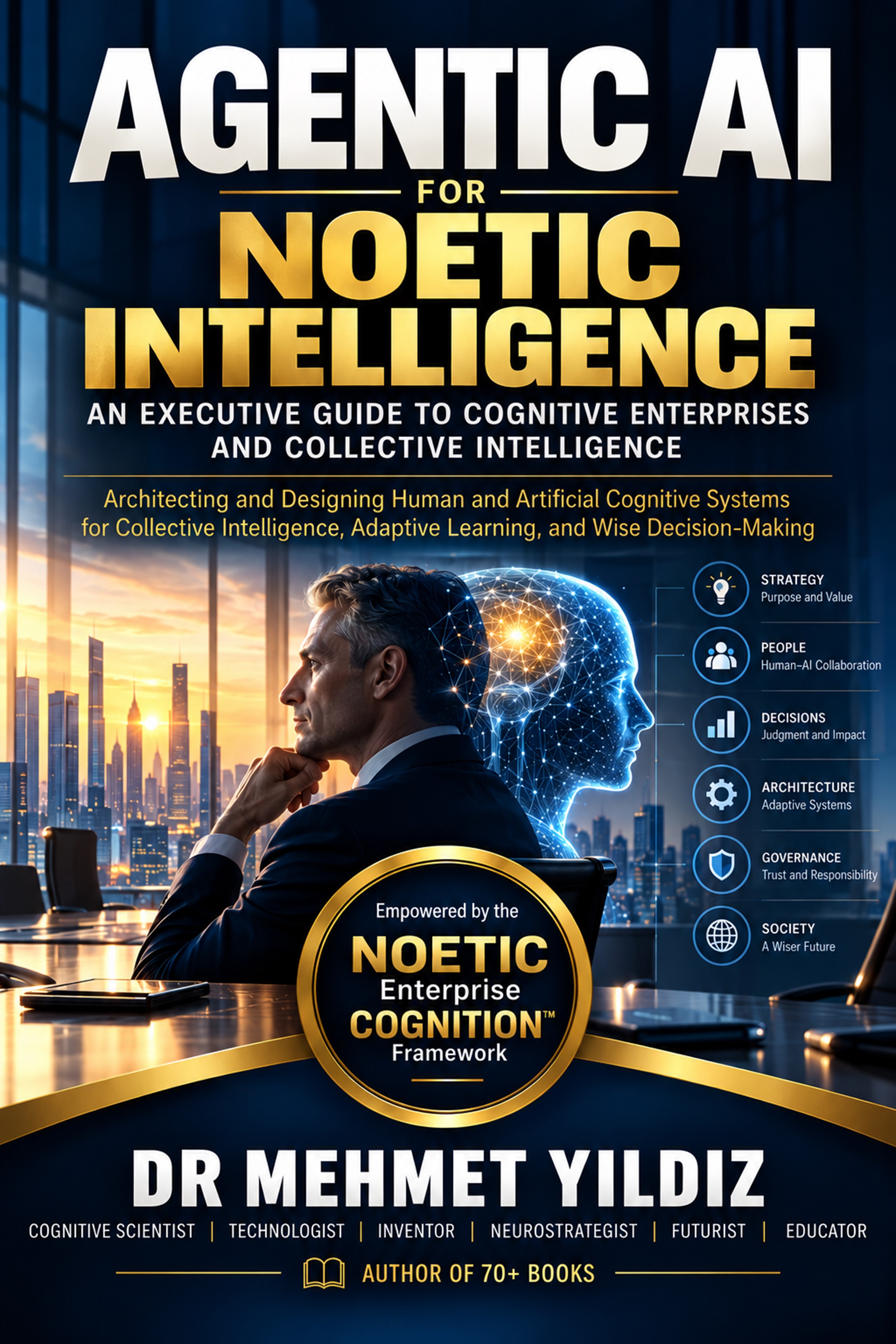
This Book Is an Executive Guide to Cognitive Enterprises and Collective Intelligence. I explain Why I Wrote This Scholarly Book and How You Can Benefit from It. Official Page
Recently, I introduced this book in a story titled, What Happens When Machines Can Act Smarter, but Organizations Struggle to Make Wiser Decisions? Today, I’m sharing the preface to give you more information about the book from multiple angles.
From Agentic Artificial Intelligence to Noetic Intelligence: A Personal and Professional Journey Toward Cognitive Enterprises and Collective Wisdom
Unexpectedly, in 2025, several clients engaged me to architect and design agentic AI solutions for their organizations. Demand grew rapidly as enterprises started exploring how autonomous AI agents could transform operations, decision-making, and business processes. Some business organizations also asked me to develop specialized educational curricula to help their AI engineers, architects, and administrators understand, implement, and manage these emerging technologies.
While developing these solutions and educational materials, I recognized an opportunity to share the knowledge, architectural insights, and practical lessons with a much broader audience. Rather than limiting this intellectual capital to individual organizations, I decided to turn it into a comprehensive, accessible book that could benefit technology professionals, business leaders, researchers, and lifelong learners. That decision gave birth to this book, scheduled for publication in November 2026. To supplement it, I also wrote a public version called “AI Agents for Everyone: A Practical Guide to Using, Creating, and Managing Intelligent Assistants for Everyday Life and Work.” It will be available in the new year.
I have spent much of my professional and intellectual life exploring a deceptively simple question: What makes an individual, an organization, or a society intelligent? My curiosity began with human cognition and gradually extended to information technology, enterprise architecture, organizational behavior, artificial intelligence, and their relationships. Over several decades of research, invention, professional practice, and executive leadership, I have come to appreciate that intelligence is far more complex than processing information, solving problems, or producing impressive results. Its practical value becomes evident when knowledge contributes to sound judgment, responsible action, continuous learning, and meaningful outcomes.
My journey as a cognitive scientist, technologist, inventor, educator, and enterprise architect has allowed me to examine intelligence through different intellectual and professional lenses. Cognitive science introduced me to the biological and psychological foundations of human capabilities. Technology and invention exposed me to the extraordinary possibilities and inherent limitations of computational systems. Enterprise architecture provided a disciplined way to connect business objectives, information, people, processes, and technology. Executive environments taught me an equally important lesson: even organizations employing highly intelligent professionals and sophisticated technologies can make decisions that undermine their long-term interests.
These experiences led me toward a broader question that continues to influence my research and writing. How can we connect individual expertise, artificial capabilities, institutional knowledge, and collective judgment to produce better decisions and more responsible outcomes? This intellectual journey informed my earlier work on Digital Intelligence, Executive Intelligence Architecture, and the Noetic Enterprise. The present book extends that exploration into one of the most consequential developments in contemporary computing: agentic artificial intelligence.
The Paradox That Motivated This Book
We are witnessing a remarkable development in the evolution of computational systems. Artificial intelligence is progressing beyond generating information and recommendations toward selecting actions, coordinating tools, and executing complex activities within defined environments. Although autonomous software agents have existed for decades, recent advances in generative AI, language models, tool integration, and computational infrastructure have made more flexible forms of artificial agency accessible to organizations across many industries.
Yet this progress exposes a paradox that I believe deserves serious scientific and executive attention. As artificial systems gain operational capabilities, the institutions that deploy them may continue to struggle with fragmented knowledge, competing objectives, inconsistent decisions, and limited collective judgment. We may be approaching a period in which our technological capacity to act outpaces our institutional capacity to decide wisely.
Consider an enterprise employing thousands of highly educated professionals, supported by advanced analytical platforms, sophisticated applications, and extensive information repositories. Despite these resources, departments may pursue conflicting objectives, decision processes may remain fragmented, and leadership may struggle to connect local improvements to enterprise-wide value. Introducing hundreds of artificial agents into such an environment does not automatically resolve these difficulties. Without coherent architecture, shared purpose, and accountable decision-making, the new agents may amplify existing weaknesses.
This observation leads to one of this book’s central propositions: the intelligence of individual components does not guarantee the intelligence of the larger system. An enterprise can become technologically more capable without becoming institutionally more intelligent. Its agents may complete their assigned tasks successfully while the organization as a whole produces disappointing or even harmful outcomes.
I wrote Agentic AI for Noetic Intelligence because I see a growing gap between what artificial systems can do and what organizations are prepared to understand, authorize, coordinate, and govern. This gap extends beyond technology into human cognition, institutional responsibility, business architecture, decision science, ethics, and the quality of collective intelligence. Closing it requires more than advanced algorithms. It requires a deeper understanding of how intelligence, judgment, action, learning, and responsibility relate.
Why Agentic AI Requires a Different Intellectual and Executive Conversation
For many years, organizations used artificial intelligence primarily to analyze information, identify patterns, predict outcomes, and support specific decisions. Generative AI extended these capabilities by enabling sophisticated interactions through natural language and other forms of digital content. Agentic systems introduce another operational dimension. They can pursue defined objectives through sequences of activities, select available tools, respond to intermediate results, and perform authorized actions within digital environments.
These capabilities create substantial opportunities for enterprises, scientific institutions, governments, educators, and healthcare organizations. They may reduce coordination costs, accelerate selected workflows, improve access to knowledge, and support professionals in managing complex information. They may also enable new forms of human–AI collaboration that were previously impractical or economically difficult to implement.
However, technical capability should not be confused with dependable organizational value. An agent that completes a task quickly but produces inaccurate results may increase the cost of correction. A network of agents that optimizes departmental activities independently may create conflicts across the enterprise. A system that appears autonomous in a demonstration may depend heavily on predefined workflows, carefully prepared information, and continuous human intervention when deployed in production.
Consider a healthcare organization using specialized artificial agents for appointment scheduling, resource allocation, operational planning, and financial management. Each agent may improve a measurable aspect of its assigned function. The scheduling agent may reduce waiting times, the resource agent may improve utilization, and the financial agent may identify opportunities to reduce expenditure. Yet their combined recommendations could compromise continuity of care, create additional burdens for clinical professionals, or disadvantage patients with complex needs.
The difficulty arises because successful local optimization does not necessarily produce desirable collective outcomes. The organization must establish how competing objectives are evaluated, how clinical and ethical considerations influence decisions, and how responsibility is maintained when artificial systems participate in operational activities. This requires institutional judgment that cannot be reduced to the computational performance of individual agents.
Similar challenges arise in banking, manufacturing, public administration, education, cybersecurity, and scientific research. Artificial systems may become capable of performing sophisticated activities, but institutions must still determine which objectives deserve pursuit, which evidence is sufficiently reliable, which decisions require human authorization, and which consequences are acceptable.
These questions explain why I believe agentic AI requires a different conversation. The essential challenge is not to maximize the number of autonomous agents or pursue automation for its own sake. It is to develop enterprises and institutions that can coordinate human and artificial intelligence toward legitimate objectives, evaluate the quality of their decisions, and learn from the consequences of their actions.
Why I Connect Agentic AI with Noetic Intelligence
My interest in Noetic Intelligence grew from a longstanding concern about knowledge fragmentation across scientific disciplines, technological systems, and organizational structures. Human cognition, artificial intelligence, collective intelligence, organizational learning, decision science, and enterprise architecture each offer valuable insights. However, their relationships become particularly important when we examine how intelligent systems operate within complex enterprises and societies.
The word noetic has philosophical associations with intellect, understanding, and mental activity. I use Noetic Intelligence in a specific conceptual and architectural sense developed through my interdisciplinary work. In this book, it refers to a proposed integrative framework for connecting information, contextual understanding, knowledge, wisdom, reflective judgment, purposeful action, ethical responsibility, and learning from consequences.
I do not present Noetic Intelligence as an established scientific category or a replacement for cognitive science, artificial intelligence research, or existing enterprise architecture disciplines. It is a conceptual contribution intended to stimulate research, professional discussion, architectural experimentation, and empirical evaluation. Its value should be judged through the clarity of its propositions, its usefulness in explaining practical problems, and the evidence generated through its application.
To clarify this contribution, I examine three interconnected levels of intelligence. The first concerns individual human and artificial capabilities, including perception, memory, attention, reasoning, learning, and action. The second concerns organizational and collective intelligence, through which people and technological systems coordinate knowledge, responsibilities, and decisions. The third concerns the proposed Noetic Intelligence perspective, which examines how these capabilities can be integrated with contextual judgment, ethical purpose, institutional accountability, and learning from consequences.
These levels should not be interpreted as a universal scientific hierarchy or a sequence through which intelligence automatically progresses. Their purpose is to provide an analytical structure for understanding relationships that are examined separately. A highly capable artificial agent may contribute to collective intelligence, but its contribution depends on the quality of the larger system in which it operates. Similarly, an organization may possess substantial collective knowledge without consistently exercising sound judgment.
This distinction leads to another important insight.
Agentic capability concerns what a system can do within its operational boundaries. Noetic Intelligence concerns how the larger human and technological system evaluates what should be done, why it matters, and how its consequences should be understood.
An artificial agent may develop and execute a complex plan. The institution must still determine whether the plan serves a legitimate purpose, whether its assumptions are reliable, whether the proposed actions fall within appropriate authority, and whether the consequences are acceptable. These questions connect computational capability with human values, institutional responsibility, and practical wisdom.
As artificial systems take on longer, more consequential activities, this distinction becomes significant. An enterprise may eventually coordinate many specialized agents across its operations. Yet the number of agents tells us relatively little about the quality of its intelligence unless we examine their relationships, decision processes, information integrity, institutional learning, and contributions to meaningful outcomes.
My passion and ambition are to give readers a disciplined way to examine these relationships without overstating what contemporary artificial intelligence can achieve.
My Intended Contribution to the Body of Knowledge
Throughout my academic and professional career, I have valued interdisciplinary thinking because many consequential problems cannot be understood adequately through a single field of inquiry. Cognitive science helps us examine the mechanisms and limitations of human intelligence. Artificial intelligence research provides methods for developing computational capabilities. Organizational science explains how people coordinate knowledge and activities. Decision science examines judgment under uncertainty, while enterprise architecture connects strategy, business capabilities, information, processes, technology, and governance.
These disciplines have established substantial bodies of knowledge. Important foundations can also be found in research on bounded rationality, distributed cognition, sociotechnical systems, organizational learning, and collective intelligence. I intend to build on these intellectual foundations by examining their relationships in environments where artificial agents participate directly in organizational activities and decisions.
Through Noetic Intelligence and the NOETIC Enterprise COGNITION™ Framework, I propose an architectural perspective that connects human and artificial cognitive capabilities to strategic intent, information integrity, decision authority, cognitive risk, operational coordination, and institutional learning. The framework offers a coherent way to examine how these elements interact and how their relationships impact enterprise outcomes.
The distinction between conceptual coherence and empirical validation is important. A framework may offer a useful interpretation of complex phenomena without yet scientifically establishing its propositions. For this reason, I encourage researchers and practitioners to examine how the proposed concepts might be evaluated through observable indicators, comparative studies, and practical experimentation.
For example, we might investigate how different arrangements of human and artificial decision authority influence error rates, recovery performance, coordination costs, decision consistency, and stakeholder outcomes. We might examine the conditions under which multi-agent coordination improves enterprise performance or introduces additional complexity. We might also study how institutional learning mechanisms influence the reliability and adaptability of agentic systems over time.
Such measures cannot establish wisdom as a single numerical property. However, they can provide evidence about specific dimensions of decision quality, organizational coordination, and responsible action. I believe this distinction is essential if we wish to move from appealing conceptual language toward disciplined scientific and professional inquiry.
I regard this book as a contribution to an evolving interdisciplinary conversation rather than a final explanation of intelligence, consciousness, or wisdom. My hope is that it will offer useful conceptual distinctions, architectural propositions, and research questions that other scholars and professionals can examine, challenge, refine, and extend.
What Executives and Enterprise Leaders Can Gain
I wrote this book with executives, senior decision-makers, and enterprise leaders in mind because they are being asked to make substantial commitments to artificial intelligence while the technology and its commercial environment continue to evolve. Many face pressure to demonstrate rapid progress, improve productivity, reduce costs, and respond to competitive developments. These pressures are understandable, but speed of adoption should not be mistaken for strategic progress.
Executives need to distinguish promising technological capabilities from sustainable business value. They must understand which activities suit agentic execution, which decisions require human judgment, and which organizational capabilities must improve before advanced systems can operate dependably. They must also consider the longer-term implications for professional skills, operating models, supplier relationships, information security, and institutional responsibility.
This book examines agentic AI through strategy, business capabilities, enterprise architecture, cognitive maturity, governance, and measurable performance. It explains why successful demonstrations may fail in production, why local productivity gains may not improve enterprise outcomes, and why decision-making quality deserves attention alongside operational efficiency. My objective is to help leaders evaluate agentic initiatives with greater intellectual clarity, architectural discipline, and confidence in the responsibilities they accept.
What Senior Technologists and Enterprise Architects Can Gain
For senior technologists, software engineers, AI specialists, and enterprise architects, the book examines the technical foundations of artificial agency and how they relate to enterprise requirements. I distinguish chatbots, conventional automation, adaptive workflows, and agentic systems, and examine the functional roles of memory, reasoning, planning, tool use, feedback, and operational control.
The architectural discussion extends into single-agent systems, multi-agent coordination, swarm intelligence, enterprise knowledge infrastructure, and cognitive operating environments. These topics require attention to state management, identity, authorization, information provenance, security, observability, error recovery, and operational resilience. A language model connected to tools may demonstrate useful agentic behavior, but dependable enterprise capabilities require considerably more engineering and governance.
I also introduce the NOETIC Enterprise COGNITION™ Framework as a proposed approach to connecting agentic capabilities with strategic objectives, cognitive risk, institutional knowledge, decision authority, and organizational learning. The intention is to support architectural reasoning rather than prescribe a universal implementation method. Different organizations will require different arrangements based on their objectives, resources, maturity, regulatory obligations, and risk tolerance.
What Scientists and Researchers Can Gain
My background in cognitive science has strongly influenced this book’s intellectual structure. I believe artificial agency becomes more meaningful when examined alongside established knowledge about biological cognition, human decision-making, and the limitations of computational models. Functional similarities between biological and artificial systems can generate valuable research questions, but they should not be mistaken for evidence of identical mechanisms or experiences.
The book explores attention, memory, reasoning, cognitive control, metacognition, intuition, decision-making, emergence, and collective intelligence. Particular attention is given to uncertainty, the distinction between prediction and judgment, and the difficulties of evaluating claims about autonomy and adaptive learning. Artificial systems may produce persuasive outputs or perform complex activities without possessing the same biological processes, subjective experiences, or forms of understanding associated with human cognition.
I hope these discussions encourage constructive dialogue among cognitive scientists, neuroscientists, computer scientists, psychologists, organizational researchers, and scholars of decision-making. The book does not claim to resolve longstanding questions about consciousness, general intelligence, or wisdom. Instead, it examines how established scientific knowledge can inform architectural practice and identifies areas where further theoretical development and empirical research are needed.
What Policymakers, Educators, and Public Leaders Can Gain
Agentic AI may influence institutions far beyond commercial enterprises. Healthcare, education, public administration, national intelligence, and scientific research offer opportunities for valuable applications, along with substantial responsibilities and risks. In these environments, automated decisions can affect individual rights, professional obligations, public resources, and social trust.
For policymakers and public leaders, the central challenge concerns the relationship between computational capability and legitimate authority. Artificial agents may support analysis, coordination, and administrative activities, but technical performance alone cannot establish the authority to make consequential decisions affecting citizens. Public accountability, procedural fairness, transparency, information security, and meaningful opportunities for human review and correction remain essential.
Educators will find discussions of cognitive development, personalized learning, intellectual independence, and the appropriate use of automated assistance. Healthcare professionals and researchers will encounter questions concerning clinical evidence, personalized intelligence, uncertainty, and the distinction between computational recommendations and validated care. Across these domains, I return to the principle that artificial intelligence should strengthen human and institutional capabilities without obscuring professional responsibility or diminishing independent judgment.
How the 31 Chapters Are Organized
I have organized the book into six connected parts, progressing from the fundamentals of artificial agency to the scientific foundations of intelligence, the conceptual principles of Noetic Intelligence, enterprise architecture, practical applications, and broader societal implications. This progression reflects my belief that we cannot adequately understand technological systems without considering the cognitive, organizational, and ethical environments in which they operate.
Part I, Understanding Agentic AI: From Automation to Autonomous Agency, contains Chapters 1 through 7. We examine the evolution from conventional automation to more adaptive systems, distinguish conversational assistants from agentic capabilities, and study the functional anatomy of cognitive agents. The discussion establishes the technical and conceptual foundations required to understand the economic and institutional significance of artificial agency.
Part II, The Science of Intelligence: Biological and Artificial Cognition, covers Chapters 8 through 9. We examine human and artificial cognition, attention, memory, reasoning, cognitive control, intuition, emergence, collective intelligence, and the neuroscience of decision-making. The objective is to establish a scientifically informed understanding of cognitive capabilities while respecting the differences between biological and computational systems.
Part III, Noetic Intelligence: From Information to Judgment and Wisdom, includes Chapters 10 through 13. I introduce the foundations and enterprise relevance of Noetic Intelligence, examine judgment under uncertainty, discuss wisdom as a cognitive and organizational aspiration, and consider the ethical requirements of intelligent systems. This part provides the conceptual and decision-science foundations for the architectural proposals that follow.
Part IV, Architecting Noetic Agentic Systems, contains Chapters 14 through 21. This is the principal architectural section of the book. We examine single-agent and multi-agent systems, swarm intelligence, enterprise memory, cognitive operating environments, the NOETIC Enterprise COGNITION™ Framework, governance, and adaptive learning. These chapters connect technical design with business authority, operational reliability, and institutional accountability.
Part V, Building and Applying Noetic Cognitive Enterprises, covers Chapters 22 through 28. The discussion moves from architecture to implementation, organizational change, cognitive maturity, decision quality, and enterprise value. We then consider applications in healthcare, education, public administration, national intelligence, and human–AI collective intelligence. This part connects conceptual and architectural principles with practical environments where decisions carry different responsibilities and consequences.
Part VI, Toward Noetic Civilizations: The Future of Collective Intelligence, concludes the book with Chapters 29 through 31. We extend the discussion toward cognitive nations, augmented wisdom, the Noetic Society, and the future of human and artificial agency. These chapters examine the possibilities and limitations of intelligence at societal scale, including democratic legitimacy, technological dependence, human development, and intergenerational responsibility.
Although the six parts are designed to build upon one another, readers may consult individual chapters according to their professional interests. Executives may initially focus on enterprise value and governance, while architects may begin with technical design. Scientists may find the cognitive foundations particularly relevant, and policymakers may concentrate on institutional accountability and societal consequences. I nevertheless encourage readers to examine the connections among these perspectives because many of the difficulties associated with advanced artificial intelligence arise when technical, cognitive, managerial, and ethical questions are treated in isolation.
What I Hope You Will Question
I do not expect readers to agree with every proposition presented in this book. Some concepts draw directly from established scientific research, while others represent my interdisciplinary interpretations, architectural proposals, and hypotheses for further examination. I have attempted to distinguish these categories because intellectual credibility requires clarity about what is supported by evidence, what can reasonably be inferred, and what remains uncertain.
I encourage readers to question the assumptions behind claims of artificial autonomy, the evidence supporting descriptions of intelligence, and the measures used to evaluate technological success. A system that performs impressively in a controlled environment may behave differently when exposed to incomplete information, conflicting objectives, unpredictable conditions, or institutional constraints. We should examine these differences carefully rather than treating successful demonstrations as sufficient evidence of dependable operational capability.
I also encourage readers to challenge the assumption that greater automation necessarily produces better organizations. In some circumstances, simpler software, clearer processes, better information management, or stronger human coordination may provide greater value than sophisticated artificial agents. The purpose of enterprise intelligence should be to improve meaningful outcomes, not to maximize technological complexity.
The NOETIC Enterprise COGNITION™ Framework and related concepts are offered for critical examination, practical experimentation, and continued refinement. I welcome alternative interpretations and independent research that may reveal limitations, identify new relationships, or suggest more effective approaches. For me, a valuable contribution to knowledge is one that encourages stronger questions, clearer reasoning, and further inquiry rather than demanding agreement with its conclusions.
My Closing Invitation: From Artificial Agency to Collective Wisdom
As I reflect on my journey through cognitive science, invention, enterprise architecture, and executive leadership, I see a common lesson connecting these disciplines. Intelligence becomes valuable when it helps us understand difficult problems, exercise sound judgment, act responsibly, and learn from experience. Artificial intelligence can extend our analytical and operational capabilities, but the purposes we establish and the consequences we accept remain matters of human and institutional responsibility.
I find the present stage of technological development intellectually fascinating because it brings together questions that were previously examined within relatively separate disciplines. We are developing computational systems capable of coordinating complex activities while continuing to investigate the biological foundations of cognition, the limitations of human judgment, and the conditions supporting collective intelligence. These developments invite us to reconsider familiar assumptions about expertise, autonomy, organizational learning, and the relationship between knowledge and wisdom.
The possibilities are substantial. Artificial systems may accelerate aspects of scientific discovery, improve access to education, support healthcare professionals, strengthen public services, and extend the capabilities of individuals and organizations. Yet these opportunities come with legitimate concerns about errors, institutional dependence, unequal access, concentrated power, weakened professional competence, and the consequences of decisions that cannot be adequately explained or challenged.
I do not believe our response should be uncritical enthusiasm or categorical rejection. We need scientific curiosity, architectural discipline, responsible experimentation, informed public discussion, and institutions capable of learning from their decisions. We also need intellectual humility because the complexity of human cognition, social systems, and artificial intelligence exceeds what any single discipline can fully explain.
As a cognitive scientist, I remain fascinated by the complexity of human intelligence. As a technologist and inventor, I appreciate the possibilities computational systems create. As an enterprise architect, I understand that capabilities become valuable when their relationships support coherent objectives and accountable action. As an author and educator, I believe knowledge becomes more meaningful when it helps people think independently, make better decisions, and contribute positively to the lives of others.
This book brings these perspectives together. I invite executives, scientists, technologists, educators, policymakers, and curious readers to look beyond agentic AI’s immediate technical achievements and consider the deeper questions it raises about cognition, organizations, human agency, and collective intelligence. I hope that the ideas presented here will encourage further research, thoughtful criticism, practical experimentation, and constructive collaboration across disciplines.
I believe that the future will be influenced and impacted by what artificial systems can do. However, the quality of that future will also depend on the purposes we establish, the institutions we develop, the evidence we examine, and the responsibilities we accept. The next frontier of enterprise intelligence may depend as much on improving the judgment of human institutions as on advancing the capabilities of artificial agents.
We may create machines capable of extraordinary intelligence. Our greater challenge is to develop the collective wisdom to use that intelligence well.
Bibliographic and Access Info: Agentic AI for Noetic Intelligence: An Executive Guide to Cognitive Enterprises and Collective Intelligence. ISBNs: 9798165700873, 9798165702228, 9780466257576 (Audio), eBook ASIN: B0H3TCW4F2, EAN: 2940184845111, GKEY. Written by Dr. Mehmet Yildiz, 2026 — Official Page.
Google Play published the audio version of this book today, which is 17 hours 40 minutes long.
I will share some sample chapters soon. My volunteer team of technology editors is also keen to turn long chapters into short educational stories and publish them in our Technology Hits publications on this platform and our community blogs on my author platform.
I also wrote a practical version of this book for the public, which is titled AI Agents for Everyone: A Practical Guide to Using, Creating, and Managing Intelligent Assistants for Everyday Life and Work. This new book is under review by SMEs and is being edited. It will be ready in the new year.

Thank you for reading my perspectives. I wish you a healthy and happy life.
[End of the Chapter]
If you are a new reader, you may check out some of my thematic story collections:
Collection 1: Brain Health and Cognitive Function
Collection 2: Weight Loss / Muscle Gain
Collection 3: Nutrition and Customized Diets
Collection 4: Valuable Nutrients and Supplements
Collection 5: Fasting, Ketosis, Autophagy, Mitophagy
Collection 6: Ketosis and Ketogenic Lifestyle
Collection 7: Major Health Conditions
Collection 8: Clinical Trials I Reviewed
Collection 9: Importance of Sleep for Health
Collection 10: Aging and Longevity
Collection 11: Writing, Content Development & Marketing Strategy Guides
Collection 12: My Most Loved Stories By Avid Readers
You can check out my FEATURED series of 70+ books on Amazon marketplaces:
I also added my catalog of digital and audiobooks from Google to a collection that can be accessed easily:
Digital and Audiobooks by Dr Mehmet Yildiz on Google Play — The Digitalmehmet Content Ecosystem
50+ Digital and Audiobooks links by Dr Mehmet Yildiz on Google Play and Google Books for easy access. Other platform…digitalmehmet.com
If you are a writer, you are welcome to join my publications by sending a request via this link. I support 43K writers who contribute to my publications on this platform. Check out the recent update for the writers of my publications.
You can contact me via my website. If you are a new writer, check out my writing list to find some helpful stories for your education. You can also join my author platform as a guest blogger.
I interviewed several new professionals and thought leaders. You can find them linked at the end of the latest one.
I invite you to subscribe to my publications on Substack, where I offer experience-based and original content on health, content strategy, book authoring, and technology topics you can’t find online to inform and inspire my readers.
Healthspan Mastery (NEW)
Get an email whenever Dr. Mehmet Yildiz publishes. He is a top writer and editor on Medium.
dr-mehmet-yildiz.medium.com
Check out Free Blog Posts by Digitalmehmet Contributors. Here is the link to my FREE personal blogs. Now you can read our blog posts via a Flipboard Magazine for convenience.
I invite you to explore some of my books on my discount bookstore including:Train Your Brain for a Healthier and Happier Life, Cortisol Clarity, Ketosis + BDNF: The Healing Molecules That Saved My Life, The Science & Wisdom of Graceful Aging, The LIFE Matrix Keeps the Score, How I Accelerated My Learning Effortlessly for a Happier Life, Neurocomputing and Neural Architectures, Substack Mastery Version 2, The Zen of Book Authoring, Monetize Your Passion with WooCommerce, Agile Business Architecture for Digital Transformation V2, Agile Business Architecture for Digital Transformation (Audiobook), A Powerful Toolkit for Substack Newsletter Mastery, Smart and Ethical SEO, Modern Affiliate Marketing for Writers, 4 Pillars of Enterprise Architecture, and Smart Email Marketing Content Integration, The Mysterious Leadership Mind of Robert F.Kennedy Jr., Cognitive Computing Reimagined.
Share links to your newsletters here and share links to your stories here



Leave a Reply