

What NVIDIA Teaches Us About Human Intelligence, Leadership, and the Future of Innovation
Curator’s Note: NVIDIA’s rise illustrates how technological vision, strategic patience, and sustained investment can transform an industry, while also revealing the limits of human brilliance. Intelligence does not guarantee wisdom, emotional maturity, or sound judgment, and success can encourage overconfidence when leaders receive insufficient challenge. AI may expand analytical capabilities, but human decisions remain shaped by emotion, relationships, and context. The company’s resilience therefore depends not only on Jensen Huang’s leadership but also on its engineers, platforms, ecosystem, governance, and ability to develop future leaders. The broader lessons are to maintain humility, distinguish evidence from speculation, welcome criticism, build institutional resilience, and balance continuity with renewal. This story, written by Dr Mehmet Yildiz, is a summary of his comprehensive book chapter on Medium. You can read the full version titled Beyond Jensen Huang’s Resignation: My Perspectives on the Mind, Emotions, Leadership Vulnerability, and NVIDIA’s Future.
Why extraordinary technological brilliance does not eliminate human vulnerability and why the future of a great company depends on more than one visionary leader
For more than three decades, I have followed NVIDIA’s extraordinary journey, from its early graphics-processing innovations to its emergence as one of the most influential companies in the artificial intelligence revolution.
As a cognitive scientist, technologist, and former enterprise architect, I have always been fascinated by more than NVIDIA’s financial achievements. What captured my imagination was the combination of long-term vision, architectural thinking, engineering excellence, and the determination to pursue technological opportunities long before their commercial potential became obvious.
Jensen Huang played a defining role in that transformation. His leadership demonstrated how strategic patience, calculated risk-taking, and a coherent technological vision could reshape an entire industry.
Recent controversy surrounding Huang prompted me to reflect on a broader question that extends far beyond NVIDIA.
Why can extraordinary professional intelligence coexist with ordinary human vulnerability, and what happens when an organization becomes closely associated with one exceptional individual?
I explored these questions in my original, more detailed article. Here, I want to share the most important lessons for business leaders, technology professionals, and anyone interested in understanding the relationship between human judgment and institutional success.
1. Intelligence Is Not the Same as Wisdom
One of the most important lessons from cognitive science is that intelligence is not a universal guarantee of sound judgment.
A person may demonstrate exceptional analytical ability, technological expertise, and strategic foresight while remaining vulnerable to emotional pressures, cognitive biases, and uncertainty in other areas of life.
This is not necessarily a contradiction. Human cognition involves interacting systems responsible for reasoning, attention, motivation, emotion, learning, and self-regulation.
The prefrontal cortex contributes to planning, working memory, and behavioral control, while distributed brain networks involved in emotion and motivation influence how we evaluate experiences and respond to opportunities or threats.
These systems work together, but they do not always produce perfectly consistent decisions.
Stress, fatigue, emotional significance, and competing priorities can influence judgment. Expertise in one domain does not automatically transfer to another.
For leaders, this creates an important distinction between intellectual capability and psychological maturity.
The ability to architect a sophisticated computing platform does not automatically confer mastery over relationships, emotions, or every personal decision.
Exceptional intelligence expands what we can accomplish. It does not eliminate the biological limitations of being human.
2. Success Can Change the Way We Perceive Risk
Success provides valuable experience, but it can also influence how people assess uncertainty.
Repeated achievements may strengthen confidence, sometimes encouraging individuals to assume that their judgment will remain equally reliable in unfamiliar circumstances.
Psychologists have extensively studied overconfidence, motivated reasoning, and the illusion of control. These concepts help explain why people sometimes overestimate their knowledge or underestimate the possibility of unfavorable outcomes.
Importantly, these mechanisms should not be used to diagnose any particular individual based on media reports. Their value comes from helping us understand general human tendencies.
In corporate environments, the challenge can become more complicated when successful leaders receive limited critical feedback. Employees may hesitate to challenge influential executives, while professional admiration can make honest disagreement increasingly difficult.
This point creates an organizational responsibility as well as a personal one. Effective governance requires independent perspectives, constructive disagreement, transparent decision-making, and mechanisms that can identify risks before they become serious problems.
A strong leader should not be surrounded exclusively by people who agree. Sometimes the most valuable person in a boardroom is the one willing to ask an uncomfortable question.
3. The Human Brain Is Not an Artificial Intelligence System
There is an intriguing irony in our current technological era. We are developing artificial intelligence systems capable of analyzing vast datasets, detecting patterns, supporting complex decisions, and performing tasks that once required considerable human expertise.
Yet the people creating these technologies remain biological organisms whose decisions are influenced by emotions, relationships, habits, and personal circumstances.
Human cognition cannot be understood simply as an optimization process. Our brains integrate conscious reasoning with emotional significance, learned experiences, social expectations, and physiological states.
These processes are essential to human creativity, empathy, and motivation. However, they also introduce complexity into decision-making.
Artificial intelligence can assist with analysis, but it does not automatically resolve the ethical, emotional, and interpersonal challenges of human life.
Nor should we assume that AI systems are inherently objective or infallible. Their outputs depend on data, models, design choices, and context.
The lesson is not that machines are wiser than humans. It is that technological intelligence and human wisdom represent different challenges, and progress in one does not guarantee progress in the other.
4. A Great Company Is More Than Its Founder
My background in enterprise architecture has shaped how I interpret NVIDIA’s success. An enterprise is not merely its chief executive, products, or market valuation. It is an interconnected system of people, capabilities, technologies, processes, relationships, and governance structures.
NVIDIA’s competitive position developed through decades of investment in accelerated computing, software platforms, engineering expertise, and a broad ecosystem of developers, researchers, customers, and partners.
CUDA, for example, helped establish a programming environment that made NVIDIA’s hardware increasingly valuable across scientific computing and artificial intelligence applications.
These capabilities did not emerge overnight. They required sustained investment, technical coordination, organizational learning, and collaboration across multiple disciplines.
Huang’s vision was instrumental in shaping this architecture. Nevertheless, the company’s long-term resilience also depends on the thousands of professionals and interconnected systems that translate strategic vision into practical results.
This distinction matters whenever an organization faces uncertainty about leadership. A visionary founder can establish direction, inspire innovation, and accelerate progress.
But the ultimate test of organizational maturity is whether the institution can continue learning, adapting, and creating value beyond any single individual.
The strongest architectural achievement is not a company that depends permanently on one brilliant mind, but one capable of developing many brilliant minds.
5. Leadership Transitions Can Become Opportunities for Renewal
Leadership uncertainty naturally raises questions about continuity, investor confidence, organizational culture, and strategic direction. However, uncertainty should not automatically be interpreted as institutional decline.
A company with substantial intellectual property, experienced engineers, established platforms, strategic partnerships, and loyal customers possesses capabilities that extend beyond its executive leadership.
At the same time, these advantages do not guarantee future success. Technology markets evolve rapidly. Competitors innovate, customers change their priorities, and new architectural approaches can challenge established business models.
Future leaders must therefore preserve valuable capabilities while remaining willing to question assumptions that no longer serve the organization. This approach requires a careful balance between continuity and renewal.
For NVIDIA, the broader strategic challenge is maintaining technological leadership as artificial intelligence evolves across data centers, robotics, scientific discovery, autonomous systems, and emerging computing architectures.
The company’s future will depend on execution, innovation, customer relationships, competition, and governance, not simply the reputation of one executive.
6. Five Lessons We Can Apply to Our Own Lives
The implications extend beyond corporate leadership. First, we should recognize that expertise has boundaries. Being highly accomplished in one field does not mean we possess equally reliable judgment in every situation.
Second, we should cultivate self-awareness and welcome constructive criticism. Confidence becomes more useful when accompanied by intellectual humility.
Third, we should distinguish evidence from interpretation, particularly when evaluating public controversies. Allegations, confirmed facts, and speculation must not be treated as interchangeable.
Fourth, organizations should develop resilient systems rather than excessive dependence on individual personalities. Knowledge sharing, succession planning, accountability, and collaborative leadership are essential.
Finally, we should remember that long-term success requires continuous adaptation. Past achievements create opportunities, but they cannot substitute for learning, ethical judgment, and responsible decisions in the present.
These principles are relevant to executives, researchers, educators, entrepreneurs, and ordinary professionals alike. They also apply to our personal lives, where intelligence alone cannot replace empathy, integrity, communication, and reflection.
Final Reflections: The Legacy of Vision and the Limits of Brilliance
Having followed NVIDIA for more than thirty years, I regard Jensen Huang’s contribution to modern computing as extraordinary.
His vision, persistence, willingness to take technological risks, and commitment to long-term architectural development helped create a foundation that now supports much of the artificial intelligence industry.
Whatever conclusions ultimately emerge from the surrounding controversy, his technological achievements deserve to be evaluated on their merits, just as questions about personal conduct and governance deserve careful treatment based on evidence.
I cannot predict exactly what NVIDIA’s next chapter will bring. A new generation of leadership may introduce fresh perspectives while building upon the company’s established strengths. Equally, sustaining technological leadership will require considerable discipline in an increasingly competitive environment.
The deeper lesson is that exceptional achievement and human vulnerability can coexist. We can admire technological brilliance without assuming perfection, and we can examine human limitations without diminishing genuine contributions to science and industry.
Perhaps the greatest legacy of a visionary leader is not simply what they personally achieve, but the knowledge, capabilities, and opportunities they leave for others to develop.
That is a lesson worth remembering long after the headlines disappear.
This article summarizes the central ideas from my longer analysis, which explores the neuroscience of judgment, cognitive psychology, executive leadership, corporate governance, and NVIDIA’s enterprise architecture in greater depth.
Read the full original article
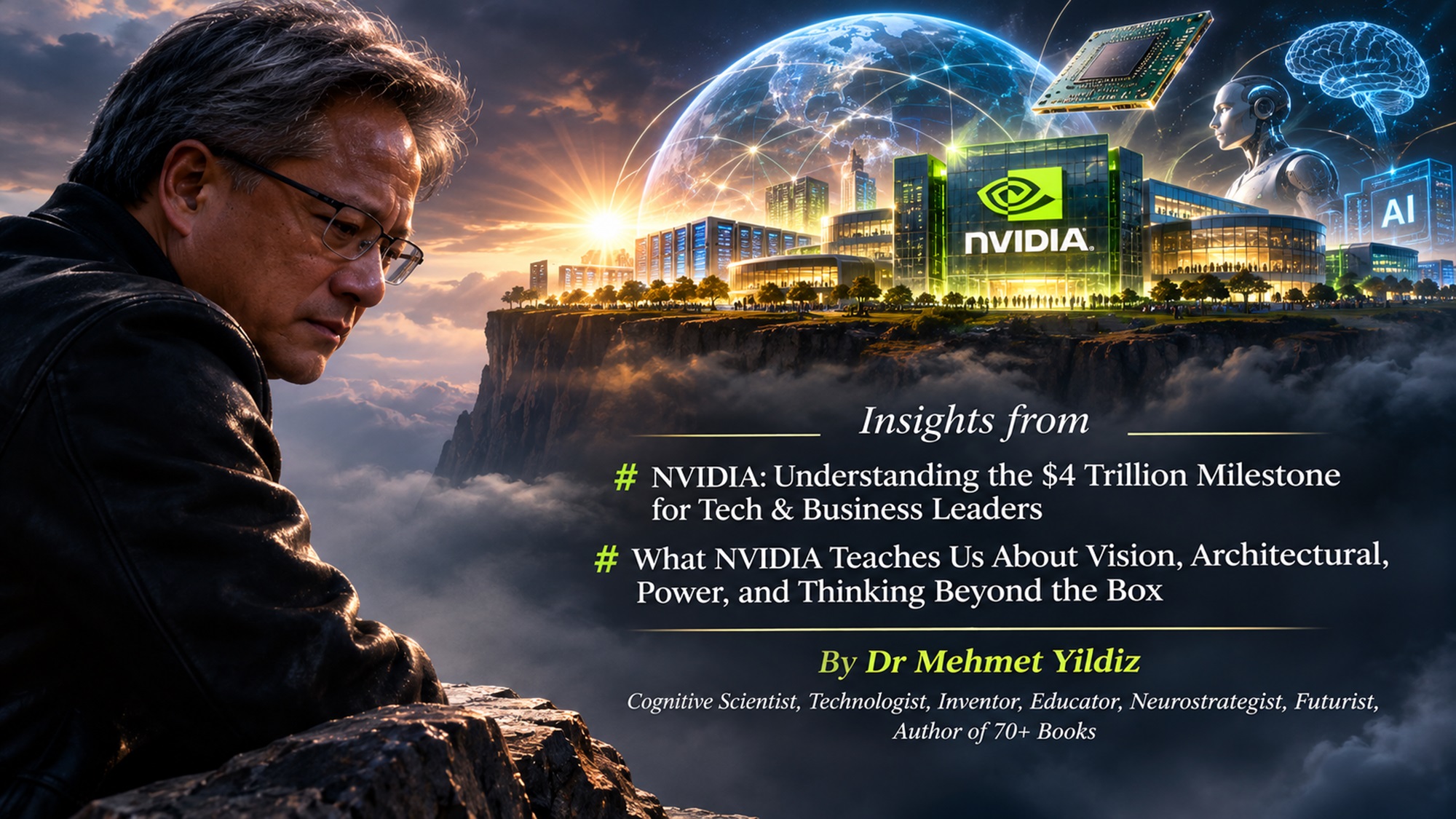
Further reading from my books: NVIDIA: Understanding the $4 Trillion Milestone for Tech & Business Leaders and Eminent Architects of the AI Era: What NVIDIA Teaches Us About Vision, Power, and Thinking Beyond the Box.
NVIDIA: Understanding the $4 Trillion Milestone for Tech & Business Leaders,” will be available on 15 July 2026; ISBNs: 9798231334452, 9798185702499, 9798185703885. Volume 1, titled “Eminent Architects of the AI Era: What NVIDIA Teaches Us About Vision, Power, and Thinking Beyond the Box,” was published in March 2026 — ISBNs: 9798231169238, 9798255048243, 9798231334452, 9798255049158

Sample Chapters on Medium
I shared several sample chapters from my NVIDIA books on Medium in story formats. Here are the links for easy access:
Why I Find NVIDIA So Special as a Strategist and Superlearner
I Can’t Tell You to Buy NVIDIA Shares Now, But I Can Guide You on How to Evaluate Tech Stocks
Eminent Architects of the AI Era: The Parallel Rise of NVIDIA and OpenAI
How NVIDIA Is Helping Robots Get Closer Toward Embodied Reasoning with “Cosmos Reason” Architecture
From GPUs to Personal Intelligence: Why NVIDIA Is Reinventing the Personal Computer
NVIDIA: Understanding the Company Behind the Computational Intelligence Revolution
The Missing Business Perspective and Approach in the Advanced Computational Intelligence Era
Why Everyone Knows Facebook but Many Have Never Heard About NVIDIA
Is Trump’s AI Strategy Brilliant or Dumb? Or Are We Asking the Wrong Question?
I wrote many stories related to the brain and cognitive function, and I linked the key ones as a reference:
Here’s How to Make the Nervous System More Flexible and Functional
Here’s How I Train My Brain Daily for Mental Clarity and Intellectual Productivity.
Thank you for reading my perspectives. I wish you a healthy and happy life.
[End of the Chapter Summary]
If you are a new reader, you may check out some of my thematic story collections:
Collection 1: Brain Health and Cognitive Function
Collection 2: Weight Loss / Muscle Gain
Collection 3: Nutrition and Customized Diets
Collection 4: Valuable Nutrients and Supplements
Collection 5: Fasting, Ketosis, Autophagy, Mitophagy
Collection 6: Ketosis and Ketogenic Lifestyle
Collection 7: Major Health Conditions
Collection 8: Clinical Trials I Reviewed
Collection 9: Importance of Sleep for Health
Collection 10: Aging and Longevity
Collection 11: Writing, Content Development & Marketing Strategy Guides
Collection 12: My Most Loved Stories By Avid Readers
You can check out my FEATURED series of 70+ books on Amazon marketplaces:
I also added my catalog of digital and audiobooks from Google to a collection that can be accessed easily:
Digital and Audiobooks by Dr Mehmet Yildiz on Google Play — The Digitalmehmet Content Ecosystem
50+ Digital and Audiobooks links by Dr Mehmet Yildiz on Google Play and Google Books for easy access. Other platform…digitalmehmet.com
If you are a writer, you are welcome to join my publications by sending a request via this link. I support 43K writers who contribute to my publications on this platform. Check out the recent update for the writers of my publications.
You can contact me via my website. If you are a new writer, check out my writing list to find some helpful stories for your education. You can also join my author platform as a guest blogger.
I interviewed several new professionals and thought leaders. You can find them linked at the end of the latest one.
I invite you to subscribe to my publications on Substack, where I offer experience-based and original content on health, content strategy, book authoring, and technology topics you can’t find online to inform and inspire my readers.
Healthspan Mastery (NEW)
Get an email whenever Dr. Mehmet Yildiz publishes. He is a top writer and editor on Medium.
dr-mehmet-yildiz.medium.com
Check out Free Blog Posts by Digitalmehmet Contributors. Here is the link to my FREE personal blogs. Now you can read our blog posts via a Flipboard Magazine for convenience.
I invite you to explore some of my books on my discount bookstore including:Train Your Brain for a Healthier and Happier Life, Cortisol Clarity, Ketosis + BDNF: The Healing Molecules That Saved My Life, The Science & Wisdom of Graceful Aging, The LIFE Matrix Keeps the Score, How I Accelerated My Learning Effortlessly for a Happier Life, Neurocomputing and Neural Architectures, Substack Mastery Version 2, The Zen of Book Authoring, Monetize Your Passion with WooCommerce, Agile Business Architecture for Digital Transformation V2, Agile Business Architecture for Digital Transformation (Audiobook), A Powerful Toolkit for Substack Newsletter Mastery, Smart and Ethical SEO, Modern Affiliate Marketing for Writers, 4 Pillars of Enterprise Architecture, and Smart Email Marketing Content Integration, The Mysterious Leadership Mind of Robert F.Kennedy Jr., Cognitive Computing Reimagined.
Share links to your newsletters here and share links to your stories here


Leave a Reply