

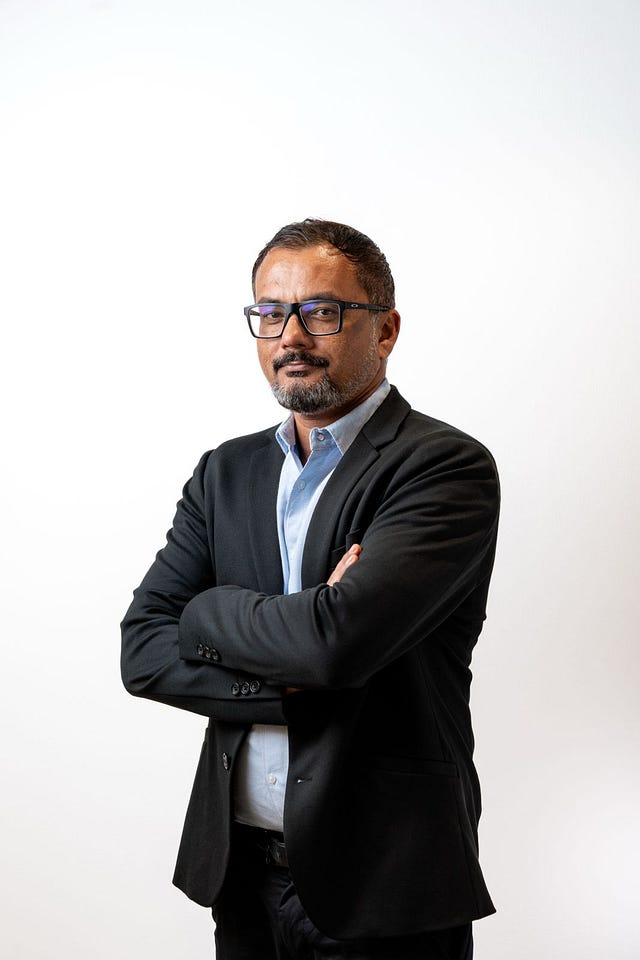
In this interview, Bindesh Vijayan helps us explore the democratization of software engineering, AI-powered development, digital ownership, enterprise architecture, and the future of intelligent applications.
Curator’s Note: This interview, conducted by Dr. Mehmet Yildiz with Bindesh Vijayan, Myndlab’s co-founder and CTO (Chief Technology Officer), examines how AI-powered development can progress beyond rapid “vibe coding” toward reliable, production-ready software. Myndlab emphasizes source-code ownership, technology-stack flexibility, GitHub integration, Docker-based deployment, interoperability, and freedom from vendor lock-in. Its platform supports design, coding, testing, security scanning, media creation, and integrations while enabling both technical and nontechnical users to build applications. Vijayan stresses that AI does not eliminate engineering responsibility: human expertise remains essential for architecture, security, compliance, scalability, maintenance, and business judgment. The discussion also highlights ownership, total cost of software, enterprise integration, and the evolving collaboration between developers, entrepreneurs, and AI.
Dear Members and Visitors,
In this episode of my insightful conversations with professionals and leaders in their fields, I will share an interview that I conducted with Mr. Bindesh Vijayan, Co-Founder and CTO (Chief Technology Officer) of Myndlab, to help aspiring technology leaders, software engineers, and entrepreneurs understand how AI-powered development can move beyond vibe coding to production-ready software.
My goal is to explore how individuals and organizations can accelerate innovation without compromising engineering quality, architectural integrity, or digital ownership. The ability to generate software rapidly is valuable, but the ability to own, control, and evolve it is strategically more important.
The business value of Myndlab’s approach comes from its emphasis on source code ownership, architectural flexibility, and vendor independence. In this interview, we examine how developers can export their code, integrate it with GitHub, choose technology stacks, and deploy applications on their preferred infrastructure. We also explore critical considerations such as scalability, cybersecurity, regulatory compliance, technical debt, and the total cost of software ownership.
For aspiring technology leaders and software engineers, this conversation offers a perspective on the evolving relationship between human expertise and artificial intelligence. As AI reduces the cost and complexity of software development, engineering judgment, systems thinking, architectural competence, and commercial acumen become extra valuable. My intention is to help you make informed technology decisions, turn your ideas into commercially viable digital assets, and retain strategic control over what you create.
A Comprehensive Interview to Guide Tech Leaders:
Guidance on Moving from Vibe Coding to Production-Ready Software with Your Ownership

1 — Hi Bindesh, before we start the business and technology discussion, could you briefly introduce yourself to our readers?
Hi Dr Yildiz. Thank you for this opportunity to introduce myself and my experience with software engineering, especially for aspiring software developers. I’d be glad to share a few highlights from my background. I am a co-founder and CTO of Myndlab, an AI app builder developed in Dubai by Permus Software House.
I spent over 14 years at Microsoft, including on the beta testing of what became Azure, and I’ve also worked with SAP, Infosys, and Accenture. My first programming language was GW-BASIC; on school-lab machines, we booted from floppy disks. Typing a few lines and watching the computer respond is still the reason I do this work. Later, when I moved to UNIX, even logging into a terminal and running a few commands felt like an achievement.
Today my work focuses on large language models, AI agents, and the architecture needed to make them useful in real software. Myndlab came out of a problem we had ourselves, which I’ll come back to. In short, we wanted software we were confident enough to ship, and the tools available weren’t getting us there.
2. Beyond Vibe Coding, what makes Myndlab fundamentally different?
Extended question: (AI-powered coding assistants and application builders have significantly reduced the barriers to software creation. However, generating a working prototype is very different from engineering a reliable, maintainable, and commercially viable application. What distinguishes Myndlab from other AI-powered development platforms, and how does your architecture bridge the gap between generating functional prototypes and delivering production-ready applications? Could you illustrate this distinction through a real-world example?)
The clearest example is how Myndlab started. At Permus, we tested the popular vibe-coding platforms to build software we could actually ship. We got impressive first screens quickly. Then came weeks of prompting, and we still weren’t confident putting the results in front of customers. The interface looked finished, but the structure underneath wasn’t something an engineer would want to maintain.
We knew the underlying models could do better if we worked with them directly, so we built our own harness around them. That became the foundation of Myndlab.
Myndlab can generate both single-architecture (monolithic) and multi-architecture web apps, as well as mobile applications, from just a few lines describing what you want to build. On paid plans, you can choose your own tech stack: Next.js, Angular, or React on the frontend, and Python (FastAPI, Django, or Flask), Go, Rust, Laravel (PHP), .NET, or NestJS on the backend. You can also design your UX first in Design Studio, set your own Design DNA to match your brand, and push the design to the coding agent once you’re happy with it.
Today, Myndlab has grown beyond a coding studio into a complete AI builder platform for creators and experienced professionals alike. It includes a Media Studio for creating videos, banners, images, and audio for your app, and a Composer for drafting slides, documents, and PDFs. The most impressive thing about Myndlab is that you aren’t limited to the design the AI picks for your app. In Design Studio, the AI renders your app’s UX live on a canvas. You can then edit each element directly, build out every page and module, and push the finished design to the coding agent.
3. Software Ownership, Intellectual Property, and Vendor Independence
Extended question: (One concern for entrepreneurs and enterprises adopting AI application builders is whether they genuinely own the resulting software or remain dependent on the platform that generated it. When users build applications with Myndlab, what exactly do they own, including source code, intellectual property, databases, and deployment configurations? Can customers export their complete applications, modify them independently, and migrate to other hosting environments without relying on Myndlab? What technical or contractual limitations should they understand?)
Users retain all rights to the code Myndlab generates from their prompts, and we claim no ownership over their projects. On paid plans, code export and two-way GitHub sync let them take that code wherever they need it. Say you’re a domain expert with no coding background, and you’ve built an app in Myndlab. When you’re ready for your company’s developers to add features, you push the project to GitHub, and they work on it there.
Once they’re done, you pull their changes back into Myndlab and see the updated preview, so you can keep building alongside them. Every app is also built for containerization and includes a Docker configuration you can use to deploy it. You can even bring in your own repository from other vibe-coding platforms and keep developing it in Myndlab, a feature currently in beta.
That matters because software does not stay the same. A company might start with a small internal tool and, two years later, need a different hosting provider, a larger team, or a new architecture. Those decisions should belong to the business, not to the tool that produced the first version.
There are limits users should understand. Owning your generated code doesn’t mean owning every component it relies on. Open-source libraries, frameworks, external APIs, and hosting services all come with their own licenses and terms. Before committing to any AI builder, I’d ask three questions. Can I export the code? Can I take my data? Can the application run somewhere else without being rebuilt? Users should be able to answer yes to all three with Myndlab.
4. Engineering Quality: Can AI-Generated Applications Meet Professional Standards?
Extended question: (Traditional software engineering relies on architectural design, code reviews, automated testing, performance optimization, and disciplined development practices. AI-generated applications may appear functional while containing vulnerabilities, architectural weaknesses, or maintainability problems. How does Myndlab assess and assure the engineering quality of the applications it generates, particularly regarding code reliability, automated testing, security, maintainability, and technical debt? What quality assurance responsibilities remain with users, and where does human engineering expertise become essential?)
Software engineering has already shifted. Much of today’s most widely used software contains AI-generated code. Software companies have embraced AI as their automated coding engineers, while human engineers review its work and redirect it to fill any gaps. That makes developers far more productive: a feature that used to take a couple of sprints can now be done in days. It should also answer any skepticism that AI-generated code can’t be shipped. It already is, and you’re probably already using it.
In Myndlab’s Code Studio, every function or method is written with a unit test, followed by a full integration test. Our custom AI harness also makes sure the AI writes current code using up-to-date packages and libraries. The studio ships with developer tools, including an App Scanner that checks for vulnerabilities and a fully functional API tester, similar to Postman, that confirms every endpoint in the app works and offers a one-click fix when one doesn’t. We’re also actively adding security features to our AI harness to strengthen the security of the apps you build.
5. Scalability: From the First Ten Users to Thousands or Millions
Extended question: (An application serving a handful of users may perform well initially but hit serious architectural limits as demand grows. Scalability requires more than additional computing resources; it involves database design, concurrency management, observability, and resilient infrastructure. How does Myndlab support applications as they grow from small prototypes into commercially deployed systems with substantial user traffic and complex business requirements? Can you share measurable performance benchmarks, architectural constraints, or customer examples demonstrating scalability under real production conditions?)
Scalability is decided early. Most applications that struggle at scale weren’t let down by a lack of servers. They were let down by a database design or an architecture that made sense for ten users, and nobody revisited. That’s why we let users choose their stack, and why access to the code matters. As an application grows, a team can optimize queries, restructure services, or move to different infrastructure without starting again.
Unlike most vibe-coding platforms, we also let users choose high-performance stacks such as Go and Rust. Both are compiled, not interpreted, languages with full concurrency support. That’s especially useful if you’re building something like an automated trading bot, where concurrency, parallelism, and network I/O matter most.
Every app, whether a monolith or a multi-architecture app with a separate frontend and backend, is also containerized from the first render. That means you can take the source code, deploy it to Kubernetes or another container platform, and scale it automatically based on demand thresholds.
We launched globally in October, so I won’t quote a production load-test figure yet. A number like that means little without the workload, data model, and infrastructure behind it. My advice to any founder is to think about expected usage before launch, keep the code somewhere you control, and bring in engineering help when growth starts to test the original design.
6. Security, Privacy, and Regulatory Compliance
Extended question: (AI-powered application development introduces security considerations across multiple layers, including generated code, third-party dependencies, authentication, data storage, and the handling of potentially sensitive prompts and business information. What security safeguards does Myndlab include, and how does the platform address vulnerabilities, data privacy, access control, and regulatory requirements such as GDPR? For organizations operating in regulated industries, which security and compliance responsibilities does Myndlab assume, and which remain with the application owner?)
There are two layers to consider: the security of the platform you build with, and the security of the application you build. They’re related but separate. At the platform level, our privacy policy states that prompts, code, and project content are not used to train Myndlab’s models or any third-party AI provider’s models.
A platform can’t make every application built on it compliant by default. GDPR compliance depends on how an organization collects and uses personal data, its legal basis for processing, and how it handles individuals’ rights. Regulated industries carry further obligations. The platform can provide the right foundations, but the application owner remains responsible for how the application handles personal data and meets regulatory requirements.
7. Empowering Non-Technical Founders Without Creating Hidden Risks
Extended question:(One of the most attractive promises of AI application builders is enabling entrepreneurs and small businesses to develop software without hiring large engineering teams. However, limited technical knowledge can also make it hard to spot security vulnerabilities, operational risks, or poor architectural decisions. How does Myndlab help non-technical users make informed decisions throughout application design, development, testing, deployment, and maintenance? Where do you draw the boundary between what a non-technical founder can safely accomplish independently and what requires professional software engineering expertise?)
Historically, someone with a strong idea needed developers, funding, and months of work before they could find out whether it worked. With Myndlab, users describe what they want, typed or spoken, in English or Arabic, and get a working application they can refine through conversation. That makes AI builders excellent for validating ideas, building early versions, and testing workflows with real users. Technical knowledge still matters, and it matters more as the stakes rise.
My rule of thumb: build freely while you’re the main user, or while you’re testing with people who know it’s an early version. Once other people depend on the app, bring in an engineer before launch. That means taking payments, storing personal data, or giving other people logins. You don’t need a full team, but someone should review authentication, data handling, and what happens when something fails.
8. Integration, Interoperability, and Enterprise Architecture
Extended question: (Business applications do not operate in isolation. They must communicate with existing databases, customer relationship management systems, payment services, enterprise applications, and AI agents. How does Myndlab support integration with external APIs, enterprise systems, databases, and emerging agentic AI workflows? Can users extend generated applications with custom code, and how does the platform handle architectural complexity when applications become part of larger enterprise technology ecosystems?)
Business applications do not stand alone. They need to talk to payment providers, CRMs, databases, and AI agents. Myndlab includes one-click connectors for common services, and because users can edit and export the code, developers can add custom integrations wherever the platform’s built-in options stop. Connectors for widely used services such as Stripe and Twilio already ship today, and the list grows with every release.
The more interesting shift for enterprises is agents inside applications. We’re moving from applications that display information toward applications that carry out work: processing requests, coordinating between services, and handling routine operational steps. That raises the bar for architecture, because an agent with access to real systems needs clear permissions, logging, and human oversight.
For enterprises, the principle is simple: No company should have to rebuild its technology environment around a single application builder. The application should fit into the existing environment, and code ownership is what makes that possible.
9. The Economics of AI-Powered Software Development
Extended question: (AI-assisted development promises substantial reductions in development time and initial costs. However, total software ownership costs also include hosting, AI inference, third-party services, maintenance, security, monitoring, and future modifications. How does the total cost of ownership of a Myndlab-built application compare with traditional development or other AI-assisted approaches over a three- to five-year period? Could you provide a transparent example showing initial development costs, recurring operational expenses, usage-based charges, and potential cost increases as an application scales?)
It’s too early for us to publish a three-to-five-year cost comparison, and I’d be cautious about anyone who does without real customer data behind it. What I’d tell a founder is to model five costs: the initial build, hosting, the AI bill of materials (BOM), third-party services, and the engineering time needed to maintain and secure the application. AI changes the first cost most dramatically. Work that once took a team weeks can now produce a working first version in a fraction of that time.
The other four costs don’t disappear, and that’s where ownership becomes an economic question. If you control your code, you can change hosting providers, bring in your own developers, or move to cheaper infrastructure when the numbers change. If you can’t take the application with you, you’ve traded a lower upfront cost for less control over every future one.
10. Evidence of Market Adoption and Customer Outcomes
Extended question: (Myndlab’s reported international expansion and growing US user base suggest interest beyond its initial regional market. Nevertheless, user registrations and geographic reach do not necessarily translate into sustained adoption, production deployments, or commercial success. What measurable outcomes best demonstrate Myndlab’s market traction and customer value, beyond registration numbers? For example, what proportion of users successfully deploy applications, how many continue maintaining them after several months, and what evidence can you share regarding development time saved, customer retention, or business results?)
When we opened the beta in May, our focus was the GCC, particularly the UAE and Saudi
Arabia. As the beta went on, interest grew well beyond the region. By our global launch in October, the US had become our largest market, accounting for 55% of users, followed by the UAE at 35% and Europe at 7%. That told us the problem we’re solving isn’t regional.
Founders, creators, and small teams everywhere want to get from an idea to working software without losing control of it.
You’re right that registrations aren’t the same as adoption. We’re early, and I’d rather share deployment and retention figures once we have enough history for them to be meaningful. The beta was valuable for a different reason: it showed us how people actually use the platform, and it confirmed how much they care about owning what they build.
11. The Future of Software Engineering and Human–AI Collaboration
Extended question: (As AI systems become capable of generating, testing, deploying, and modifying software, the responsibilities of developers, architects, entrepreneurs, and technology leaders may change substantially. Yet engineering judgment, accountability, and systems thinking remain essential. Looking three to five years ahead, how do you envision the relationship between AI-powered development platforms, professional software engineers, and non-technical entrepreneurs evolving? Which aspects of software engineering do you expect AI to automate reliably, and which human capabilities will become even more valuable? How is Myndlab preparing for this transition? )
AI’s ability to write code has ushered in a new era of software engineering, and its capabilities are advancing rapidly. Over the next three to five years, AI will take on far more of the implementation work: writing complete features end to end, generating tests, handling repetitive changes, and carrying tasks across several steps with less supervision. That makes engineers more important.
As code gets cheaper to produce, the scarce skills are understanding the business problem, designing systems, judging trade-offs, and deciding what can be trusted in production. Engineers also need to read and understand generated code well enough to step in and override it when needed. That increases demand for experienced engineers, and those skills will grow in value as the volume of AI-generated code increases.
For nontechnical founders, the change is just as significant. People will be able to test and launch ideas that once required a funded team, which opens the field to smaller businesses and independent creators. At Myndlab, we’re preparing for this by focusing on what happens after generation: code quality, ownership, and the path from a first version to software people rely on.
12. Finally, what practical advice would you offer someone considering Myndlab for their first serious commercial application? How can interested developers get started with your services?
If you have a complex application to build in Myndlab, start with a clearly defined problem. Know who the application is for, what it needs to do, and which features are essential for the first version.
A clear description gets you far more from any AI builder than a vague one. Then turn on ideation mode and work through each part of the app with the AI until you’re aligned. It will suggest what your app needs, including the architecture, concurrency, database schema, and integrations, such as AI orchestration with frontier models or integrations with Notion or SendGrid. Once you’re satisfied, switch to build mode and let Myndlab do the rest.
This is it from me today. Thank you, Dr. Yildiz, for letting me share my perspectives and experience from Myndlab. I invite your readers to check out our work and services. To get started, they can visit www.myndlab.ai and describe their idea, typed or spoken, in English or Arabic. Our aim is simple:
Think it. Build it. Own it.
Many thanks to Bindesh Vijayan for guiding us with his generous responses to these critical questions. You can connect with Bindesh on LinkedIn.
[End of the Interview]
This interview series is an excellent networking opportunity for new writers looking to build their audiences across multiple platforms. The more successful people you meet and engage with, the more successful you can become, from my experience. The more you give without expecting, the more you receive, as my grandparents taught me.
Thank you for being part of our community and joining our joyful and exciting journey. You can review some sample interviews I conducted. Please consider reviewing their profiles and stories, sharing them in your network, and reaching out to them to expand your professional connections.
Thank you for supporting our community initiative, Neurostrategic Digital Authority Building for Creators, Freelancers, Book Authors, and Startups. Here is a story covering the details of why I rebranded the Substack Mastery Boost Pilot: Why I’m Rebranding Substack Boost Pilot as Neurostrategic Digital Authority Building Initiative.
I also post links to these interviews on LinkedIn to increase visibility for creators, so please consider engaging with this post on that professional platform to grow your audience. Originally published on my author platform.
Links to Other Interviews and Conversations
Interview Rosana Elizabet Schumaher, Interview Dr. Bekim Belica, Interview Unicorniolibre.com, Interview Leila Drouby, Nutritionist, Interview Matt Hasan, Ph.D., Interview Shreyas Naphad, Interview, The Story Telling Paramedic, Interview Dr Edward Serdioukov, Interview, A.K.Girisam, Interview Raviv Ventura, Interview Dr Bernhard Kutzler, Interview Dr Corneliu Bacauanu MD, Interview Dr Laust Lauridsen, MD, Interview Peeter Jakobson, M.D, Interview Dr Jeff W Welsh, Interview Nazli Aydin (Misselbereth), Interview,Dr. Pamela Ramirez, PsyD, MD,Interview Lukman Aufbau, Interview Tanugandass, Interview Dr. Shiv K. Goel, Interview James Alexander, PhD, Interview, S R Harsha, Interview Adam Regiaba, Interview Elizabeth Woods,Interview Gary L. Fretwell, Interview, Keith Williams, Interview, Liauw Pauw Phing, Interview Somya Golchha, Interview, Alexander Simon, Interview, Paul | Divine Light Path, Interview, Ben J Clarke, Interview, Dr. Hatem El-Nagar, Interview Vic Shayne, Interview, Dr diana swezy, Interview, Dr Ashish Juneja, PhD, Interview Dr. Khalid Rahman, Interview Georgia Kreiger, Interview Hamid Akhtar, Interview Bear Kosik, Interview Dr Russell Carr,Interview Fildy Bejaoui, Interview Peter Mukherjee, Interview Patricia Ross, Interview Ana J, Interview Dr. Jason Hung, Interview Maria Cross,Interview Brooklyn Grace (editor), Interview Grant Lawson, Interview Ute Luppertz ✨, Interview Dr Kenneth Silvestri, Interview MAGDALENA PONURSKA, Interview with Joanie Adams (left Medium), Interview Liat Portal, Interview Dr Dominic Farsi, PhD RNutr, Interview Sara Redondo, MD, Interview Dr Bronce Rice, Interview Yana G.Y. Interview Dr. Gabriella Korosi, Interview Sinem Günel, Interview Recep Taylanhan, Interview John Worthington, Interview, Joellyn Rose Keener, ✍️Author Deaf and Determined, Interview Thomas Cherickal, Interview, Shamim Rajani, Interview, Svyatoslav Biryulin,Interview, Danielle Benvenuto, Interview Scarlet Ibis James 🦩, Interview Biswanath Datta,Interview Veronica Llorca-Smith,Interview James King, Interview Lauren Grawert, MD,InterviewJerry Keszka, Interview Davor Katusic,Interview David Gerken,Interview Claudio D’Andrea, Interview William Spivey,Interview James Boylan, Interview Ruby Noir, Interview Joshua Mason, Interview Michelle Mariscal, Interview Tim Denning, Interview Wendi Gordon, Interview Elle, Interview Bill Petro, Interview Sylvain Zyssman, Interview Matthew Bamberg, Interview Øivind H. Solheim, Interview Payal Koul, Interview Matt Lillywhite, Interview Genius Turner, Interview Shirley Willett, Interview David Mokotoff, MD, Interview Martin D. Hirsch, Interview Gill McCulloch, Interview Adelia Ritchie, PhD, Interview Dr. Lutz Kraushaar, Interview Lorwen Harris Nagle, PhD, Interview Matt Williams-Spooner, Ph.D., Interview Pernoste & Dahl, Interview Luay Rahil, Interview Melissa Kalt, MD, Interview Ayodeji Awosika, Interview Dr. Preeti Singh, Interview Dr. ADAM TABRIZ, Interview Dr John Frederick Rose, Interview Yogesh Haribhau Kulkarni (PhD), Interview Hakima T A N T R I K A, Interview Mark Sanford, Ph.D, Interview Raymond M.E. Aguirre, Interview Keri Mangis, Interview John D. Leavy, Interview Toni Koraza, Interview Annelise Lords, Interview, Mike Zillo, Interview Charles Roast, Interview Libby Mitchell, Interview Timothy Key, Interview, Christopher D. Connors, Interview Desiree Driesenaar, Interview Jill Ebstein, Interview Bill Abbate, Interview Anita Lesko, Interview John Cousins, Interview Suntonu Bhadra, Interview Lawson Wallace, Interview Chelsea Renee MAT, Interview MaryJo Wagner, PhD, Interview Martine Weber, Interview Michael Patanella, Interview Tree Langdon, Interview, Agnes Laurens, Interview Liam Ireland.
Our editors compile them in a collection. If you want to be interviewed, please leave a comment on this story or reach out to me via this form.
Quick Updates on Our Community Initiatives
You are welcome to join our new Expert Contributor Network. It will empower our Substack Mastery Boost program.
Welcome to the Expert Contributor Network Curation Program at Digitalmehmet Content Ecosystem
If you are a business owner and want to sponsor talented writers contributing to my ecosystem and publications on Medium and Substack, please reach out to me via this form, and I will provide you with the best creators who can amplify your content efficiently to a broad audience.
Share the links to your articles, newsletters, stories, and blog posts for free here. You can also join my author platform as a guest blogger. Here is the link to my blog pins.
For Substack writers, we created a 6-level course on Udemy titled From Zero to Substack Hero, which I also offer via my Content Strategy, Development, & Marketing Insights on Substack. If you are interested in joining, you can use these discount vouchers:
We also completed a new course titled Patreon Mastery.
I introduced the new Substack bundle for advanced writers and Patreon Mastery in two articles linked below for more information: From Zero to Substack Hero: Advanced Levels 4, 5, & 6 Bundle Is Ready for Beta Learners
What If Your Creativity Could Fund Your Financial Freedom for a Lifetime?
If you are a writer, you are welcome to join my publications by sending a request via this link. I support 43K writers who contribute to my publications on this platform. Here are links to submission guidelines:
ILLUMINATION, Curated Newsletters, SYNERGY (Newsletter Booster), Technology Hits, Health and Science,ILLUMINATION Book Chapters, ILLUMINATION’s Mirror, Readers Hope, ILLUMINATION Gaming,Videos/Podcasts, Magnetic Newsletter Pro, Neurostrategic Digital Authority Building , ILLUMINATION Scholar, ILLUMINATION Local News and Documentaries, ILLUMINATION Retirement, Aging, and Legacy, ILLUMINATION Philosophy and Metaphysics, ILLUMINATION India. ILLUMINATION Beyond Identity, Travel, Food, Culture Publication
You can contact me via my website. If you are a new writer, check out my writing list to find some helpful stories for your education.
I interviewed several new professionals and thought leaders. You can find them linked at the end of the latest one.
You can check out my FEATURED series of 70+ books on Amazon marketplaces:
I invite you to subscribe to my publications on Substack, where I offer experience-based and original content on health, content strategy, book authoring, and technology topics you can’t find online to inform and inspire my readers.
Healthspan Mastery (NEW)
If you are a new reader, you may check out some of my thematic story collections:
Collection 1: Nutrition and Customized Diets
Collection 2: Valuable Nutrients and Supplements
Collection 3: Brain Health and Cognitive Function
Collection 4: Fasting, Ketosis, Autophagy, Mitophagy
Collection 5: Weight Loss / Muscle Gain
Collection 6: Ketosis and Ketogenic Lifestyle
Collection 7: Major Health Conditions
Collection 8: Clinical Trials I Reviewed
Collection 9: Importance of Sleep for Health
Collection 10: Major Health Conditions
Collection 11: Writing, Content Development & Marketing Strategy Guides
Collection 12: My Most Loved Stories By Avid Readers
Get an email whenever Dr. Mehmet Yildiz publishes. He is a top writer and editor on Medium.
dr-mehmet-yildiz.medium.com
Check out Free Blog Posts by Digitalmehmet Contributors. Here is the link to my FREE personal blogs. Now you can read our blog posts via a Flipboard Magazine for convenience. Payhip
I invite you to explore some of my books on my discount bookstore including:Train Your Brain for a Healthier and Happier Life, Cortisol Clarity, Ketosis + BDNF: The Healing Molecules That Saved My Life, The Science & Wisdom of Graceful Aging, The LIFE Matrix Keeps the Score, How I Accelerated My Learning Effortlessly for a Happier Life, Neurocomputing and Neural Architectures, Substack Mastery Version 2, The Zen of Book Authoring, Monetize Your Passion with WooCommerce, Agile Business Architecture for Digital Transformation V2, Agile Business Architecture for Digital Transformation (Audiobook), A Powerful Toolkit for Substack Newsletter Mastery, Smart and Ethical SEO, Modern Affiliate Marketing for Writers, 4 Pillars of Enterprise Architecture, and Smart Email Marketing Content Integration, The Mysterious Leadership Mind of Robert F.Kennedy Jr., Cognitive Computing Reimagined,
Reference: Chapter of Generosity™ at Digitalmehmet Content Ecosystem
Socials Connections: LinkedIn | X (Twitter) | Facebook | Instagram | Quora



Leave a Reply