

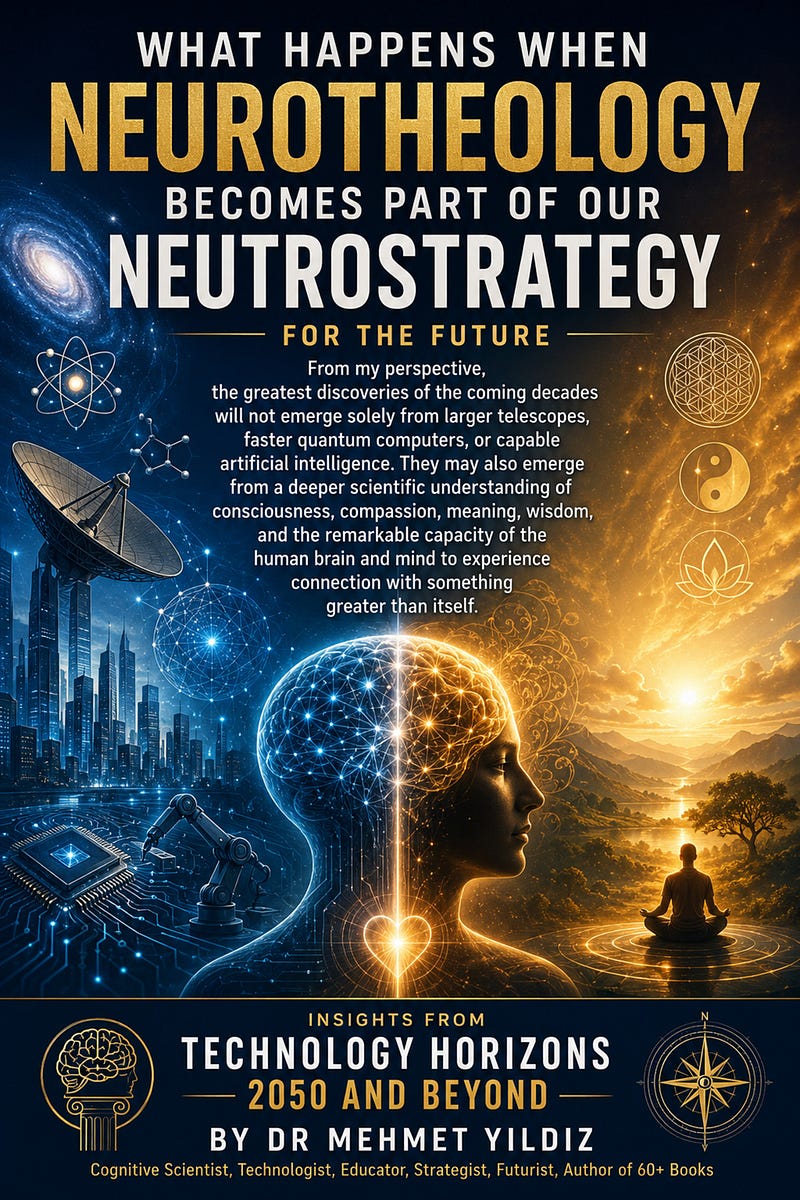
A Chapter of Technology Horizons 2050 and Beyond titled “Neurotheology as Our Neurostrategy for the Future of Human Purpose and Meaning: Why Understanding Consciousness, Spirituality, Metaphysics, Divinity, and Ancient Wisdom May Become One of the Most Important Scientific Journeys of the 2050s“
Curator’s Note: The chapter “Neurotheology as Our Neurostrategy for the Future” from the book “Technology Horizons 2050 and Beyond” explores the interplay between advanced technologies and the human search for meaning and purpose. It argues for the convergence of science and spirituality, particularly through neurotheology, which studies the brain’s role in spiritual and contemplative experiences. By the 2030s, advances in neuroscience and artificial intelligence may reveal deeper insights into human cognition and emotional experiences. The author, Dr Mehmet Yildiz, suggests that as machines become smarter, the focus on wisdom, ethical judgment, and human values will become increasingly crucial in shaping our future and understanding consciousness.
Introduction to Chapter 35 of Technology Horizons 2050 and Beyond: What Happens When Neurotheology Becomes Part of Our Neutrostrategy for the Future
Throughout this book, we have explored remarkable advances in regenerative medicine, artificial intelligence, quantum computing, space exploration, neuromorphic systems, and many other technologies that may reshape civilization during the coming decades. Yet every one of these developments ultimately raises a deeper question that science alone cannot fully answer.
As our machines become more intelligent, how do we become wise? Throughout history, humanity has searched for answers in two directions. One path looked outward. We built telescopes to study galaxies, microscopes to examine cells, particle accelerators to investigate matter, and, more recently, artificial intelligence to analyze information at scales no human mind could previously imagine.
The other path looked inward. Philosophers reflected on consciousness. Mystics sought transcendence. Religious traditions developed practices of prayer, meditation, contemplation, compassion, gratitude, forgiveness, and service. Across civilizations separated by geography and thousands of years, people asked remarkably similar questions.
For example: Why are we here? What gives life meaning? What is consciousness? How should we live? What connects us to one another? What does beyond identity mean?
From my research, I noticed that for much of modern history, these two journeys appeared to move in different directions. Science concentrated on measurable evidence, while spirituality explored subjective experience. Too often, they were presented as opposing worldviews, each suspicious of the other’s methods and assumptions.
I believe the coming decades may bring these worlds closer together than many people imagine. We know that science will not replace spirituality or metaphysics, and that spirituality or metaphysics will not replace science.
Rather, both approaches are attempting to understand one of the most extraordinary phenomena in the known universe: the conscious human mind. This is where the emerging discipline of neurotheology becomes particularly fascinating.

Beyond Religion, Neurotheology Is the Science of Human Meaning
In my previous articles, stories, and blog posts, I answered the question of “What is neurotheology and why does it matter?” I also taught this topic at the postgraduate level using my own curriculum.
Those stories and educational resources received interesting comments on different platforms. One key point is that, despite its name and some misconceptions, neurotheology is not an attempt to prove or disprove the existence of God. Nor is it an effort to promote one religion over another.
Instead, neurotheology is an interdisciplinary scientific field that investigates how the brain, nervous system, endocrine system, and body participate in religious, spiritual, contemplative, and transcendent experiences. It brings together neuroscience, psychology, cognitive science, medicine, anthropology, philosophy, and theology to examine questions that until recently lay largely outside empirical investigation.
Researchers study what happens in the brain during prayer, meditation, gratitude, compassion, forgiveness, worship, awe, silence, and profound experiences of unity or transcendence. Modern neuroimaging has revealed that these experiences recruit distributed neural networks involved in attention, emotional regulation, self-awareness, empathy, memory, and social connection.
The objective of this discipline is not to reduce spirituality to brain chemistry. Nor is it to dismiss deeply personal experiences as merely electrical activity inside neurons.
Rather, neurotheology recognizes a simple scientific reality. Every human experience, whether composing music, solving a mathematical equation, falling in love, admiring a sunset, or praying in solitude, involves biological processes worthy of careful investigation. Understanding those processes may ultimately help us understand ourselves more deeply.
Neurotheology: Connecting Religion and Spirituality for the Human Mind
One lesson I have learned from decades of studying cognition is that many people use the words “religion” and “spirituality” interchangeably, even though they describe different dimensions of human experience.
Religion generally refers to organized systems of belief, shared rituals, sacred texts, ethical traditions, and communities that have evolved over centuries. Spirituality is broader, reflecting the human search for meaning, purpose, connection, transcendence, and inner transformation.
Some people experience both together. Others embrace spirituality without formal religion. Still others identify with neither, yet experience profound awe, compassion, gratitude, or a sense of belonging within nature, science, family, or humanity itself. This distinction matters because neurotheology is interested in the underlying human experience rather than any particular doctrine.
Whether a person prays in a cathedral, meditates in silence, studies the elegance of mathematics, gazes through a telescope, or stands speechless before the beauty of the night sky, similar cognitive and emotional networks may contribute to feelings of wonder, awe, humility, connectedness, purpose, and meaning.
From a scientific perspective, these experiences deserve careful investigation regardless of one’s worldview. This understanding is where unity and peace might become possible in the next few decades.
Why Neurotheology May Matter More Than Ever
Artificial intelligence will continue expanding its capacity to analyze information, generate content, design products, and support scientific discovery. Machines may eventually outperform humans across many intellectual tasks once considered uniquely ours.
Yet none of these systems asks why life matters. They optimize, calculate, and predict. Whether they will ever genuinely experience hope, love, awe, forgiveness, purpose, or moral responsibility remains an open question.
Ironically, the more intelligent our technologies become, the more valuable these uniquely human dimensions may prove to be.
In the coming decades, competitive advantage may depend less on information itself and increasingly on wisdom, ethical judgment, creativity, compassion, purpose, and our ability to cooperate across cultures and generations. Neurotheology investigates these dimensions precisely.
Personal Experiences and Lessons from History
Although I had scientific curiosity, my interest in this subject did not emerge from theology itself but from observing people in ethnographic settings.
Having lived and worked across many countries, cultures, and professional environments, I have been privileged to know individuals from many religious traditions and philosophical perspectives.
I have worked alongside Christians, Muslims, Jews, Buddhists, Hindus, Sikhs, agnostics, atheists, and many people who preferred no labels at all. What fascinated me was not primarily their differences but their similarities.
Across cultures, people searched for belonging, hope, forgiveness, compassion, purpose, and inner peace. They celebrated births, mourned losses, cared for families, sought justice, and attempted to understand suffering. These universal experiences suggested to me that beneath theological differences lies a remarkably consistent human search for meaning.
History also teaches an important lesson. Some religions have inspired extraordinary compassion, education, healthcare, scientific inquiry, charitable service, and artistic achievement. Many universities, hospitals, humanitarian organizations, and social reforms emerged from religious communities motivated by deeply held spiritual convictions.
History also reminds us that religion has sometimes been associated with intolerance, persecution, violence, political manipulation, and division when humility gave way to certainty and compassion yielded to ideology.
As a cognitive scientist, I find both realities equally important. I want to highlight that neurotheology does not ask us to defend or reject belief. Far from it, it asks a more fundamental question.
Why can the same human mind produce profound compassion under some conditions and profound division under others? Understanding that question may teach us as much about ourselves as it does about religion.
Now, following the template of this book, I will share my predictions for the impact of neurotheology in the 2030s, 2040s, 2050s, and beyond.
2030 Outlook: Mapping the Neuroscience of Meaning
By the early 2030s, advances in neuroimaging, wearable physiology, artificial intelligence, and computational neuroscience are likely to provide increasingly detailed insights into the biological foundations of contemplative practices.
Researchers may better understand how gratitude influences emotional regulation, how compassion alters social cognition, how forgiveness affects stress physiology, and how meditation impacts attention networks through neuroplasticity.
Studies are already suggesting that many contemplative practices influence inflammatory pathways, autonomic regulation, emotional resilience, and cognitive performance.
Healthcare systems may integrate evidence-based contemplative interventions into mainstream medicine, not as replacements for clinical care but as complementary approaches that improve resilience, recovery, and quality of life.
Rather than viewing biology and metaphysics as competing explanations, clinicians may recognize that physical health, psychological well-being, social relationships, and existential meaning often influence one another in measurable and biologically significant ways.
2040 Transition: Personalized Pathways to Human Flourishing
By the 2040s, artificial intelligence, digital biomarkers, and neuroscience may enable highly personalized approaches to cultivating psychological and spiritual well-being.
Wearable technologies may detect prolonged stress, declining resilience, emotional exhaustion, or disrupted attention before individuals consciously recognize these patterns. Intelligent systems may recommend evidence-based practices suited to each person’s biology, culture, personality, and preferences.
For one individual, restoration may come through contemplative meditation. For another, a meaningful service to the community. Others may benefit from artistic expression, time in nature, philosophical reflection, music, prayer, or strengthening relationships with family and friends.
In the 2040s, I predict that emerging technologies will not create meaning. They may help people rediscover the conditions under which meaning naturally emerges.
2050 Vision: Understanding Consciousness Empirically
By the middle of the century, cognitive science and neuroscience may possess tools capable of observing the dynamics of consciousness with unprecedented precision.
For example, artificial intelligence may identify relationships between neural activity, physiology, emotion, and subjective experience that remain invisible today. We may begin answering questions that philosophers have debated for thousands of years.
Why does awe transform people? Why do compassion and forgiveness improve both psychological and physical health? Why do humans consistently seek meaning across every civilization? Why do practices developed thousands of years ago continue influencing well-being today?
These discoveries may impact medicine, psychology, education, leadership, and public health. They may also introduce profound ethical questions, such as:
Should technology induce mystical experiences? Should brain stimulation enhance compassion? Can artificial intelligence guide spiritual development? Can machines study consciousness without possessing consciousness? Can they analyze meaning without experiencing it?
These questions may ultimately distinguish intelligence from wisdom, information from understanding, and computation from lived experiences.
Neurotheology Through the Lens of Noetic Intelligence
My own perspective on metaphysics is influenced by more than four decades of study across multiple disciplines, including cognition, superintelligence, human behavior, neurobiology, neurostrategy, healthcare, health sciences, systems thinking, enterprise architecture, and emerging technologies.
From the standpoint of Noetic Intelligence, as I developed it into the Noesis framework, spirituality is not defined solely by religious doctrine. It also reflects humanity’s remarkable capacity to construct meaning, integrate knowledge with wisdom, transcend immediate self-interest, and connect individual consciousness with something larger than oneself.
For some people, that larger reality is understood through faith. For others, it is expressed through scientific discovery, nature, artistic creation, service, family, or the continuing story of humanity itself.
The underlying cognitive processes deserve scientific exploration regardless of philosophical perspective. If artificial intelligence teaches us how machines may become more intelligent, neurotheology can help us understand how people become wiser.
That distinction may prove increasingly important as civilization enters an era where computational intelligence becomes abundant while wisdom remains one of humanity’s scarcest resources.
Final Reflections on Possibilities
As I reflect on the extraordinary technologies explored throughout this futuristic book, I repeatedly return to a remarkably simple observation. We have become skilled at understanding the external universe, yet we are only beginning to understand the universe that exists within every conscious human mind.
From my perspective, the greatest discoveries of the coming decades will not emerge solely from larger telescopes, faster quantum computers, or capable artificial intelligence. They may also emerge from a deeper scientific understanding of consciousness, compassion, meaning, wisdom, and the remarkable capacity of the human brain and mind to experience connection with something greater than itself.
Throughout history, every generation has searched for purpose, belonging, hope, forgiveness, and understanding. These questions have survived every scientific revolution because they address dimensions of human existence that extend beyond efficiency or computation. I do not believe technology will eliminate these questions. If anything, it may make them even more important.
If the twentieth century helped us understand matter, and the early twenty-first century helped us understand information, I believe that the second half of this century will be the era in which humanity begins to understand the purpose and meaning of life.
I find that possibility every bit as exciting as artificial general intelligence, quantum computing, regenerative medicine, or interplanetary exploration, because no matter how advanced our technologies become, the future will continue to be influenced not only by the intelligence of our machines, but by the wisdom of the minds that create, govern, and use them.
[End of the Chapter]
I introduced this futuristic book in a story last year. The book Technology Horizons 2050 and Beyond has been published in paperback, hardcover, and large-print versions on multiple platforms. The digital and audio versions will be available on 30 June 2026.

Early access to audio via Google Play is now available. It is 9 hours 56 minutes listening time.
In this book, you will explore 30+ interconnected domains that will impact the future. The central thesis of this book is simple yet profound: the future is a systems problem. The most significant changes of the coming decades will arise not from individual technologies but from their convergence.
Advances in biotechnology will influence artificial intelligence. Quantum computing will reshape materials science and climate modeling. Neurotechnology and immersive realities will redefine education, creativity, and identity. New forms of energy and the space industry may alter economics and geopolitics in ways previous generations could scarcely have imagined.
Each chapter follows a three-stage foresight model:
2030 Outlook — technologies moving from laboratories into practical deployment
2040 Transition — large-scale adoption and societal adaptation
2050 Vision — long-term implications for industries, institutions, and human experience
This framework transforms the book from a collection of predictions into a practical roadmap for thinking about change.
This work explores the concepts through my previous work on the psychology and philosophy of emerging technologies. It answers questions such as:
What happens to identity when organs become replaceable, and biology becomes designable? What happens to work when intelligence becomes collaborative? What happens to culture when physical and virtual realities merge? And what does it mean to remain human in an age of increasingly intelligent machines and modifiable biology?
This book is not speculative science fiction. It is grounded in current research, scientific literature, industry developments, and strategic foresight methodologies. The result is a credible and thought-provoking guide for thought leaders, entrepreneurs, inventors, artists, educators, scientists, policymakers, investors, and curious minds seeking to understand where humanity may be heading.
If you are building the next breakthrough company, designing policy for emerging technologies, investing in frontier science, developing your own inventions, or simply exploring the deeper meaning of human evolution in an age of machines, this book offers both a strategic framework and an invitation to think differently.
The future will not wait for us to be ready. Its earliest signals are already visible in laboratories, code repositories, hospitals, research centers, creative studios, and classrooms around the world.
The coming decades may become the most extraordinary period in human history. This book is an invitation to see it before it arrives, to understand its possibilities and risks, and even to help shape it because the future is not something we inherit. It is something we actively create.
I’d like to share some sample chapters published on this platform.
The Dawn of Organoid Intelligence: Towards Brain-Like Machines in the 2030s
The Power of Swarm Intelligence for Collective Human-AI Systems by the 2050s
A Glimpse Into the Future of Science, Technology, and Engineering from My Perspective
The Psychology of Emerging Technology Will Guide Us in This Journey to the 2050s and Beyond
The Hidden Foundations of Our Future: Energy, Ecology, and Human Cooperation for the 2050s
I will share more chapters in the Technology Horizons 2050 and Beyond — Official Page
I also introduced another futuristic book for creators, which will be published in January 2027. It is titled “The Neuro-Ethnographic Creator: Neurostrategy, Ethnography, and Design Thinking Form the Ultimate Human Advantage in the AI Era for Creators”
Here is the link to the introduction:
The Neuro-Ethnographic Creator™
Neurostrategy, Ethnography, and Design Thinking Form the Ultimate Human Advantage in the AI Era medium.com
Thank you for reading my perspectives. I wish you a healthy and happy life.
[End of story]
Updates on My Creative Work with Relevant Links
I am pleased that my new health and wellness books, What the Brain Needs, Why We Fail, and How We Can Fix It, Ketosis + BDNF: The Healing Molecules That Saved My Life, Cellular Intelligence, Feel Better, Live Smarter, Thrive Anywhere, How I Accelerated My Learning Effortlessly for a Happier Life, Healthspan Mastery, The Science & Wisdom of Graceful Aging, and the Subconsious book, were published and are now available in many bookstores, as part of my Health, Wellness, and Cognitive Performance Series.
You can check out my FEATURED series of 60+ books on Amazon markets:
Some of my books are published at Apple Stores, Smashwords, Vivlio, Kobo, Barnes & Noble, BooksaMillion, Fable, Bookshop.org, or my discount bookstore.
If you are a writer, you are welcome to join my publications by sending a request via this link. I support 42K writers who contribute to my publications on this platform. Check out the recent update for the writers of my publications.
You can contact me via my website. If you are a new writer, check out my writing list to find some helpful stories for your education. You can also join my author platform as a guest blogger.
I interviewed several new professionals and thought leaders. You can find them linked to the end of the latest one.
I invite you to subscribe to my publications on Substack, where I offer experience-based and original content on health, content strategy, book authoring, and technology topics you can’t find online to inform and inspire my readers.
Healthspan Mastery (NEW)
Get an email whenever Dr. Mehmet Yildiz publishes. He is a top writer and editor on Medium.
dr-mehmet-yildiz.medium.com
Check out Free Blog Posts by Digitalmehmet Contributors. Here is the link to my FREE personal blogs. Now you can read our blog posts via a Flipboard Magazine for convenience.
I invite you to explore some of my books on my discount bookstore including: Train Your Brain for a Healthier and Happier Life, Cortisol Clarity, Substack Mastery Version 2, The Zen of Book Authoring, Monetize Your Passion with WooCommerce, Agile Business Architecture for Digital Transformation V2, Agile Business Architecture for Digital Transformation (Audiobook), A Powerful Toolkit for Substack Newsletter Mastery, Smart and Ethical SEO, Modern Affiliate Marketing for Writers, 4 Pillars of Enterprise Architecture, and Smart Email Marketing Content Integration, The Mysterious Leadership Mind of Robert F. Kennedy Jr.,
Can Rapid AI Development Cause an Existential Crisis by the 2050s? — The Digitalmehmet Content…
Foundations of Our Future: Energy, Ecology, and Human Cooperation for the 2050s. What Must Happen Before Our…digitalmehmet.com


Leave a Reply